The Money Market
Introduzido| English | Significado |
|---|---|
| money market/ˈmʌni ˈmɑːkɪt/ | mercado monetário |
| central bank/ˈsentrəl bæŋk/ | banco central |
| money supply/ˈmʌni səˈplaɪ/ | oferta monetária |
| demand for money/dɪˈmænd fɔː ˈmʌni/ | demanda por dinheiro |
| equilibrium nominal interest rate/ˌiːkwɪˈlɪbrɪəm ˈnɒmɪnl ˈɪntrest reɪt/ | taxa de juros nominal de equilíbrio |
What sets the interest rate
- Just like any market, money has a demand side and a supply side.
- Bring them together and you get the nominal interest rate.
- This is the money market 货币市场.
- It is the lever the central bank pulls to steer the economy.
Money demand slopes down
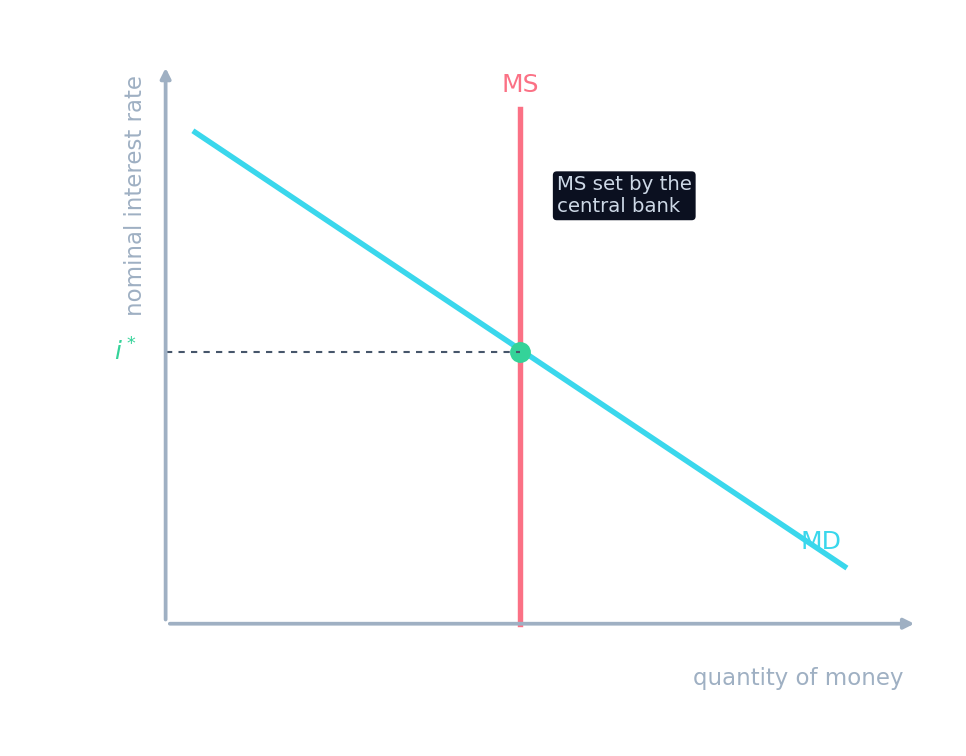
- The demand for money 货币需求 slopes downward against the interest rate.
- The interest rate is the opportunity cost of holding cash (cash earns no interest).
- So when rates are high, people hold less money and buy bonds instead.
Which way does the interest rate move?
A higher money supply lowers the equilibrium interest rate; higher money demand raises it. Money demand slopes down; money supply is vertical.
The demand for money slopes downward against the interest rate because:
Dificuldade 1/5 · Moedas 100 + pequeno bônus na primeira conclusão hoje
When rates are high, holding cash costs more, so people hold less and buy bonds.
When interest rates are high, people tend to:
Dificuldade 1/5 · Moedas 100 + pequeno bônus na primeira conclusão hoje
High rates make holding non-interest cash costly, so people move into bonds.
Money supply is vertical
- The money supply 货币供给 is set by the central bank 中央银行, so it is a vertical line — it does not depend on the interest rate.
- Where demand and supply cross is the equilibrium nominal interest rate 均衡名义利率.
The money supply curve is drawn as:
Dificuldade 1/5 · Moedas 100 + pequeno bônus na primeira conclusão hoje
The central bank fixes the quantity of money, so it does not depend on the interest rate.
Where money demand crosses money supply is the equilibrium ______ interest rate.
Dificuldade 1/5 · Moedas 100 + pequeno bônus na primeira conclusão hoje
The money market sets the nominal interest rate.
Shifting the market
- If the central bank raises the money supply (the vertical line slides right), the equilibrium interest rate falls.
- Worked idea. More money than people want to hold → they buy bonds → bond prices rise, yields fall → the interest rate settles lower.
- If money demand rises (say output grows and people need more cash), the interest rate rises.
- That fall in the interest rate is the first step of expansionary monetary policy.
If the central bank raises the money supply, the equilibrium interest rate:
Dificuldade 1/5 · Moedas 100 + pequeno bônus na primeira conclusão hoje
More money than people want to hold → they buy bonds → yields fall → the rate settles lower.
If real output grows and people need more cash to shop, money demand rises and the interest rate rises.
Dificuldade 1/5 · Moedas 100 + pequeno bônus na primeira conclusão hoje
A rightward shift in money demand pushes the equilibrium interest rate up.
Worked example: two shifts in the money market
Draw the money market: (a) the central bank cuts the money supply; (b) a boom raises the number of transactions people make. What happens to the nominal interest rate in each case?
- (a) The vertical money supply curve shifts left. At the old rate, people want to hold more money than exists, so they sell bonds; bond prices fall and the interest rate rises.
- (b) More transactions raise money demand: the curve shifts right along the fixed supply, so the interest rate rises too. Same result on the rate, but a different curve moved.
The price level rises. What happens in the money market?
Dificuldade 1/5 · Moedas 100 + pequeno bônus na primeira conclusão hoje
Higher prices mean people need more money for the same purchases.
The money supply curve is vertical because the central bank sets it regardless of the interest rate.
Dificuldade 1/5 · Moedas 100 + pequeno bônus na primeira conclusão hoje
Its quantity does not respond to the interest rate.
The money market sets the nominal interest rate where money demand (downward) meets money supply (a vertical line fixed by the central bank). Raising the money supply lowers the equilibrium interest rate; a rise in money demand raises it.
Write from an interest rate that falls to 5
- The central bank raises the money supply.
- The equilibrium interest rate moves from 8 percent to 5 percent.
The central bank increases the money supply and the equilibrium interest rate moves from 8 percent to 5 percent. Why did the rate fall, and what is the new rate?
More money than people want to hold lowers the equilibrium rate.
What is the new equilibrium interest rate?
Dificuldade 1/5 · Moedas 100 + pequeno bônus na primeira conclusão hoje
The larger money supply settles at an interest rate of 5 percent. Other options — 8 percent (the old rate); 13 percent (the two rates added).