Definition, Measurement, and Functions of Money
Introduzido| English | Significado |
|---|---|
| medium of exchange/ˈmiːdɪəm ɒv eksˈtʃeɪndʒ/ | meio de troca |
| barter/ˈbɑːtə/ | troca direta |
| store of value/stɔː ɒv ˈvæljuː/ | reserva de valor |
| unit of account/ˈjuːnɪt ɒv əˈkaʊnt/ | unidade de conta |
| money supply/ˈmʌni səˈplaɪ/ | oferta monetária |
| commodity money/kəˈmɒdɪti ˈmʌni/ | dinheiro-commodity |
| fiat money/ˈfiːət ˈmʌni/ | dinheiro-fiat |
What makes money, money?
- Money is anything widely accepted in trade.
- A ten-dollar note, a coin, a bank balance — all do the job.
- But why do we accept them, and how do we count them?
- Money does three jobs, comes in layers, and takes two forms.
The three functions of money
- Medium of exchange 交换媒介: it is accepted in payment, so we avoid clumsy barter 以物易物.
- Store of value 价值储藏: it holds its worth over time, so you can save it.
- Unit of account 记账单位: it is the common measuring stick for prices.
- One ten-dollar note can do all three at once.
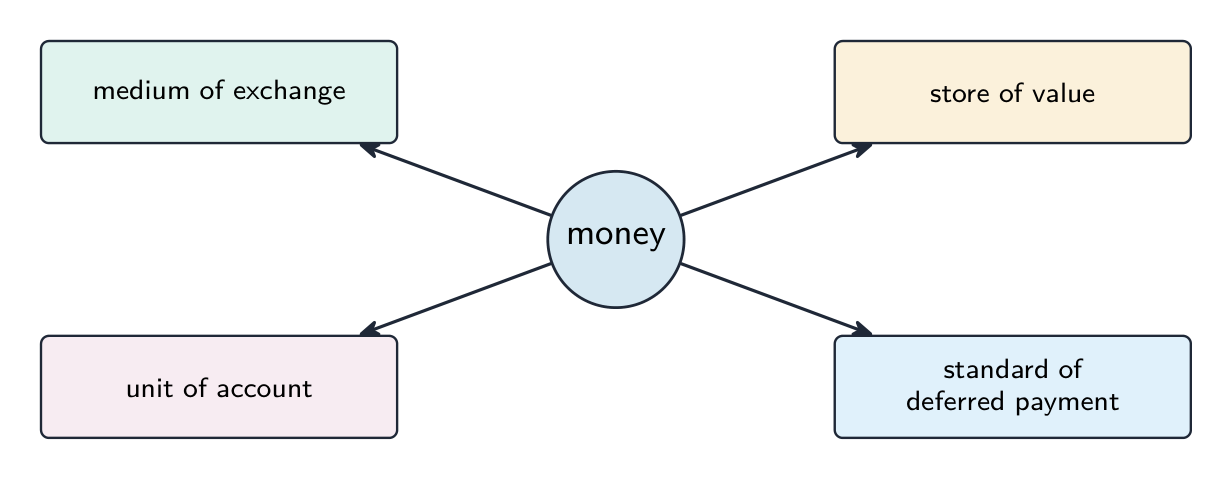
The functions of money; the AP exam tests the first three
Which function of money?
Money is a medium of exchange (it pays), a store of value (it saves), and a unit of account (it prices). One object does all three.
Money used to pay for goods, avoiding barter, is acting as a:
Dificuldade 1/5 · Moedas 100 + pequeno bônus na primeira conclusão hoje
Accepting money in payment is the medium-of-exchange function.
Select todos three functions of money.
Dificuldade 2/5 · Moedas 140 + pequeno bônus na primeira conclusão hoje
Money is a medium of exchange, a store of value and a unit of account.
Money you keep to spend next year is acting as a store of value.
Dificuldade 1/5 · Moedas 100 + pequeno bônus na primeira conclusão hoje
Holding value over time is exactly the store-of-value function.
Measuring the money supply
- The money supply 货币供给 is measured in layers by how liquid it is.
- M1 counts the most liquid money: cash and checking deposits.
- M2 counts M1 plus slightly less liquid savings, such as savings and small time deposits.
M1 counts:
Dificuldade 1/5 · Moedas 100 + pequeno bônus na primeira conclusão hoje
M1 is the most liquid layer; M2 adds slightly less liquid savings.
Match each measure to what it includes.
Dificuldade 2/5 · Moedas 140 + pequeno bônus na primeira conclusão hoje
M2 is broader and slightly less liquid than M1.
Two forms of money
- Commodity money 商品货币 has value in itself, like gold coins.
- Fiat money 法定货币 (today's paper notes) has value only because a government declares it legal money and people accept it.
- Fiat money works purely on trust and acceptance.
Paper money that has value only because the government declares it legal is called ______ money.
Dificuldade 1/5 · Moedas 100 + pequeno bônus na primeira conclusão hoje
Fiat money works on trust; commodity money has value in itself.
Worked example: M1 or M2?
Tom moves $\$500$ from his checking account into his savings account. Then he withdraws $\$200$ of cash from savings. What happens to M1 and M2 at each step?
- Step 1: checking deposits (in M1) fall by 500 and savings (in M2 but not M1) rise by 500. M1 falls by 500; M2 is unchanged, because M2 includes both.
- Step 2: savings fall by 200 and currency rises by 200. M1 rises by 200; M2 is unchanged again. Moving money between forms changes M1, but only new money changes M2.
A shop labels a jacket "$\$80$". Which function of money is shown?
Dificuldade 1/5 · Moedas 100 + pequeno bônus na primeira conclusão hoje
Money measures the value of the jacket.
A US dollar bill is fiat money.
Dificuldade 1/5 · Moedas 100 + pequeno bônus na primeira conclusão hoje
It has value because the government declares it legal tender and people accept it.
Money does three jobs: medium of exchange, store of value, and unit of account. The money supply is measured in layers — M1 (cash + checking) and M2 (M1 + savings). It takes two forms: commodity money (valuable in itself) and fiat money (valuable by government decree).
Write from the data given
- People hold 200 in cash and 800 in checking accounts. Savings accounts hold 1500.
- Find M1.
Households hold 200 in cash and 800 in checking accounts. Savings accounts hold another 1500. What is M1, and is the savings balance inside it?
200 plus 800 is 1000.
What is M1?
Dificuldade 1/5 · Moedas 100 + pequeno bônus na primeira conclusão hoje
M1 is cash plus checking deposits, 200 plus 800.