Body Paragraphs and Topic Sentences
Introduzido| English | Significado |
|---|---|
| topic sentences/ˈtɒpɪk ˈsentənsɪz/ | A sentence that states the main idea developed in a paragraph. |
| body paragraph | a paragraph in the main part of an essay that develops one point with evidence |
| commentary/ˈkɒməntri/ | the writer's own explanation of how evidence supports the claim |
A ghost-story contest, 1816
- In June 1816, kept indoors by storms at the Villa Diodati near Geneva, Lord Byron challenged his guests to write ghost stories. Eighteen-year-old Mary Shelley began the novel that became Frankenstein (1818).
- An essay on Frankenstein that walks through the plot from Victor's childhood to his death in the Arctic retells the story. An essay with topic sentences 主题句 that each make a claim argues about it.
How did Mary Shelley begin Frankenstein?
Dificuldade 1/5 · Moedas 100 + pequeno bônus na primeira conclusão hoje
Byron set the challenge during storms.
Organise by claims, not chronology
- Each body paragraph 正文段落 develops one claim that supports the thesis. The order of paragraphs follows the logic of the argument.
- Following the plot's order gives no argument by itself; the reader learns what happens, not what it means.
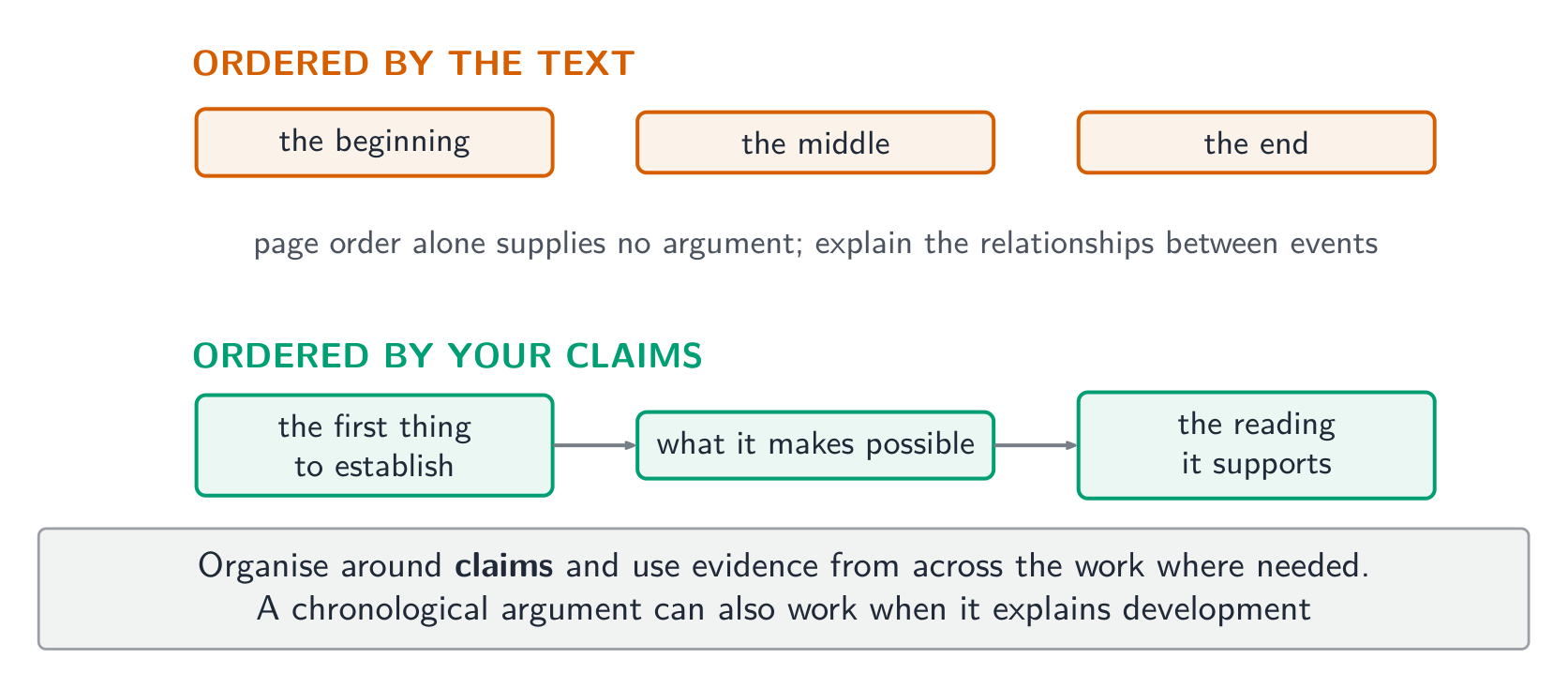
Following the plot's order gives an essay an argument by itself.
Dificuldade 1/5 · Moedas 100 + pequeno bônus na primeira conclusão hoje
Organise by claims.
What a topic sentence does
- A topic sentence states the paragraph's claim and links it to the thesis. The rest of the paragraph gives evidence and commentary for that claim.
- Weak: "In chapter 5, Victor creates the creature." Strong: "Victor's horror at his creation begins the novel's real crime — not making life, but abandoning it."
Make a topic sentence do work
A topic sentence that announces the scene commits the paragraph to summary before it starts.
Which is a strong topic sentence?
Dificuldade 1/5 · Moedas 100 + pequeno bônus na primeira conclusão hoje
It states a claim linked to the thesis.
Worked example: three body paragraphs
Thesis: Shelley shows that the creature becomes a monster because he is rejected, so the true monstrosity is Victor's.
- Paragraph 1: "Victor's first response to his creation is flight, not care." Evidence: he runs from the room, "unable to endure the aspect of the being I had created".
- Paragraph 2: "The creature learns kindness before cruelty." Evidence: he secretly gathers firewood for the De Lacey family; he learns to read and is deeply moved by Paradise Lost.
- Paragraph 3: "Each rejection turns the creature's goodness into revenge." Evidence: the De Laceys flee; he says, "I am malicious because I am miserable." Each paragraph advances one step of the argument.
Order the three body paragraphs in the worked example.
Dificuldade 3/5 · Moedas 200 + pequeno bônus na primeira conclusão hoje
Each step advances the argument.
Which quotation supports the third paragraph?
Dificuldade 1/5 · Moedas 100 + pequeno bônus na primeira conclusão hoje
The creature links his cruelty to rejection.
Evidence and commentary
- After the topic sentence, give short quotations, then commentary 评论: explain how the evidence supports the claim. Commentary should be longer than the quotations.
- End the paragraph by linking back to the thesis.
Commentary should usually be longer than the quotations.
Dificuldade 1/5 · Moedas 100 + pequeno bônus na primeira conclusão hoje
Commentary explains how evidence supports the claim.
Transitions between paragraphs
- Use transitions that show the argument's movement: "This abandonment matters because…", "Yet the creature's first lessons are gentle…".
- Each paragraph should depend on the one before.
Plot summary is not a body paragraph. "Next, the creature finds a family and watches them" tells events. Open with a claim, and use events only as evidence for it.
"Next, the creature finds a family" is a good topic sentence.
Dificuldade 1/5 · Moedas 100 + pequeno bônus na primeira conclusão hoje
It tells events, not a claim.
Organise body paragraphs by claims, not plot order. Each topic sentence states one claim linked to the thesis; evidence and longer commentary follow, and transitions show how each paragraph leads to the next.
Write a thesis and three claim-based topic sentences for an essay on a work you know.
Thesis, claims, links.