A Claim About a Poem
Introduzido| English | Significado |
|---|---|
| topic | the general subject a text is about |
| claim/kleɪm/ | a statement about a text that a reader could argue with |
| defensible | able to be supported with evidence against an objection |
"Look on my Works, ye Mighty, and despair!", 1818
- Percy Bysshe Shelley's sonnet "Ozymandias" describes a broken statue in the desert. On its base are the words: "My name is Ozymandias, King of Kings, / Look on my Works, ye Mighty, and despair!"
- The next lines answer him: "Nothing beside remains. Round the decay / Of that colossal Wreck, boundless and bare / The lone and level sands stretch far away."
What surrounds the broken statue in "Ozymandias"?
Dificuldade 1/5 · Moedas 100 + pequeno bônus na primeira conclusão hoje
"Nothing beside remains."
From topic to claim
- A topic 话题 names what the poem is about: power, time. A claim 主张 says something arguable about how the poem treats it.
- "The poem is about power" is a topic. "The poem shows that power does not last" is a claim, but almost every reader would agree with it, so it is still weak.
Match each statement to what it is.
Dificuldade 2/5 · Moedas 140 + pequeno bônus na primeira conclusão hoje
Topic, broad claim, narrow claim.
Narrow the claim
- A strong claim is defensible 站得住脚的: it could be argued against, and the text gives you evidence to defend it.
- Ask what is surprising in the poem. Here the only thing that survives the king is the sculptor's work: "The hand that mocked them, and the heart that fed".
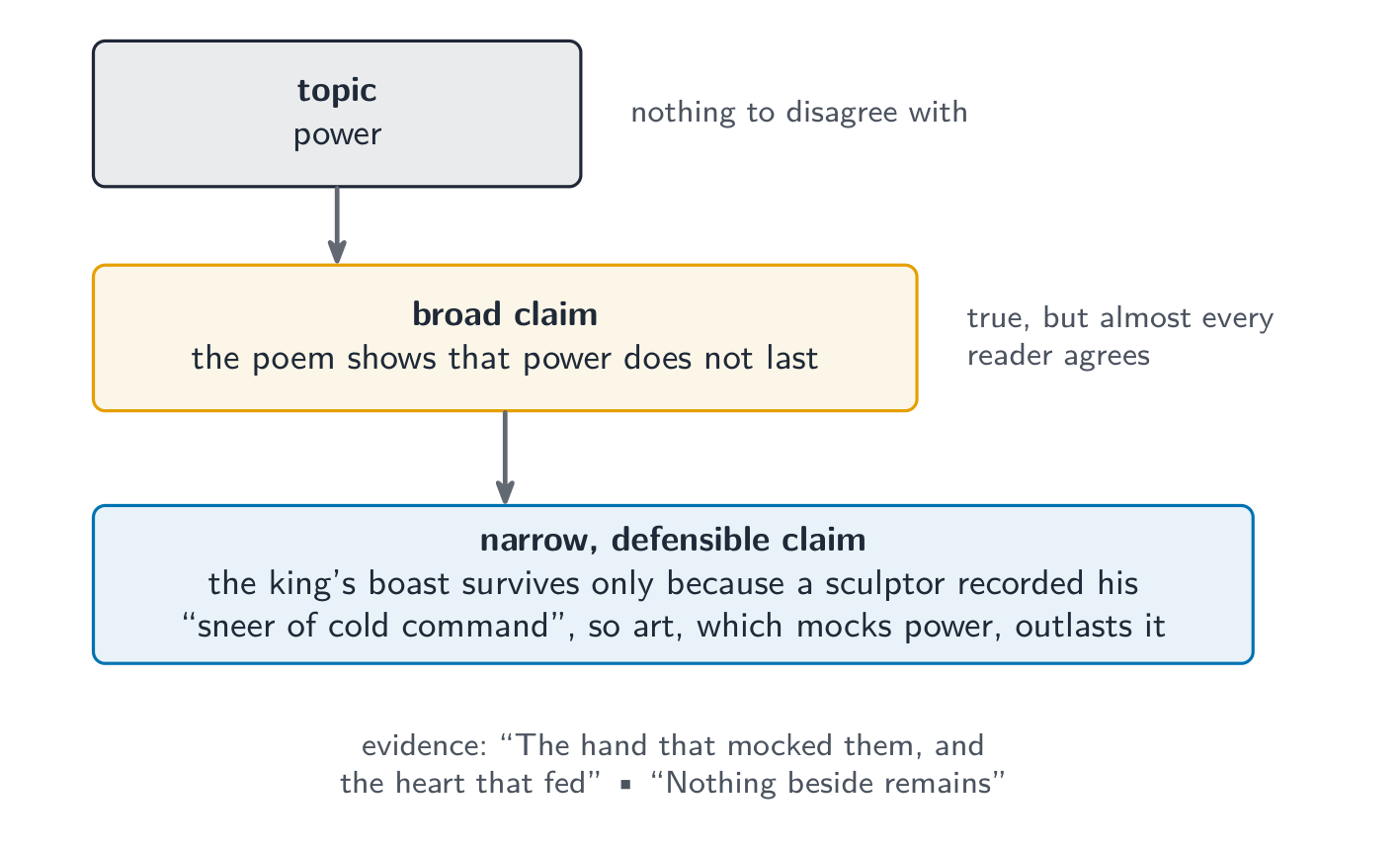
Is this claim the right size for one paragraph?
Sort each statement by whether a single paragraph could defend it.
A defensible claim is one that nobody could disagree with.
Dificuldade 1/5 · Moedas 100 + pequeno bônus na primeira conclusão hoje
It can be argued against and defended with evidence.
In the poem, whose work survives?
Dificuldade 1/5 · Moedas 100 + pequeno bônus na primeira conclusão hoje
"The hand that mocked them, and the heart that fed".
Worked example: three versions
- Topic: "Ozymandias" is about power.
- Broad claim: the poem shows that power does not last.
- Narrow claim: in "Ozymandias", the king's boast survives only because a sculptor recorded his "sneer of cold command", so Shelley suggests that art, which mocks power, outlasts it.
Use the poem's own structure
- The poem passes through three voices: a traveller tells the speaker what the sculptor made of the king. The king's words reach us only through others.
- A claim that uses this structure is harder to argue with, because the structure is evidence.
Order the voices through which the king's words reach the reader, starting with the king.
Dificuldade 3/5 · Moedas 200 + pequeno bônus na primeira conclusão hoje
The king's words reach us only through others.
Test your claim
- Could someone reasonably disagree? If not, it is too obvious.
- Can you point to at least two places in the poem that support it? If not, it is too narrow or unsupported.
A list of devices is not a claim. "Shelley uses irony, imagery and a sonnet form to show power" names tools, not an argument. Say what the poem shows and how.
"Shelley uses irony, imagery and a sonnet form" is a strong claim.
Dificuldade 1/5 · Moedas 100 + pequeno bônus na primeira conclusão hoje
It names devices, not an argument.
Move from a topic to a defensible claim: say something specific that a reader could disagree with and that the poem's words and structure can support. Look for what is surprising in the poem and build the claim from it.
Write a narrow, defensible claim about a short poem you know, and name two pieces of evidence for it.
Specific, arguable, supported.