Buffer Capacity
Introduzido| English | Significado |
|---|---|
| buffer capacity/ˈbʌfə kəˈpæsɪti/ | capacidade tampão |
How much can it take?
- Every protector has a limit before it gives out.
- A dilute mixture tires quickly; a concentrated one holds firm.
- Its reserves decide how much shock it can absorb.
- Beyond that limit, the pH finally lurches.
The reserve strength
- Buffer capacity 缓冲容量 is how much acid or base a buffer can absorb.
- A higher capacity resists larger additions.
- Exceed it, and the pH swings sharply.
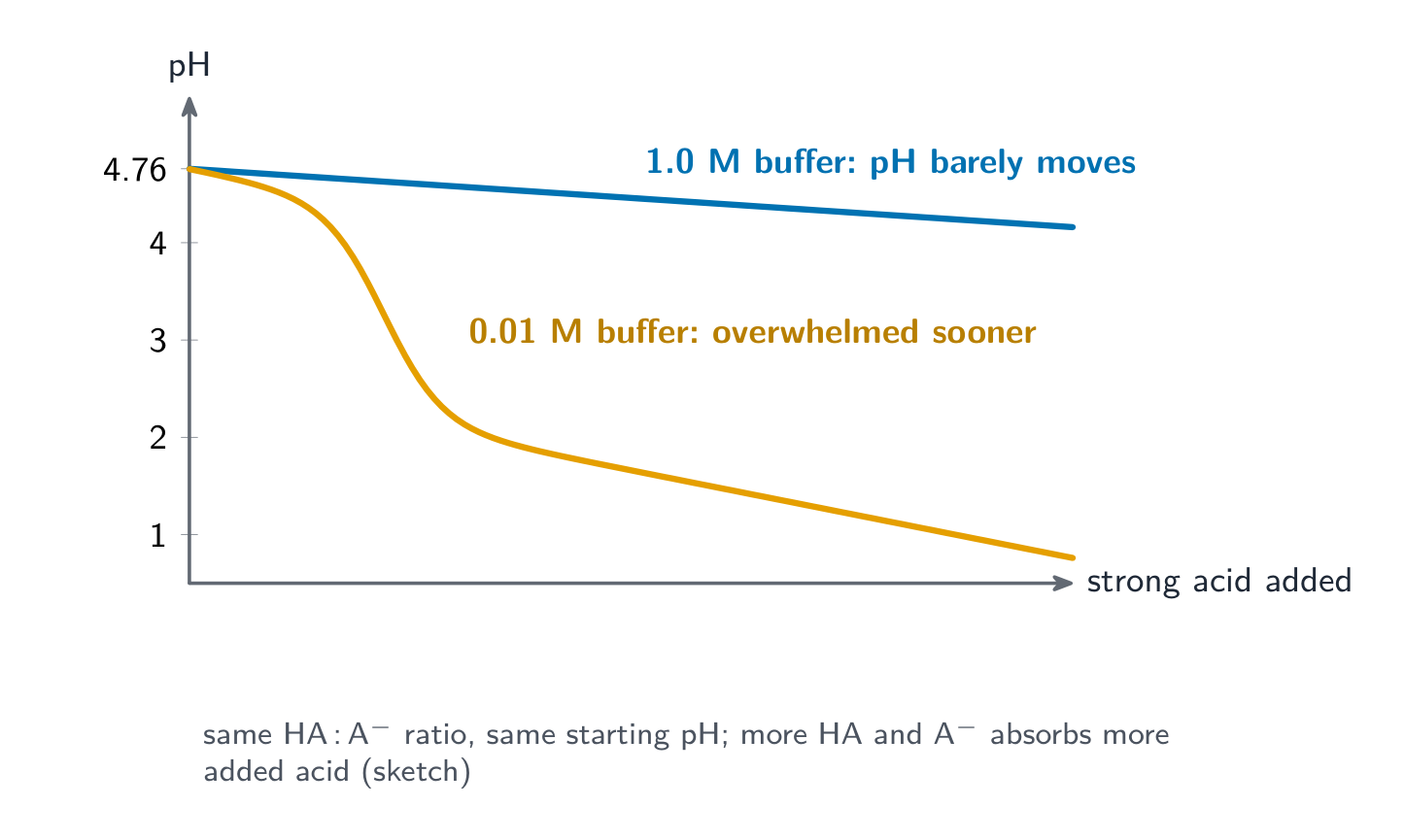
Once a buffer's capacity is exceeded, the pH changes sharply.
Dificuldade 1/5 · Moedas 100 + pequeno bônus na primeira conclusão hoje
The buffer fails and can no longer resist the change.
More concentrated, more capacity
- Higher concentrations of both components give a larger capacity.
- More reserve means more added acid or base can be neutralized.
- Dilute buffers run out quickly.
A more concentrated buffer has a...
Dificuldade 1/5 · Moedas 100 + pequeno bônus na primeira conclusão hoje
More of both components means more can be absorbed.
For equal volumes of the same conjugate pair at the same ratio, a dilute buffer can absorb more added acid than a concentrated one.
Dificuldade 1/5 · Moedas 100 + pequeno bônus na primeira conclusão hoje
False. A dilute buffer has fewer moles of acid and base in reserve, so it is overwhelmed sooner.
Buffer capacity increases with the ____ of the buffer components.
Dificuldade 1/5 · Moedas 100 + pequeno bônus na primeira conclusão hoje
Higher concentrations provide more reserve.
Balanced is best
- For a fixed total concentration of one conjugate pair, capacity against small pH changes is greatest near equal acid and base.
- A lopsided buffer runs out on one side first.
- So near $\text{pH} = \text{p}K_a$, the capacity peaks.
At fixed total concentration of one conjugate pair, buffer capacity against small pH changes is greatest near which acid-to-base ratio?
Dificuldade 1/5 · Moedas 100 + pequeno bônus na primeira conclusão hoje
A balanced 1:1 buffer handles both directions best.
For equal volumes of the same conjugate pair, which buffer resists more added acid: $1.0\ \text{M}$ or $0.01\ \text{M}$ (same ratio)?
- The $1.0\ \text{M}$ buffer has far more reserve.
- So it resists more added acid — a higher capacity.
What raises buffer capacity?
Sort each buffer by whether it resists more or less added acid/base.
Two buffers have the same pH. Do they necessarily have the same capacity?
Dificuldade 1/5 · Moedas 100 + pequeno bônus na primeira conclusão hoje
Same pH (ratio) can hide very different concentrations.
Buffer capacity is about the amount of buffer (its concentration), not just the ratio — two buffers can share a pH but have very different capacities. At fixed total concentration of one conjugate pair, it peaks near a 1:1 ratio ($\text{pH} = \text{p}K_a$). And once the capacity is exceeded, the buffer fails and the pH jumps.
Buffer capacity is how much acid or base a buffer can absorb before failing. It rises with the concentration of both components and peaks when they are balanced ($\text{pH} = \text{p}K_a$). Two buffers can share a pH yet differ greatly in capacity.