pH and Solubility
Introduzido| English | Significado |
|---|---|
| solubility/ˌsɒljuːˈbɪlɪti/ | solubilidade |
Acid that dissolves the insoluble
- Some "insoluble" salts vanish when you add acid.
- Chalk fizzes and disappears in vinegar.
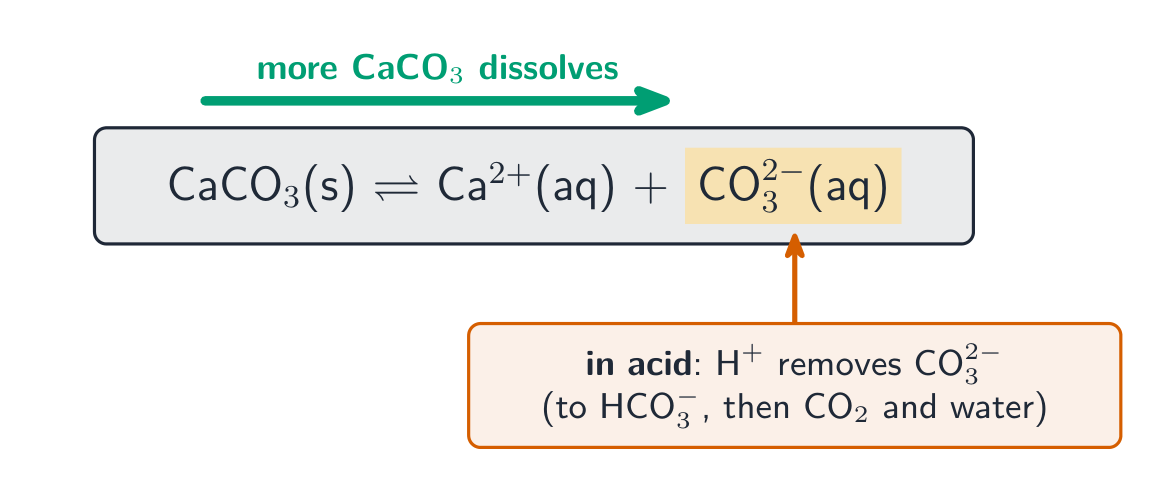
- The acid quietly removes one of the salt's ions.
- That removal pulls more solid into solution.
Salts with basic anions
- Salts whose anion is a weak base dissolve more in acid.
- Carbonates, hydroxides, and fluorides are examples.
- Their anion reacts with the added $\text{H}^+$.
Which type of salt dissolves more as the pH is lowered?
Dificuldade 1/5 · Moedas 100 + pequeno bônus na primeira conclusão hoje
A basic anion reacts with added acid, so more dissolves.
Salts of weak-acid anions, such as carbonates and ____, dissolve more in acid.
Dificuldade 1/5 · Moedas 100 + pequeno bônus na primeira conclusão hoje
Hydroxide and carbonate anions are basic, so acid dissolves them.
Removing an ion shifts the balance
- Acid consumes the dissolved anion.
- That drops $Q$ below $K_{sp}$, so more solid dissolves.
- It is Le Chatelier applied to solubility 溶解度.
Adding acid removes the anion, which drops $Q$ abaixo $K_{sp}$, so the solid...
Dificuldade 1/5 · Moedas 100 + pequeno bônus na primeira conclusão hoje
With $Q < K_{sp}$, more solid dissolves to restore equilibrium.
The pH effect on solubility is an example of Le Chatelier's principle.
Dificuldade 1/5 · Moedas 100 + pequeno bônus na primeira conclusão hoje
Removing an ion shifts the dissolving equilibrium forward.
Not every salt cares
- In the simple dissolution model, chloride is too weak a base to be appreciably protonated in ordinary aqueous acid.
- Their solubility changes little through anion protonation; other reactions, such as complex formation, can still matter.
- Basic anions such as carbonate respond strongly to acid; do not generalize this to every salt or condition.
The solubility of $\text{AgCl}$ changes strongly with pH.
Dificuldade 1/5 · Moedas 100 + pequeno bônus na primeira conclusão hoje
Chloride is an extremely weak conjugate base, so acid has little effect through protonation in the simple dissolution model.
Does $\text{CaCO}_3$ dissolve more in acid or in neutral water?
- Acid removes carbonate: $\text{CO}_3^{2-}+\text{H}^+\to\text{HCO}_3^-$, then $\text{HCO}_3^-+\text{H}^+\to\text{CO}_2+\text{H}_2\text{O}$.
- So $\text{CaCO}_3$ dissolves more in acid.
Does pH change solubility?
Sort each salt by whether lowering the pH makes it more soluble.
$\text{CaCO}_3$ dissolves more in...
Dificuldade 1/5 · Moedas 100 + pequeno bônus na primeira conclusão hoje
Acid reacts with the basic carbonate ion, dissolving more solid.
In this simple model, salts with a basic anion (from a weak acid, like carbonate or hydroxide) dissolve more in acid — salts of strong-acid anions like chloride do not respond. Lowering the pH removes the anion, pulling more solid in. This is just Le Chatelier acting on the dissolving equilibrium.
Salts with a basic anion (carbonates, hydroxides) dissolve more in acid: the added $\text{H}^+$ removes the anion, dropping $Q$ below $K_{sp}$ so more solid dissolves. Chloride salts show little effect from anion protonation in this model — it is Le Chatelier acting on solubility.