Acid-Base Reactions
Introduzido| English | Significado |
|---|---|
| acid/ˈæsɪd/ | ácido |
| base/beɪs/ | fundamentais |
| conjugate base/ˈkɒndʒuːɡeɪt beɪs/ | The species formed when an acid loses one proton. |
| conjugate acid/ˈkɒndʒuːɡeɪt ˈæsɪd/ | The species formed when a base accepts a proton. |
| amphoteric/ˌæmfəʊˈterɪk/ | amphoteric |
The great proton handoff
- Vinegar fizzes with baking soda; ammonia cleaner neutralizes acid spills. In both, a tiny particle, a proton ($\text{H}^+$), moves from one species to another.
- AP asks you to find conjugate pairs, write net ionic equations for acid–base reactions, and tell strong from weak.
Donors and acceptors
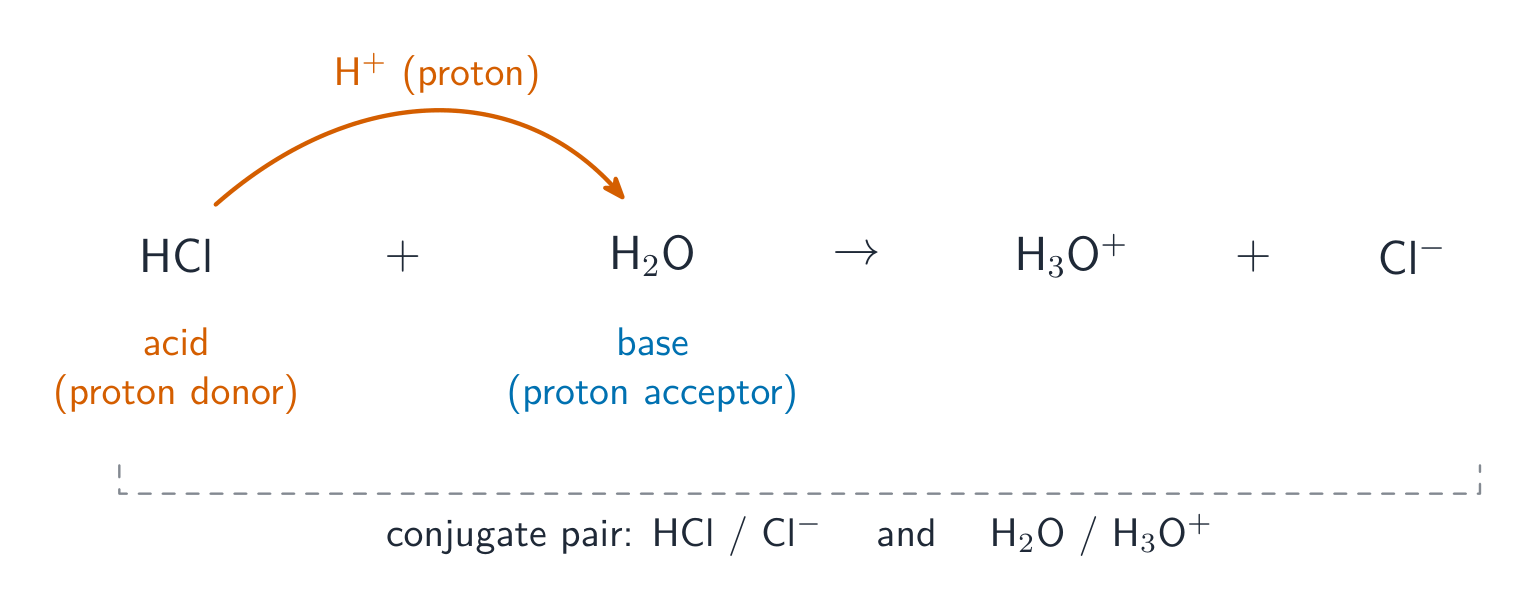
- Brønsted–Lowry: an acid 酸 donates a proton; a base 碱 accepts one.
- After the transfer, the acid becomes its conjugate base 共轭碱 (one H fewer), and the base becomes its conjugate acid 共轭酸 (one H more).
What is the conjugate base of HCO₃⁻?
Dificuldade 1/5 · Moedas 100 + pequeno bônus na primeira conclusão hoje
Remove one H⁺ from HCO₃⁻ to get CO₃²⁻. (H₂CO₃ is its conjugate acid.)
Find the pairs. $\text{NH}_3(aq)+\text{H}_2\text{O}(l)\rightleftharpoons\text{NH}_4^+(aq)+\text{OH}^-(aq)$
- $\text{H}_2\text{O}$ gives a proton: it is the acid, and $\text{OH}^-$ is its conjugate base.
- $\text{NH}_3$ takes a proton: it is the base, and $\text{NH}_4^+$ is its conjugate acid.
- Water can act as an acid or a base: it is amphoteric 两性的.
In HF(aq) + H₂O(l) ⇌ F⁻(aq) + H₃O⁺(aq), which species is the base?
Dificuldade 1/5 · Moedas 100 + pequeno bônus na primeira conclusão hoje
Water accepts the proton from HF, becoming H₃O⁺.
Strong and weak
- Learn the six strong acids: HCl, HBr, HI, $\text{HNO}_3$, $\text{H}_2\text{SO}_4$, $\text{HClO}_4$. They ionize completely. Strong bases: Group 1 hydroxides and $\text{Ca}$, $\text{Sr}$, $\text{Ba}$ hydroxides.
- Weak acids (such as $\text{CH}_3\text{COOH}$, HF) and weak bases (such as $\text{NH}_3$) ionize only a little, so in equations they stay as molecules.
Acid or base?
In each reaction, decide which species donates a proton (acid) and which accepts one (base).
Which are strong acids? Select all that apply.
Dificuldade 2/5 · Moedas 140 + pequeno bônus na primeira conclusão hoje
HNO₃ and HClO₄ are on the list of six strong acids; HF and CH₃COOH are weak.
Net ionic equations
- Write strong acids, strong bases and soluble salts as ions; write weak acids, weak bases, water and solids as formulas. Then cancel spectator ions.
- For strong acid + strong base, the net ionic equation is always $\text{H}^+(aq)+\text{OH}^-(aq)\rightarrow\text{H}_2\text{O}(l)$, whatever the acid and base.
Three net ionic equations.
- HCl + NaOH (both strong): $\text{H}^+(aq)+\text{OH}^-(aq)\rightarrow\text{H}_2\text{O}(l)$.
- $\text{CH}_3\text{COOH}$ (weak) + NaOH: $\text{CH}_3\text{COOH}(aq)+\text{OH}^-(aq)\rightarrow\text{CH}_3\text{COO}^-(aq)+\text{H}_2\text{O}(l)$.
- HCl + $\text{NH}_3$ (weak base): $\text{H}^+(aq)+\text{NH}_3(aq)\rightarrow\text{NH}_4^+(aq)$. No water forms.
What is the net ionic equation for HF(aq) + KOH(aq)?
Dificuldade 1/5 · Moedas 100 + pequeno bônus na primeira conclusão hoje
HF is weak, so it stays as a molecule; K⁺ is a spectator.
- Strong ≠ concentrated. 0.001 M HCl is strong but dilute; 6 M ethanoic acid is weak but concentrated.
- Never split a weak acid into $\text{H}^+$ and its anion in a net ionic equation.
- Conjugate pairs differ by exactly one $\text{H}^+$: $\text{H}_2\text{SO}_4$/$\text{HSO}_4^-$, not $\text{H}_2\text{SO}_4$/$\text{SO}_4^{2-}$.
A 0.0010 M solution of HCl is a weak acid because it is dilute.
Dificuldade 1/5 · Moedas 100 + pequeno bônus na primeira conclusão hoje
False. HCl is strong at any concentration because it ionizes completely; it is just dilute.
- Acid donates $\text{H}^+$; base accepts it. Each forms a conjugate partner differing by one $\text{H}^+$.
- Six strong acids ionize fully; weak acids and bases stay as molecules in net ionic equations.
- Strong acid + strong base: $\text{H}^+ + \text{OH}^- \rightarrow \text{H}_2\text{O}$.