Oxidation-Reduction (Redox) Reactions
Introduzido| English | Significado |
|---|---|
| redox/rɪˈdɒks/ | A process in which oxidation and reduction occur together through changes in oxidation state. |
| oxidation/ˌɒksɪˈdeɪʃn/ | oxidação |
| reducing agent/rɪˈdjuːsɪŋ ˈeɪdʒənt/ | agente redutor |
| reduction/rɪˈdʌkʃn/ | redução |
| oxidizing agent/ˈɒksɪdaɪzɪŋ ˈeɪdʒənt/ | agente oxidante |
The electron trade
- A phone battery, rusting iron and the burning of fuel are all redox 氧化还原 reactions: electrons move from one substance to another.
- AP asks you to spot redox with oxidation numbers, name the oxidizing and reducing agents, and write balanced half-reactions.
Losing and gaining electrons
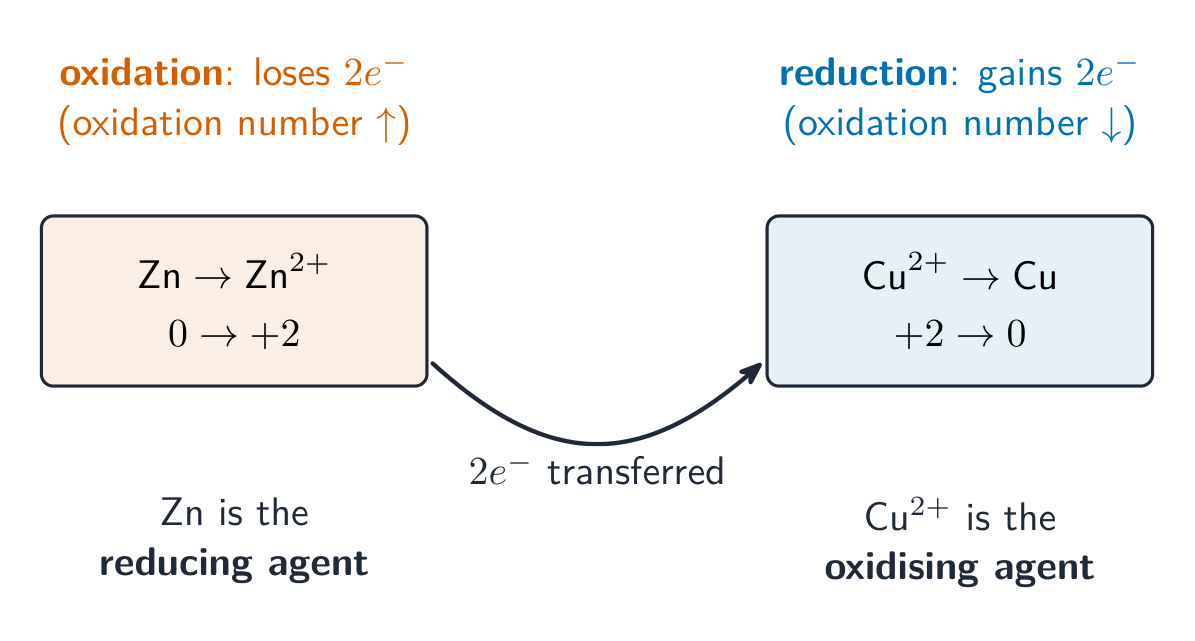
- Oxidation 氧化 is loss of electrons: the oxidation number goes up. Reduction 还原 is gain of electrons: the oxidation number goes down.
- They always happen together: every electron lost by one species is gained by another.
When a species is oxidized, its oxidation number decreases.
Dificuldade 1/5 · Moedas 100 + pequeno bônus na primeira conclusão hoje
False. Oxidation is loss of electrons, so the oxidation number increases.
Oxidation-number rules
- Free elements are 0; a simple ion equals its charge. In compounds: F is −1; O is usually −2 (−1 in peroxides); H is +1 with non-metals; Group 1 metals +1, Group 2 metals +2.
- The numbers add up to 0 in a neutral compound, or to the charge of an ion.
Assigning numbers.
- Mn in $\text{MnO}_4^-$: $x+4(-2)=-1$, so $x=+7$.
- Cr in $\text{Cr}_2\text{O}_7^{2-}$: $2x+7(-2)=-2$, so $x=+6$.
- S in $\text{H}_2\text{SO}_4$: $2(+1)+x+4(-2)=0$, so $x=+6$.
What is the oxidation number of N in NO₃⁻?
Dificuldade 2/5 · Moedas 140 + pequeno bônus na primeira conclusão hoje
x + 3(−2) = −1, so x = +5.
What is the oxidation number of Cl in ClO⁻?
Dificuldade 2/5 · Moedas 140 + pequeno bônus na primeira conclusão hoje
x + (−2) = −1, so x = +1.
Oxidizing and reducing agents
- The oxidizing agent 氧化剂 takes electrons, so it is itself reduced. The reducing agent 还原剂 gives electrons, so it is itself oxidized.
- Name the whole species (for example $\text{Fe}^{3+}$, or $\text{MnO}_4^-$), not just the atom whose number changes.
Oxidised or reduced?
Track the electrons: sort each half-change as oxidation or reduction.
Name the agents. $\text{Fe}_2\text{O}_3(s)+3\text{CO}(g)\rightarrow2\text{Fe}(s)+3\text{CO}_2(g)$ (a blast furnace).
- Fe: +3 → 0, reduced. C: +2 → +4, oxidized.
- So $\text{Fe}_2\text{O}_3$ is the oxidizing agent and CO is the reducing agent. Each CO loses 2 electrons; 3 CO give the 6 electrons that 2 Fe gain.
In Zn(s) + 2Ag⁺(aq) → Zn²⁺(aq) + 2Ag(s), what is the oxidizing agent?
Dificuldade 1/5 · Moedas 100 + pequeno bônus na primeira conclusão hoje
Ag⁺ gains electrons (is reduced), so it is the oxidizing agent.
Which reactions are redox? Select all that apply.
Dificuldade 2/5 · Moedas 140 + pequeno bônus na primeira conclusão hoje
Oxidation numbers change only in the first and third. Precipitation and this decomposition keep every number the same.
Half-reactions
- Split a redox reaction into an oxidation half-reaction and a reduction half-reaction, each showing electrons.
- Balance atoms, then charge with electrons. Multiply so that electrons lost = electrons gained, then add and cancel.
Balancing with half-reactions. Aluminium reacts with copper(II) ions.
- Oxidation: $\text{Al}\rightarrow\text{Al}^{3+}+3e^-$. Reduction: $\text{Cu}^{2+}+2e^-\rightarrow\text{Cu}$.
- Multiply by 2 and 3 to make 6 electrons each: $2\text{Al}+3\text{Cu}^{2+}\rightarrow2\text{Al}^{3+}+3\text{Cu}$. Charge: $+6$ on both sides ✓
When Fe²⁺ → Fe³⁺ + e⁻ is combined with Cl₂ + 2e⁻ → 2Cl⁻, how many Fe²⁺ react per Cl₂ in the balanced equation?
Dificuldade 2/5 · Moedas 140 + pequeno bônus na primeira conclusão hoje
Cl₂ takes 2 electrons, so 2Fe²⁺ are needed: 2Fe²⁺ + Cl₂ → 2Fe³⁺ + 2Cl⁻.
- An equation must balance charge as well as atoms: $\text{Al}+\text{Cu}^{2+}\rightarrow\text{Al}^{3+}+\text{Cu}$ has the atoms right but the charge wrong.
- The oxidizing agent is the species that is reduced, which feels backwards. Check with the oxidation numbers.
- Not every reaction is redox: in $\text{HCl}+\text{NaOH}$ no oxidation number changes.
- Oxidation: electrons lost, number up. Reduction: electrons gained, number down.
- Oxidizing agent is reduced; reducing agent is oxidized.
- Half-reactions: balance atoms, then charge with $e^-$; match electrons, then add.