Types of Chemical Reactions
Introduzido| English | Significado |
|---|---|
| synthesis/ˈsɪnθəsɪs/ | síntese |
| decomposition/ˌdiːkɒmpəˈzɪʃn/ | decomposição |
| combustion/kəmˈbʌstʃn/ | combustão |
Sorting reactions into families
- A battery, an antacid tablet and a water-softening filter run on three different kinds of reaction: electron transfer, proton transfer and ions forming a solid.
- AP Chemistry sorts reactions by what is transferred. Patterns such as synthesis or combustion also help you spot them.
Joining and splitting
- Synthesis 化合反应 combines two things into one ($A + B \to AB$).
- Decomposition 分解反应 breaks one thing into parts ($AB \to A + B$).
- They are exact opposites.
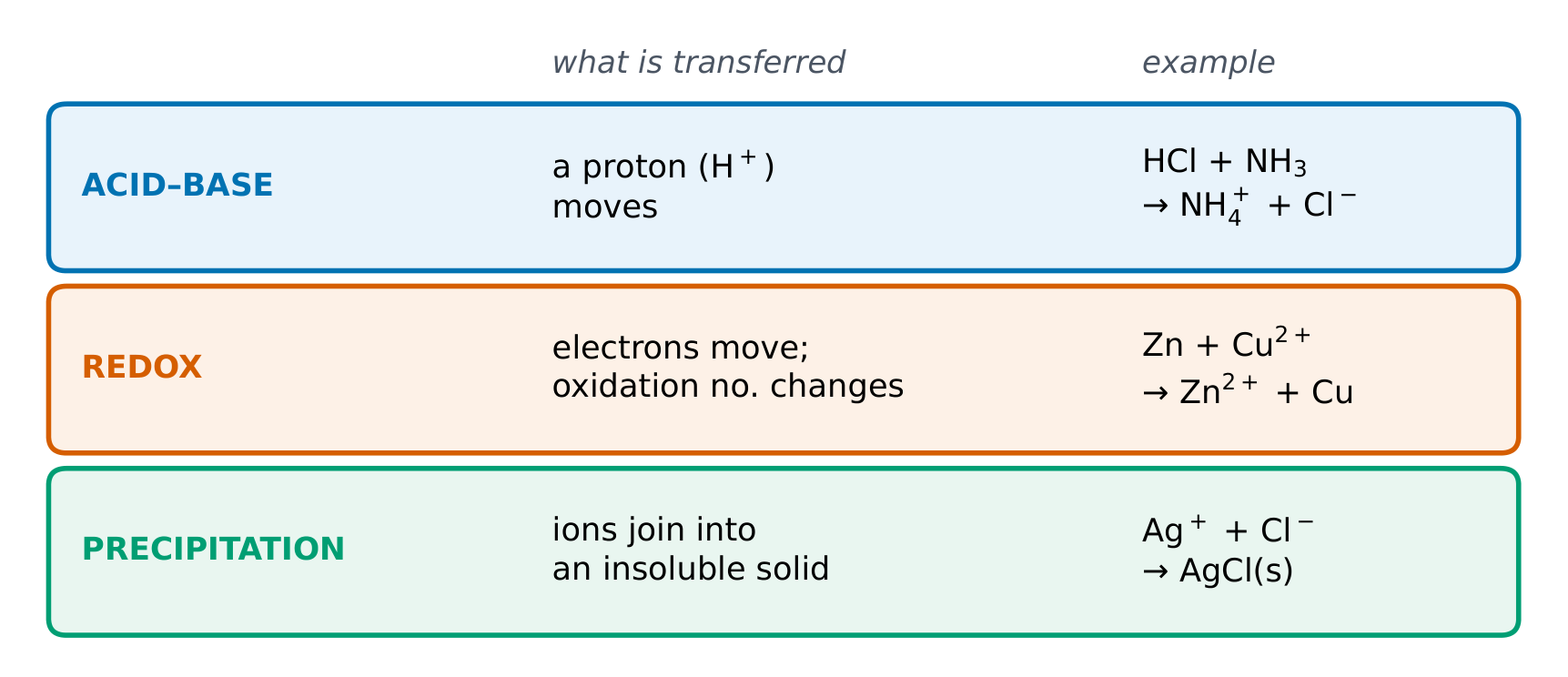
Acid-base reactions move protons; redox moves electrons; precipitation forms a solid
$A + B \to AB$ is which type of reaction?
Dificuldade 1/5 · Moedas 100 + pequeno bônus na primeira conclusão hoje
Two things combining into one is a synthesis.
$AB \to A + B$ is which type?
Dificuldade 1/5 · Moedas 100 + pequeno bônus na primeira conclusão hoje
One compound breaking into parts is a decomposition.
Swapping partners
- Single replacement: one element kicks out another ($A + BC \to AC + B$).
- Double replacement: two compounds swap partners ($AB + CD \to AD + CB$).
- Many precipitation and acid–hydroxide neutralization equations fit double replacement; acid–base reactions can also transfer a proton without this pattern.
Match each pattern to its reaction type.
Dificuldade 2/5 · Moedas 140 + pequeno bônus na primeira conclusão hoje
Join, split, and swap are synthesis, decomposition, and double replacement.
A precipitation reaction, where two compounds swap partners, is a ____ replacement.
Dificuldade 1/5 · Moedas 100 + pequeno bônus na primeira conclusão hoje
Two compounds exchanging ions is a double replacement.
Burning in oxygen
- Combustion 燃烧反应 is a fuel reacting with oxygen and releasing energy.
- Complete hydrocarbon combustion in sufficient oxygen gives $\text{CO}_2$ and $\text{H}_2\text{O}$; limited oxygen can produce CO or carbon.
- It always needs $\text{O}_2$ and gives off heat.
Classifique a reação
Sort each equation by its reaction pattern.
Every combustion reaction requires...
Dificuldade 1/5 · Moedas 100 + pequeno bônus na primeira conclusão hoje
Combustion is a fuel reacting with oxygen.
Classify $2\text{H}_2 + \text{O}_2 \to 2\text{H}_2\text{O}$.
- Two substances combine into one product, so it is a synthesis.
- It is also a combustion, since a fuel reacts with oxygen.
A single reaction can belong to more than one type.
Dificuldade 1/5 · Moedas 100 + pequeno bônus na primeira conclusão hoje
Hydrogen burning is both synthesis and combustion.
The three AP reaction types
| Type | What happens | How to spot it | Example |
|---|---|---|---|
| acid–base | a proton (H⁺) moves | an acid meets a base; water or a salt forms | HCl + NaOH → NaCl + H₂O |
| redox | electrons move | oxidation numbers change; often an element is involved | Zn + Cu²⁺ → Zn²⁺ + Cu |
| precipitation | ions form a solid | two solutions give an insoluble product | Ag⁺ + Cl⁻ → AgCl(s) |
- Combustion and single replacement are always redox.
Pb(NO₃)₂(aq) + 2KI(aq) → PbI₂(s) + 2KNO₃(aq). Which type is it?
Dificuldade 1/5 · Moedas 100 + pequeno bônus na primeira conclusão hoje
No oxidation numbers change and no proton moves: Pb²⁺ and I⁻ form an insoluble solid.
Prove it is redox. Classify $\text{Mg}(s) + 2\text{HCl}(aq) \rightarrow \text{MgCl}_2(aq) + \text{H}_2(g)$.
- Oxidation numbers: Mg goes 0 → +2 (oxidised); H goes +1 → 0 (reduced). Cl stays −1.
- Electrons moved from Mg to H⁺, so it is a redox reaction (and a single replacement). It is not acid–base: no proton is passed to a base.
In 2Na + Cl₂ → 2NaCl, which statement is true?
Dificuldade 1/5 · Moedas 100 + pequeno bônus na primeira conclusão hoje
Na loses an electron and Cl gains one, so this synthesis is also a redox reaction.
- A reaction can fit more than one pattern: H₂ burning is synthesis, combustion and redox.
- Check oxidation numbers to prove redox; do not rely on the name.
- Combustion needs O₂; without oxygen it is not combustion.
Most reactions fall into families: synthesis (join into one), decomposition (split apart), single and double replacement (swap partners), and combustion (fuel plus oxygen). Recognize the pattern to predict products, and remember a reaction can belong to more than one family.