Estrutura de Sólidos Iônicos
Introduzido| English | Significado |
|---|---|
| crystal lattice/ˈkrɪstl ˈlætɪs/ | retículo cristalino |
| lattice energy/ˈlætɪs ˈenədʒi/ | energia reticular |
A perfect repeating grid
- Table salt crystals have flat faces and sharp corners.
- Zoom in and you find a grid that repeats forever.
- Positive and negative charges alternate like a 3D checkerboard.
- That orderly pattern gives salt its tough, brittle nature.
The lattice
- An ionic solid is a crystal lattice 晶格 of alternating positive and negative ions.
- Each ion is surrounded by neighbours of the opposite charge.
- Strong electrostatic attraction locks the whole grid together.
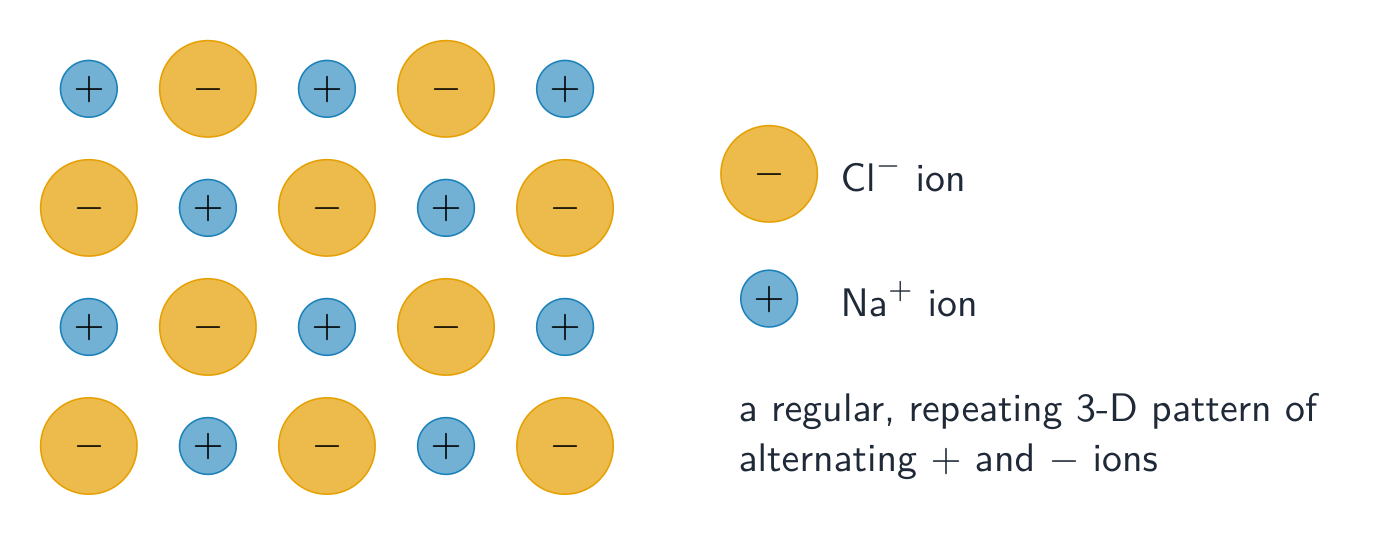
Ions pack into a giant lattice of alternating positive and negative ions
Em uma rede iônica, cada íon é rodeado por íons de carga oposta.
Dificuldade 1/5 · Moedas 100 + pequeno bônus na primeira conclusão hoje
Cargas opostas alternadas maximizam a atração e a estabilidade.
Lattice energy
- Here lattice energy 晶格能 means the positive energy needed to separate one mole of an ionic solid into gaseous ions; formation uses the opposite sign.
- Higher charges and smaller ions give stronger attraction and higher lattice energy.
- Stronger attraction generally raises melting point; melting disrupts the lattice but does not separate every ion into the gas phase.
Qual composto iônico tem maior energia reticular?
Dificuldade 1/5 · Moedas 100 + pequeno bônus na primeira conclusão hoje
Cargas maiores atraem muito mais fortemente, então MgO tem a maior energia reticular.
Uma energia reticular maior geralmente significa um ponto de fusão mais baixo.
Dificuldade 1/5 · Moedas 100 + pequeno bônus na primeira conclusão hoje
Falso. Maior energia reticular mantém os íons unidos com mais força, exigindo mais calor para romper a rede: ponto de fusão mais alto.
A energia reticular aumenta quando as cargas dos íons ficam ____.
Dificuldade 1/5 · Moedas 100 + pequeno bônus na primeira conclusão hoje
Cargas mais fortes atraem mais, aumentando a energia reticular.
Why ionic solids behave as they do
- High melting points: the strong grid is hard to break apart.
- Brittle: shift a layer and like charges meet and repel, cracking it.
- They conduct only when molten or dissolved, when the ions can move.
Dentro de um sólido iônico
Íons com cargas opostas se encaixam em uma grande rede repetitiva mantida por forças eletrostáticas.
Um sólido iônico conduz eletricidade...
Dificuldade 1/5 · Moedas 100 + pequeno bônus na primeira conclusão hoje
Os íons devem estar livres para se mover -- isso acontece quando derretidos ou dissolvidos.
Por que os sólidos iônicos são frágeis?
Dificuldade 1/5 · Moedas 100 + pequeno bônus na primeira conclusão hoje
Um pequeno deslocamento aproxima cargas iguais; sua repulsão racha o cristal.
Which has the higher lattice energy, $\text{NaCl}$ or $\text{MgO}$?
- MgO has $2+$ and $2-$ ions; NaCl has $1+$ and $1-$.
- Bigger charges mean much stronger attraction, so MgO wins and melts far hotter.
Ionic solids do not conduct electricity as solids — the ions are locked in place; they conduct only once melted or dissolved. Compare charge product and ion separation together: attraction grows with $|q_+q_-|/r$, so charge alone is not a universal ranking rule. And the brittleness comes from the lattice: a small shift lines up like charges, which repel and shatter it.
An ionic solid is a crystal lattice of alternating ions held by strong electrostatic attraction. Its lattice energy — larger for higher charges and smaller ions — gives it a high melting point. It is brittle and conducts only when molten or dissolved, once the ions are free to move.