Composition of Mixtures
Introduzido| English | Significado |
|---|---|
| mixture/ˈmɪkstʃə/ | mistura |
| mass percent/mæs pəˈsent/ | percentagem em massa |
When things are blended
- Salt water can be barely salty or nearly saturated.
- Unlike a pure compound, a blend has no fixed recipe.
- You can have any amount of each ingredient.
- To describe a blend, we measure how much of each part it holds.
Blends have no fixed formula
- A mixture 混合物 contains two or more substances in variable amounts.
- Each keeps its own identity and can be separated physically.
- Air, seawater, and steel are all mixtures.
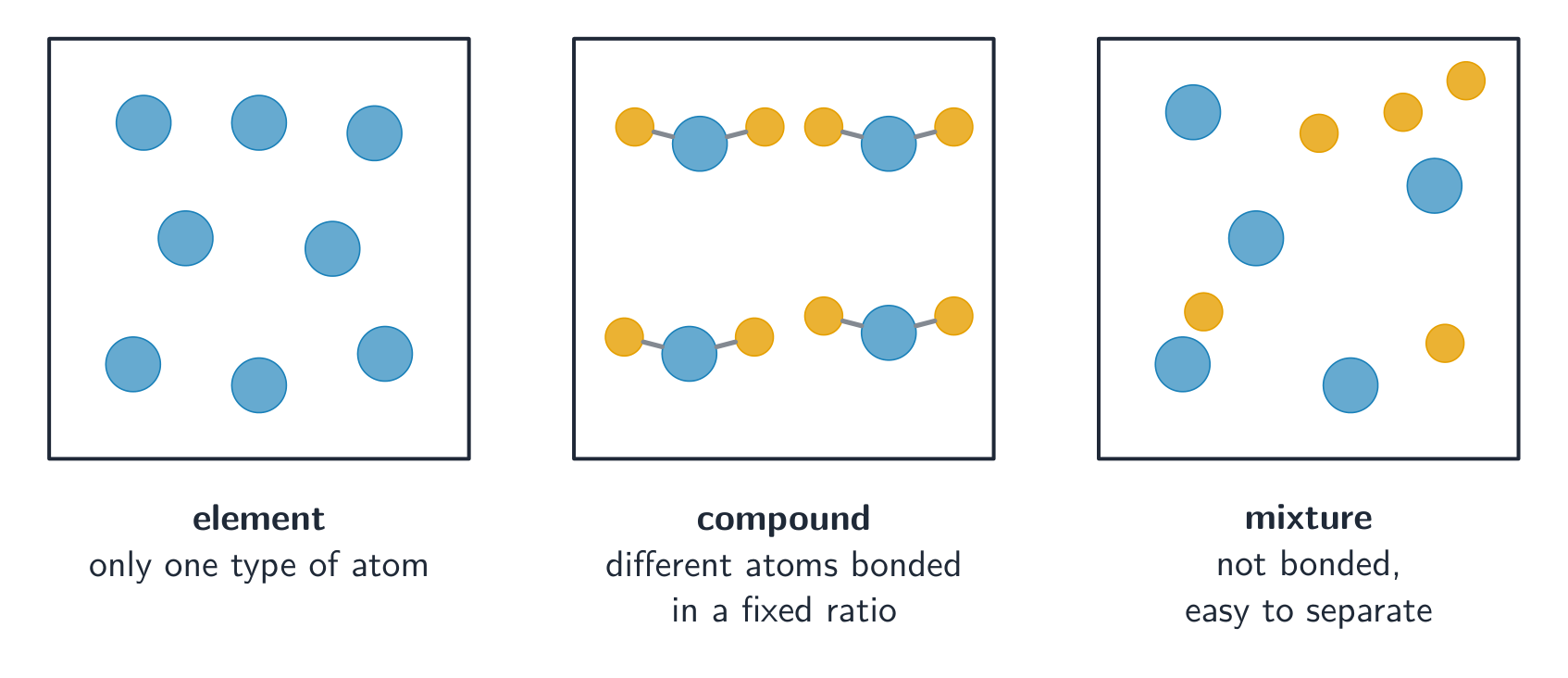
An element has one type of atom; a compound has different atoms bonded in a fixed ratio; a mixture is not bonded
A mixture can have different proportions from one sample to another.
Dificuldade 1/5 · Moedas 100 + pequeno bônus na primeira conclusão hoje
Mixtures have variable composition, unlike pure compounds.
The components of a mixture can generally be separated by...
Dificuldade 1/5 · Moedas 100 + pequeno bônus na primeira conclusão hoje
Components keep their identity and separate physically (filtering, distilling).
Select todos that are mixtures.
Dificuldade 2/5 · Moedas 140 + pequeno bônus na primeira conclusão hoje
Seawater, air, and brass are mixtures; pure water is a compound.
Mass percent of a component
- The mass percent 质量分数 of a component is:
- It tells you the concentration by weight.
Element, compound or mixture?
Sort each sample into element, compound or mixture.
A $200\ \text{g}$ solution is 15% sugar by mass. The mass of sugar (in g)?
Dificuldade 2/5 · Moedas 140 + pequeno bônus na primeira conclusão hoje
Convert 15% to the mass fraction $15/100=0.15$. Then $m_{\mathrm{sugar}}=(0.15)m_{\mathrm{solution}}=0.15\times200=30\ \text{g}$.
An alloy is 60% iron and the rest carbon. The mass percent of carbon (in %)?
Dificuldade 2/5 · Moedas 140 + pequeno bônus na primeira conclusão hoje
Percents sum to 100, so carbon is $100 - 60 = 40\%$.
Working backward to amounts
- Knowing the total mass and one part's percent gives that part's mass.
- A reaction can reveal a hidden component's amount.
- Molar masses then convert those masses into moles.
A sample holds $24\ \text{g}$ of carbon (molar mass 12). How many moles of carbon?
Dificuldade 2/5 · Moedas 140 + pequeno bônus na primeira conclusão hoje
$n = m/M = 24/12 = 2\ \text{mol}$.
A $50\ \text{g}$ alloy is 30% copper by mass.
- Mass of copper: $0.30 \times 50 = 15\ \text{g}$.
- The other component has mass $m_{\mathrm{other}}=m_{\mathrm{total}}-m_{\mathrm{Cu}}=50-15=35\ \text{g}$.
A mixture's percent composition is not fixed — it changes from sample to sample, unlike a pure compound. The mass percents of all components must add to 100%. And keep the mixture's total mass separate from any single component's molar mass; they play different roles.
A mixture holds two or more substances in variable amounts, each keeping its identity. The mass percent of a component is its mass over the mixture's mass, times 100. Because the total is fixed, the components' percents sum to 100%, and molar masses turn any component mass into moles.