Moles and Molar Mass
Introduzido| English | Significado |
|---|---|
| mole/məʊl/ | Mol |
| Avogadro's number/ˌævəˈɡædrəʊz ˈnʌmbə/ | Numero de Avogadro |
| molar mass/ˈməʊlə mæs/ | Massa molar |
Counting the uncountable
- You cannot count atoms one by one — there are billions of billions.
- Yet a chemist needs to know exactly how many are in a sample.
- The trick is to weigh it, because each atom has a known heft.
- One clever number bridges the grams you weigh and the atoms you cannot see.
The mole
- A mole 摩尔 is a fixed count of particles:
- That count is Avogadro's number 阿伏伽德罗常数.
- Just as "a dozen" means 12, "a mole" means $6.022\times10^{23}$.
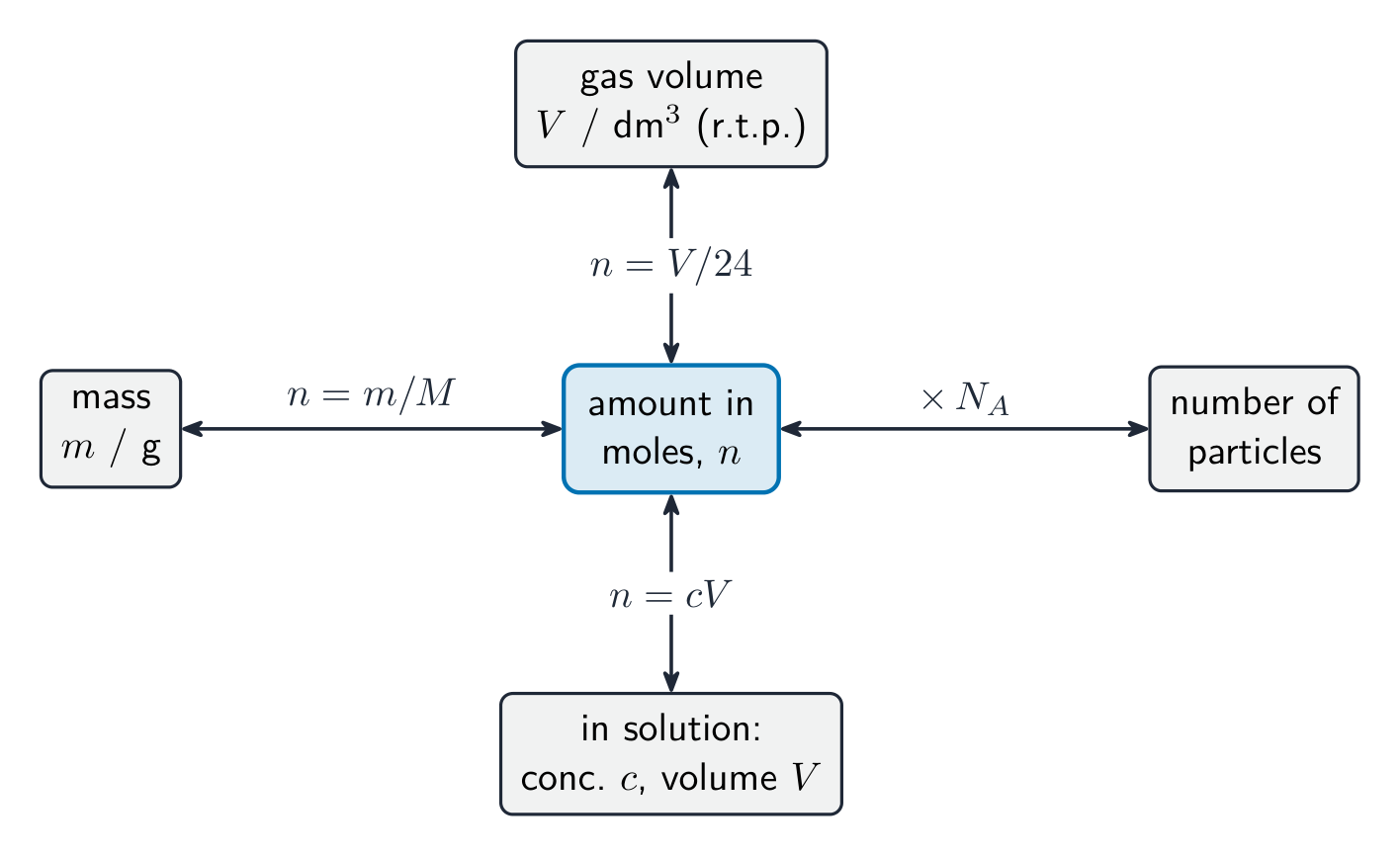
The mole is the hub: convert between mass, particles, gas volume, and concentration
One mole of any substance contains how many particles?
Dificuldade 1/5 · Moedas 100 + pequeno bônus na primeira conclusão hoje
A mole is Avogadro's number of particles, $6.022\times10^{23}$.
Molar mass
- The molar mass 摩尔质量 is the mass of one mole, in g/mol.
- Numerically it equals the atomic or molecular mass on the periodic table.
- Water ($\text{H}_2\text{O}$) has a molar mass of about $18\ \text{g/mol}$.
The molar mass of water is 2(1) + 16. What is it (in g/mol)?
Dificuldade 2/5 · Moedas 140 + pequeno bônus na primeira conclusão hoje
$2\times1 + 16 = 18\ \text{g/mol}$.
The units of molar mass are...
Dificuldade 1/5 · Moedas 100 + pequeno bônus na primeira conclusão hoje
Molar mass is the mass of one mole, so g/mol.
Grams, moles, particles
- Divide mass by molar mass to get moles: $n = \dfrac{m}{M}$.
- Multiply moles by Avogadro's number to get the particle count.
- These two steps convert between what you weigh and how many you have.
How many moles are in $44\ \text{g}$ of $\text{CO}_2$ (molar mass $44\ \text{g/mol}$)?
Dificuldade 2/5 · Moedas 140 + pequeno bônus na primeira conclusão hoje
$n = m/M = 44/44 = 1\ \text{mol}$.
What is the mass of $3\ \text{mol}$ of carbon atoms (molar mass $12\ \text{g/mol}$) in grams?
Dificuldade 2/5 · Moedas 140 + pequeno bônus na primeira conclusão hoje
$m = nM = 3\times12 = 36\ \text{g}$.
How many moles are in $36\ \text{g}$ of water?
- The molar mass of $\text{H}_2\text{O}$ is $18\ \text{g/mol}$.
- $n = \dfrac{m}{M} = \dfrac{36\ \text{g}}{18\ \text{g/mol}} = 2\ \text{mol}$; then $N = nN_A = 2\times6.022\times10^{23} = 1.2044\times10^{24} \approx 1.2\times10^{24}$ molecules.
Moles to grams
The mole links a count of particles to a mass you can weigh: mass is proportional to amount.
Two moles of water contain about $1.2\times10^{24}$ molecules.
Dificuldade 1/5 · Moedas 100 + pequeno bônus na primeira conclusão hoje
Use $N=nN_A$: $N=2\times6.022\times10^{23}=1.2044\times10^{24}\approx1.2\times10^{24}$ molecules.
Molar mass has units of g/mol — do not confuse it with the mass of a single molecule, which is far tinier. For a compound, add the molar masses of every atom ($\text{H}_2\text{O} = 2\times1 + 16 = 18$). And match the particle: moles of atoms, moles of molecules, and moles of ions are counted separately.
A mole is $6.022\times10^{23}$ particles (Avogadro's number), and molar mass is the grams in one mole, read off the periodic table. Convert with $n = m/M$, then multiply by Avogadro's number for a raw count. This is how weighing a sample tells you how many atoms it holds.