Evaluating Improper Integrals
Introduzido| English | Significado |
|---|---|
| improper integral/ɪmˈprɒpə ˈɪntɪɡrəl/ | integral imprópria |
| infinite limit/ˈɪnfɪnət ˈlɪmɪt/ | limite infinito |
| unbounded integrand/ʌnˈbaʊndɪd ˈɪntɪɡrænd/ | integrando não limitado |
Integrating over the infinite (or the unbounded)
- A normal definite integral has finite limits and a finite integrand. An improper integral 反常积分 breaks one of those.
- Two ways it goes improper: an infinite limit 无穷极限 of integration (like $\int_1^\infty$), or an unbounded integrand 无界被积函数 (a vertical asymptote at an endpoint or inside the interval).
- We can't just "plug in $\infty$" or evaluate at a blow-up, so we use a limit.
- The integral converges if that limit is a finite number, and diverges otherwise.
An integral is improper when...
Dificuldade 2/5 · Moedas 140 + pequeno bônus na primeira conclusão hoje
Infinite limit or unbounded integrand → improper.
You can evaluate an improper integral by directly substituting $\infty$ into the antiderivative.
Dificuldade 1/5 · Moedas 100 + pequeno bônus na primeira conclusão hoje
You must take a limit instead.
Infinite limits → a limit
- Replace the infinite limit with a variable, integrate, then let it run to infinity:
-
$$\int_a^\infty f(x)\,dx=\lim_{b\to\infty}\int_a^b f(x)\,dx$$
- Compute the ordinary integral up to $b$, then take the limit as $b\to\infty$.
- If the limit is finite, the improper integral converges to it.
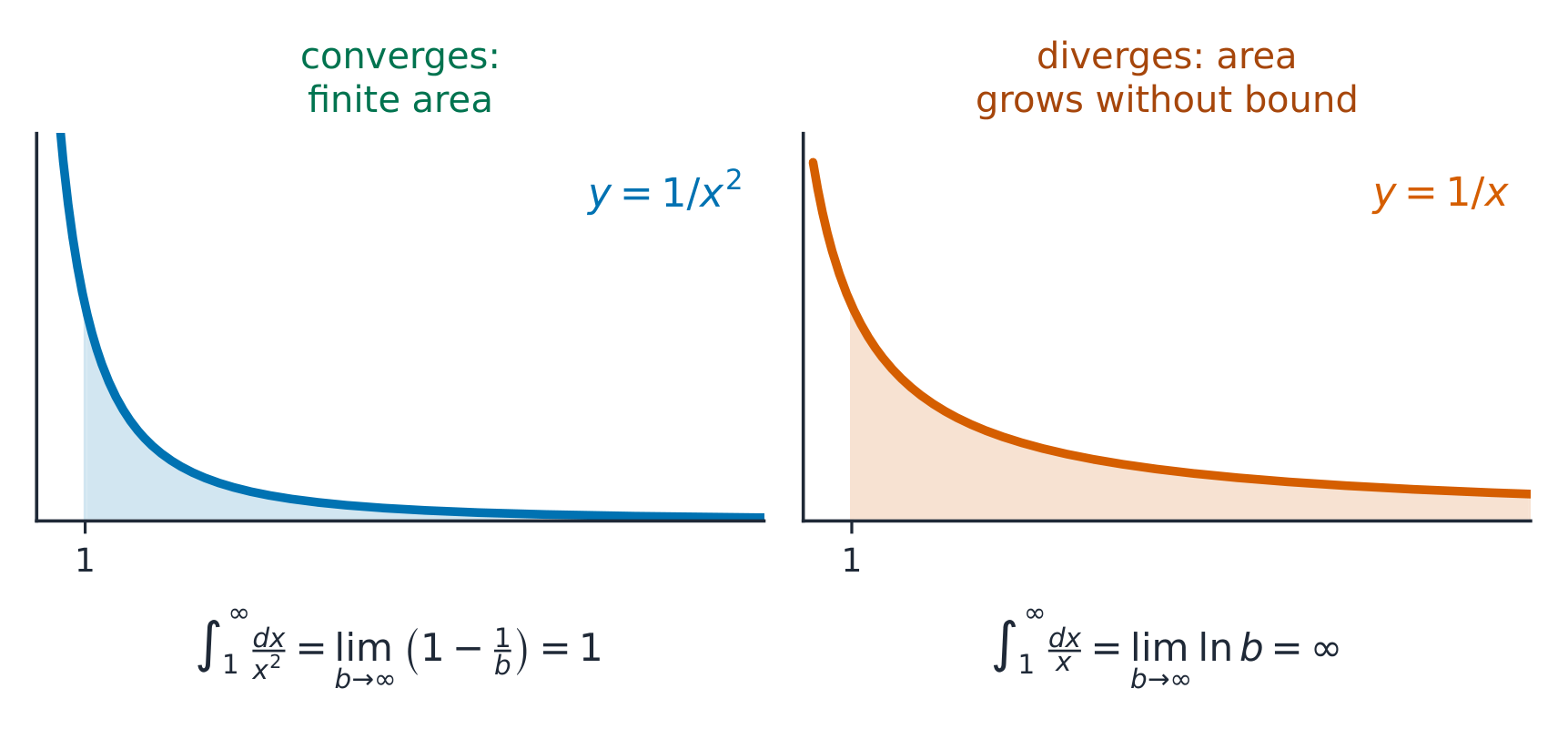
The area under 1/x² out to infinity is finite; under 1/x it is not
A finite area and its improper-integral limit
At the default settings, the displayed area under $1/x^2$ from $1$ até $6$ é $5/6$. The separate improper-integral readout is $1$: it evaluates the limit as the upper bound tends to infinity.
$\displaystyle\int_a^\infty f\,dx$ is defined as...
Dificuldade 1/5 · Moedas 100 + pequeno bônus na primeira conclusão hoje
It is the limit of the proper integral.
Unbounded integrand → a limit at the trouble point
- If $f$ blows up at an endpoint $c$, approach it with a limit instead of evaluating there:
- $\displaystyle\int_a^c f\,dx=\lim_{t\to c^-}\int_a^t f\,dx$ (and similarly from the other side).
- $\int_0^1 \tfrac{1}{\sqrt x}\,dx$ is improper at $0$ — take $\lim_{t\to0^+}\int_t^1$.
- Same principle: sneak up on the singularity with a limit.
Evaluate $\displaystyle\int_1^\infty \dfrac{1}{x^2}\,dx$.
Dificuldade 2/5 · Moedas 140 + pequeno bônus na primeira conclusão hoje
An antiderivative is $-1/x$. Thus $\int_1^b x^{-2}\,dx=[-1/x]_1^b=1-1/b$, and its limit as $b\to\infty$ é $1$.
Converge or diverge
- Converges: the limit is a finite number — that number is the value.
- Diverges: the limit is infinite or does not exist — the integral has no finite value.
- A famous pair: $\int_1^\infty\tfrac{1}{x}\,dx$ diverges, but $\int_1^\infty\tfrac{1}{x^2}\,dx$ converges (to $1$).
- The difference — same-looking integrands, opposite fates — is the whole point.
What happens to $\displaystyle\int_1^\infty \dfrac{1}{x}\,dx$?
Dificuldade 1/5 · Moedas 100 + pequeno bônus na primeira conclusão hoje
$\int_1^b dx/x=[\ln x]_1^b=\ln b-\ln1=\ln b\to\infty$, so the improper integral diverges.
An improper integral ____ if its defining limit is a finite number.
Dificuldade 1/5 · Moedas 100 + pequeno bônus na primeira conclusão hoje
Finite limit → converges.
You cannot treat an improper integral like a normal one — plugging in $\infty$ or a blow-up point is meaningless. Always rewrite it as a limit and evaluate that limit. And spot interior singularities: if the integrand blows up inside $[a,b]$, split the integral at that point and handle each piece separately. Both one-sided integrals must converge; divergent pieces cannot cancel to define the improper integral.
Evaluate $\displaystyle\int_1^\infty \dfrac{1}{x^2}\,dx$.
- Rewrite: $\displaystyle\lim_{b\to\infty}\int_1^b x^{-2}\,dx=\lim_{b\to\infty}\Big[-\tfrac1x\Big]_1^b$.
- $=\displaystyle\lim_{b\to\infty}\Big(-\tfrac1b+1\Big)=0+1=1$.
- The limit is finite, so the integral converges to $1$.
An improper integral has an infinite limit or an unbounded integrand. Rewrite it as a limit of a proper integral: $\int_a^\infty f=\lim_{b\to\infty}\int_a^b f$ (or a limit approaching a singularity). It converges if the limit is finite, and diverges otherwise.