Selecionando Técnicas para Antiderivação
Introduzido| English | Significado |
|---|---|
| antidifferentiation/ˌæntɪˌdɪfəˌrenʃɪˈeɪʃn/ | antiderivação |
Which antiderivative tool fits?
- You now have several ways to integrate — the skill is choosing the right technique fast.
- Antidifferentiation 求原函数 has no single algorithm, so you read the integrand's structure.
- A quick triage points you to a basic rule, a substitution, or an algebraic rewrite.
- This lesson is the decision guide that ties the integration methods together.
Leia o integrando, escolha o método
y = ax³ + bx
Se o integrando é uma potência simples, composta ou fração imprópria determina qual ferramenta de antiderivada usar.
First: does a basic rule fit directly?
- Is the integrand a power, or one of the standard forms ($\sin, \cos, e^x, \tfrac1x$)?
- If so, apply the basic rule and add $+C$ — no tricks needed.
- $\displaystyle\int (x^3+\cos x)\,dx$ is just term-by-term basic antiderivatives.
- Always try this first; it's the fastest path.
Qual é o método mais rápido para $\int (3x^2+e^x)\,dx$?
Dificuldade 1/5 · Moedas 100 + pequeno bônus na primeira conclusão hoje
Ambos os termos são antiderivadas padrão → regras básicas.
Next: is there an inner function with its derivative?
- Spot a composite with its inner derivative present → u-substitution.
- $\displaystyle\int 2x\,e^{x^2}\,dx$: inner $u=x^2$, and $2x\,dx=du$ is right there.
- If $du$ is off by a constant, adjust; if the inner derivative is truly absent, u-sub won't help.
- This handles the large class of chain-rule-shaped integrals.
Qual integral é melhor feita por substituição u?
Dificuldade 1/5 · Moedas 100 + pequeno bônus na primeira conclusão hoje
Uma composta com sua derivada interna ($u=x^2+1$, $du=2x\,dx$) → substituição u.
Selecione todas as sinais corretos de método.
Dificuldade 2/5 · Moedas 140 + pequeno bônus na primeira conclusão hoje
substituição u não é universal — combine o método com a estrutura.
Otherwise: rewrite the algebra first
- No basic rule and no clean substitution? Rewrite the integrand.
- Improper rational fraction → long division; irreducible quadratic denominator → complete the square.
- Expand a product, split a fraction into separate terms, or simplify — then re-triage.
- After the rewrite, a basic rule or u-sub usually finishes it.
O primeiro passo para $\int\dfrac{x^2}{x-1}\,dx$ é...
Dificuldade 1/5 · Moedas 100 + pequeno bônus na primeira conclusão hoje
Grau do numerador ≥ grau do denominador → divida primeiro.
Você pode verificar qualquer antiderivada diferenciando-a novamente para obter o integrando.
Dificuldade 1/5 · Moedas 100 + pequeno bônus na primeira conclusão hoje
Diferenciar sua resposta deve retornar $f$.
Organize as técnicas da primeira à última para tentar.
Dificuldade 3/5 · Moedas 200 + pequeno bônus na primeira conclusão hoje
Regra básica, depois substituição u, depois reescrita.
Don't reach for a heavy technique before checking the easy ones. Try a basic rule first, then u-substitution, and only then an algebraic rewrite. And confirm every antiderivative by differentiating it back to the integrand — that catches most mistakes on the spot.
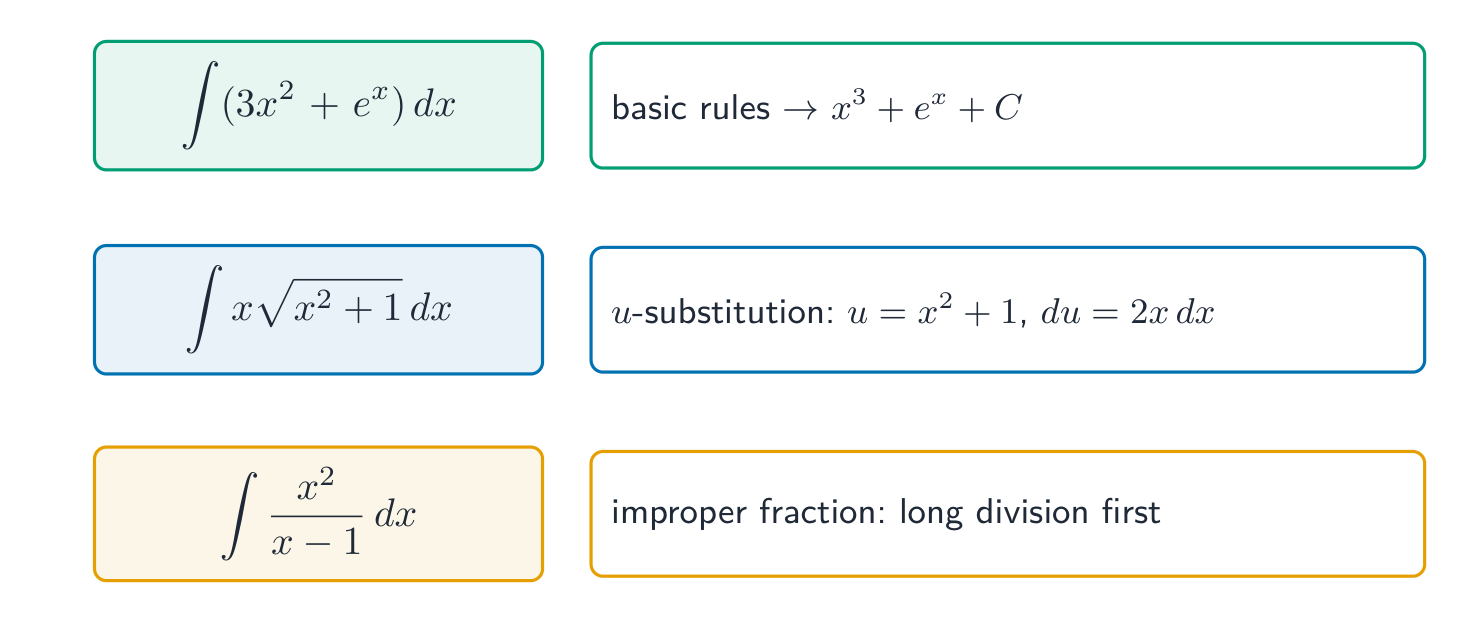
Choose a method for each, then note the first step:
- $\displaystyle\int (3x^2 + e^x)\,dx$: basic rules → $x^3+e^x+C$.
- $\displaystyle\int x\,\sqrt{x^2+1}\,dx$: u-sub ($u=x^2+1$, $du=2x\,dx$).
- $\displaystyle\int \dfrac{x^2}{x-1}\,dx$: long division first (improper fraction).
Selecting an antidifferentiation technique: try a basic rule first; if the integrand is a composite with its inner derivative, use u-substitution; otherwise rewrite the algebra (long division / completing the square / expanding) and re-triage. Always verify by differentiating your answer.