Integrating Functions Using Long Division and Completing the Square
Introduzido| English | Significado |
|---|---|
| completing the square/kəmˈpliːtɪŋ ðə skweə/ | completar o quadrado |
| polynomial long division/ˌpɒlɪˈnəʊmɪəl lɒŋ dɪˈvɪʒn/ | divisão longa de polinômios |
Rewrite first, then integrate
- Some fractions match no basic antiderivative until you rewrite them. Two algebra tools do the reshaping: long division and completing the square.
- Neither is calculus. After the rewrite, a basic rule, a known integral or a $u$-substitution finishes the job.
Long division for "top-heavy" fractions
- If the top's degree is $\ge$ the bottom's, the fraction is improper. Use polynomial long division 多项式长除法 to split it into a polynomial plus a proper remainder.
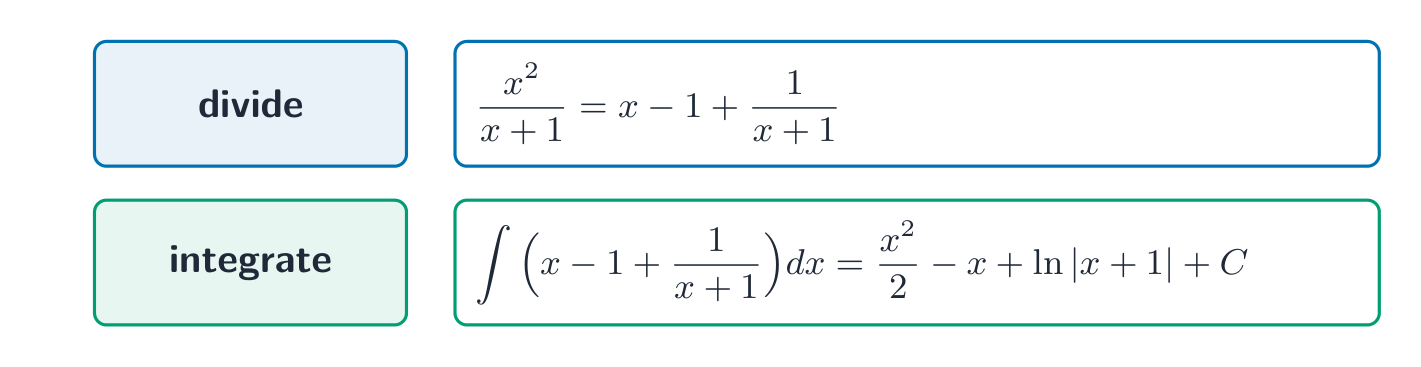
- $\dfrac{x^2}{x+1}=x-1+\dfrac{1}{x+1}$, so $\displaystyle\int\dfrac{x^2}{x+1}\,dx=\dfrac{x^2}{2}-x+\ln|x+1|+C$.
A rational curve to rewrite
y = a / (x − b)
An improper fraction like $\tfrac{x^2}{x+1}$ becomes a line plus a small remainder — each piece integrates easily.
Use polynomial long division when the numerator's degree is...
Dificuldade 1/5 · Moedas 100 + pequeno bônus na primeira conclusão hoje
An improper fraction (top-heavy) calls for division.
Long division gives $\dfrac{x^2}{x+1}=$
Dificuldade 1/5 · Moedas 100 + pequeno bônus na primeira conclusão hoje
$x^2=(x+1)(x-1)+1$, so the quotient is $x-1$ resto $1$.
Completing the square for inverse-trig forms
- A denominator like $x^2+4x+5$ hides a square: complete the square 配方 to get $(x+2)^2+1$. Then $\displaystyle\int\dfrac{dx}{(x+2)^2+1}=\arctan(x+2)+C$.
- When the constant is not $1$, use the arctangent form below. It comes from $u=a\,t$ in $\int\frac{dt}{t^2+1}$.
Completing the square, $x^2+4x+5=$
Dificuldade 1/5 · Moedas 100 + pequeno bônus na primeira conclusão hoje
$(x+2)^2=x^2+4x+4$, so $x^2+4x+5=(x+2)^2+1$.
The form $\dfrac{1}{(x+2)^2+1}$ integrates to an ____ function.
Dificuldade 1/5 · Moedas 100 + pequeno bônus na primeira conclusão hoje
$\int\tfrac{1}{u^2+1}\,du=\arctan u+C$.
Recognize the signal
- Top degree $\ge$ bottom degree: long division first.
- A quadratic bottom with no real roots: complete the square and aim for arctan. If the top is a multiple of the bottom's derivative, use $u$-substitution and $\ln$ instead.
$\displaystyle\int\dfrac{x^2}{x+1}\,dx=$
Dificuldade 1/5 · Moedas 100 + pequeno bônus na primeira conclusão hoje
Divide first, then integrate $x-1+\tfrac1{x+1}$.
Match the signal to the rewrite: select todos true pairings.
Dificuldade 2/5 · Moedas 140 + pequeno bônus na primeira conclusão hoje
Long division is for improper fractions only; both are pre-integration rewrites.
Completing the square with $a\neq1$. Find $\displaystyle\int\frac{dx}{x^2+6x+13}$.
- $x^2+6x+13=(x+3)^2+4=(x+3)^2+2^2$.
- With $u=x+3$ and $a=2$: $\dfrac12\arctan\dfrac{x+3}{2}+C$.
Buscar $\displaystyle\int\frac{dx}{x^2-2x+10}$.
Dificuldade 1/5 · Moedas 100 + pequeno bônus na primeira conclusão hoje
$x^2-2x+10=(x-1)^2+9$, so $u=x-1$, $a=3$: $\tfrac13\arctan\tfrac{x-1}{3}+C$.
Division, then a $u$-substitution. Find $\displaystyle\int\frac{x^3+2x}{x^2+1}\,dx$.
- Divide: $\dfrac{x^3+2x}{x^2+1}=x+\dfrac{x}{x^2+1}$.
- $\int x\,dx=\dfrac{x^2}{2}$. For $\int\dfrac{x}{x^2+1}\,dx$ let $u=x^2+1$, $du=2x\,dx$: $\dfrac12\ln(x^2+1)$. Total: $\dfrac{x^2}{2}+\dfrac12\ln(x^2+1)+C$.
- Divide only when the fraction is improper. Dividing a proper fraction gets you nowhere.
- Keep the constant right when completing the square: $x^2+4x+5=(x+2)^2+1$, not $(x+2)^2+5$.
- Don't forget the $\frac1a$ in front, and the $a$ inside: $\int\frac{dx}{x^2+9}=\frac13\arctan\frac{x}{3}+C$, not $\arctan\frac{x}{3}+C$.
When a fraction fits no basic rule, rewrite it first: polynomial long division for an improper fraction, or complete the square in a quadratic bottom with no real roots to reach $\int\frac{du}{u^2+a^2}=\frac1a\arctan\frac ua+C$. Then finish with a basic antiderivative or $u$-substitution.
Evaluate $\displaystyle\int_0^3\frac{dx}{x^2+9}$. Give 4 decimal places.
Dificuldade 2/5 · Moedas 140 + pequeno bônus na primeira conclusão hoje
$\tfrac13\left[\arctan\tfrac x3\right]_0^3=\tfrac13\cdot\tfrac{\pi}{4}=\tfrac{\pi}{12}\approx0.2618$.