Applying Properties of Definite Integrals
Introduzido| English | Significado |
|---|---|
| linearity/lɪˈnɪərɪti/ | A system is linear if scaling and adding inputs scales and adds the outputs in the same way. |
Rules that make integrals easier
- Definite integrals obey clean algebra — the same friendly rules limits and derivatives have.
- These properties let you split, combine, and rearrange integrals without recomputing areas.
- Most follow directly from "integral = signed area."
- Learn the handful here and hard-looking integrals often simplify in one step.
$\int fg\,dx$ equals $\left(\int f\,dx\right)\left(\int g\,dx\right)$.
Dificuldade 1/5 · Moedas 100 + pequeno bônus na primeira conclusão hoje
There is no product rule for integrals.
Linearity: split sums and pull out constants
- Constant multiple: $\displaystyle\int_a^b k\,f(x)\,dx = k\int_a^b f(x)\,dx$.
- Sum / difference: $\displaystyle\int_a^b \big(f\pm g\big)\,dx = \int_a^b f\,dx \pm \int_a^b g\,dx$.
- Together these are linearity 线性 — integrate term by term, coefficients out front.
- Just like differentiation, you handle a combination one piece at a time.
Given $\int_0^4 f\,dx=10$ e $\int_0^4 g\,dx=3$, find $\int_0^4 (2f-g)\,dx$.
Dificuldade 2/5 · Moedas 140 + pequeno bônus na primeira conclusão hoje
$2(10)-3=17$.
Zero width and swapping limits
- Zero width: $\displaystyle\int_a^a f(x)\,dx = 0$ — no interval, no area.
- Swap the limits: $\displaystyle\int_b^a f(x)\,dx = -\int_a^b f(x)\,dx$ — reversing direction negates it.
- So the order of the limits carries a sign.
- These two keep bookkeeping consistent when limits move around.
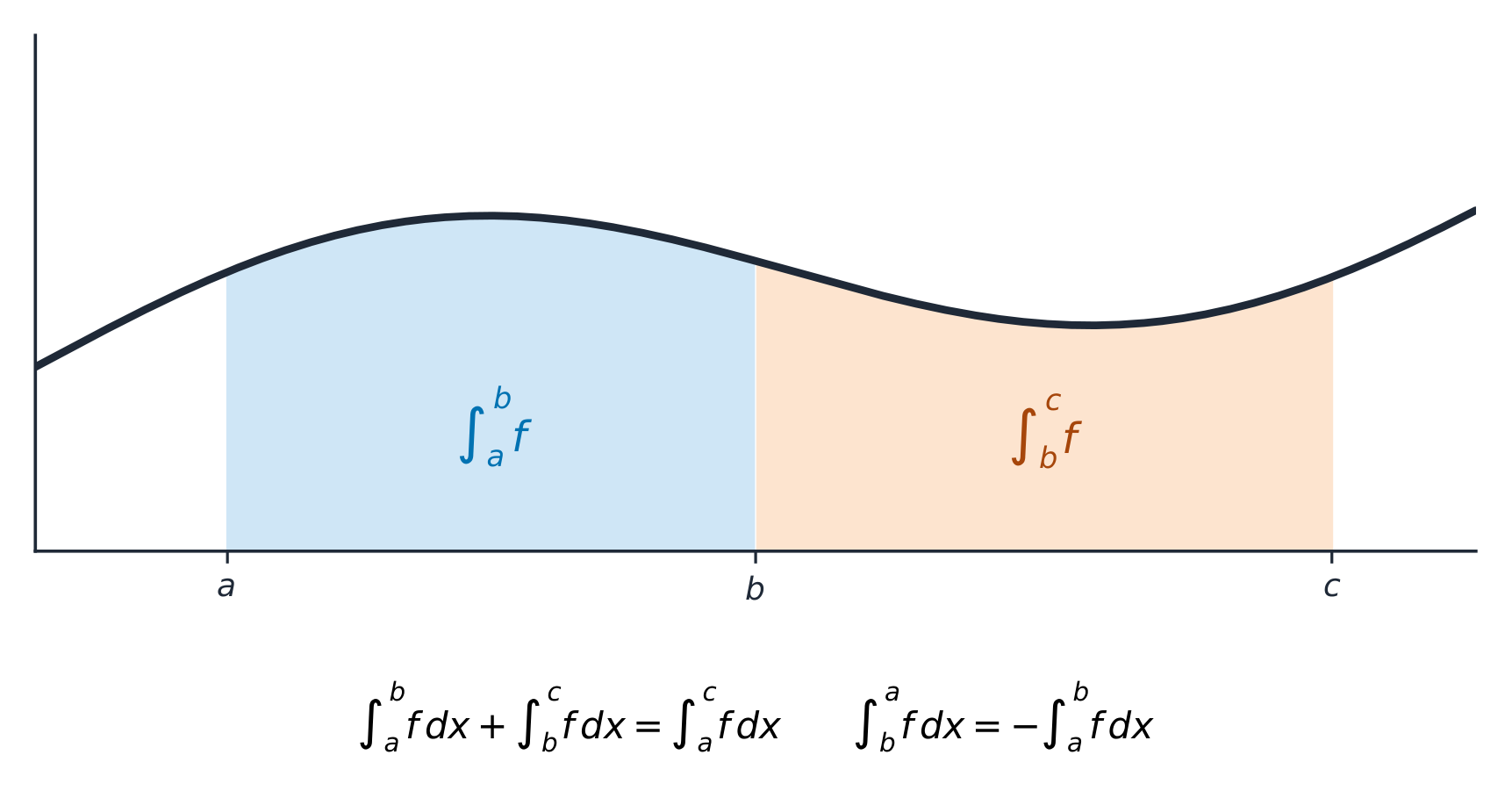
Integrals over adjacent intervals add; reversing the limits changes the sign
What is $\int_5^5 f(x)\,dx$ for any $f$?
Dificuldade 2/5 · Moedas 140 + pequeno bônus na primeira conclusão hoje
Zero width interval → $0$.
If $\int_1^4 f\,dx=7$, then $\int_4^1 f\,dx=$
Dificuldade 1/5 · Moedas 100 + pequeno bônus na primeira conclusão hoje
Swapping limits negates: $-7$.
Select todos valid definite-integral properties.
Dificuldade 2/5 · Moedas 140 + pequeno bônus na primeira conclusão hoje
The first three hold; the product "rule" is false.
Splitting an interval
- Adjacent intervals: $\displaystyle\int_a^c f\,dx = \int_a^b f\,dx + \int_b^c f\,dx$.
- You can break one integral into pieces at any interior point $b$ and add them.
- This is essential for piecewise integrands and for using given sub-areas.
- It also runs backward: combine two adjacent integrals into one.
Split the area at an interior point
y = x²
The area from $a$ até $c$ equals the area from $a$ até $b$ mais $b$ até $c$ — integrals split over adjacent intervals.
If $\int_0^2 f\,dx=5$ e $\int_2^6 f\,dx=8$, find $\int_0^6 f\,dx$.
Dificuldade 2/5 · Moedas 140 + pequeno bônus na primeira conclusão hoje
Adjacent intervals add: $5+8=13$.
There is no "product rule" for integrals: $\int fg\,dx \neq \left(\int f\,dx\right)\left(\int g\,dx\right)$. Linearity only splits across sums and constant multiples, never products or quotients. And remember swapping the limits flips the sign — a very easy point to drop.
Given $\displaystyle\int_0^4 f\,dx=10$ and $\displaystyle\int_0^4 g\,dx=3$, find $\displaystyle\int_0^4\big(2f-g\big)\,dx$.
- Linearity: $\displaystyle\int_0^4 2f\,dx - \int_0^4 g\,dx = 2\int_0^4 f\,dx - \int_0^4 g\,dx$.
- $=2(10)-3=17$.
- No need to know $f$ or $g$ themselves — the properties do it.
Combining several rules. $\displaystyle\int_1^7 f(x)\,dx=12$ and $\displaystyle\int_4^7 f(x)\,dx=5$. Find $\displaystyle\int_4^1\big(3f(x)+2\big)\,dx$.
- Split: $\displaystyle\int_1^4 f\,dx=12-5=7$. Swap the limits: $\displaystyle\int_4^1 f\,dx=-7$.
- The constant: $\displaystyle\int_4^1 2\,dx=2(1-4)=-6$. Total: $3(-7)+(-6)=-27$.
- A constant $k$ integrates to $k(b-a)$: the width times the height, with the sign from the order of the limits.
∫ from 0 to 5 of g(x) dx = 8 and ∫ from 2 to 5 of g(x) dx = 3. Find ∫ from 2 to 0 of (4g(x) − 1) dx.
Dificuldade 2/5 · Moedas 140 + pequeno bônus na primeira conclusão hoje
∫₀² g = 8 − 3 = 5, so ∫ from 2 to 0 of g = −5. ∫ from 2 to 0 of 1 dx = −2. Total: 4(−5) − (−2) = −18.
$\displaystyle\int_1^4 f(x)\,dx=10$. Find $\displaystyle\int_4^1 f(x)\,dx$ e $\displaystyle\int_2^2 f(x)\,dx$.
Direction of the limits carries the sign.
$\displaystyle\int_1^4 f(x)\,dx=10$. What is $\displaystyle\int_4^1 f(x)\,dx$?
Dificuldade 1/5 · Moedas 100 + pequeno bônus na primeira conclusão hoje
Swapping the limits negates the value.
Using symmetry
- An even function has $f(-x)=f(x)$, so $\displaystyle\int_{-a}^{a}f\,dx=2\int_0^a f\,dx$. An odd function has $f(-x)=-f(x)$, so $\displaystyle\int_{-a}^{a}f\,dx=0$.
- Example: $\displaystyle\int_{-2}^{2}(x^3+5x)\,dx=0$ at once, since $x^3+5x$ is odd. The areas on the two sides cancel.
Use symmetry to find ∫ from −3 to 3 of (x⁵ − 2x + 4) dx.
Dificuldade 2/5 · Moedas 140 + pequeno bônus na primeira conclusão hoje
x⁵ − 2x is odd, so its integral is 0. The constant 4 gives 4 × 6 = 24.
Definite-integral properties: linearity ($\int kf = k\int f$; $\int (f\pm g)=\int f\pm\int g$), zero width ($\int_a^a f=0$), swapping limits negates ($\int_b^a f=-\int_a^b f$), and splitting ($\int_a^c=\int_a^b+\int_b^c$). There is no product rule for integrals.