Determining Limits Using Algebraic Properties of Limits
Introduzido| English | Significado |
|---|---|
| limit laws/ˈlɪmɪt lɔːz/ | leis dos limites |
| direct substitution/daɪˈrekt ˌsʌbstɪˈtjuːʃn/ | substituição direta |
| polynomial/ˌpɒlɪˈnəʊmɪəl/ | polinômio |
| rational/ˈræʃənl/ | racional |
| indeterminate form/ˌɪndɪˈtɜːmɪnət fɔːm/ | forma indeterminada |
Limits obey friendly algebra
- Once you know the limits of two functions, you can combine them like ordinary numbers.
- Whatever $f$ and $g$ head toward, their sum heads toward the sum of those targets.
- The same works for differences, products, and (carefully) quotients.
- These are the limit laws 极限法则 — they let you break a messy limit into simple pieces.
The limit laws, in one place
- Suppose $\displaystyle\lim_{x\to c} f(x)=L$ and $\displaystyle\lim_{x\to c} g(x)=M$. Then:
- Sum / difference: $\lim (f\pm g) = L\pm M$.
- Product: $\lim (f\cdot g) = L\cdot M$; constant multiple: $\lim (k f)=kL$.
- Quotient: $\displaystyle\lim \frac{f}{g}=\frac{L}{M}$, provided $M\neq 0$.
Given $\lim f = 6$ e $\lim g = 3$, find $\lim \dfrac{f}{g}$.
Dificuldade 2/5 · Moedas 140 + pequeno bônus na primeira conclusão hoje
Quotient law (denominator limit $3\neq0$): $\frac{6}{3}=2$.
The quotient law $\lim\frac fg=\frac LM$ requires that $M$, the denominator's limit, is not ____.
Dificuldade 1/5 · Moedas 100 + pequeno bônus na primeira conclusão hoje
If $M=0$ the law does not apply directly — you may have an indeterminate form.
Direct substitution: the fast lane
- For a polynomial 多项式, or a rational 有理 function with nonzero denominator at $c$, the shortcut is to plug $c$ in.
- $\displaystyle\lim_{x\to 3}(x^2-2x+1) = 3^2-2(3)+1 = 4$ — no table, no graph.
- Direct substitution 直接代入 works whenever the function is defined and continuous at $c$.
- This is always the first thing to try — it is fastest when it works.
Um polinómio não tem surpresas
y = ax² + bx + c
Polynomials are smooth everywhere — drag the coefficients and see why plugging in $c$ (direct substitution) simply reads off the height.
Evaluate $\displaystyle\lim_{x\to 2}(3x^2 - x + 4)$.
Dificuldade 2/5 · Moedas 140 + pequeno bônus na primeira conclusão hoje
Direct substitution: $3(4)-2+4 = 14$.
For which limits does direct substitution give the answer immediately?
Dificuldade 2/5 · Moedas 140 + pequeno bônus na primeira conclusão hoje
The third gives $\tfrac00$ (denominator limit $0$) so substitution stalls; the others give a finite value straight away.
When substitution stalls
- Plug in and you might hit $\dfrac{0}{0}$: an indeterminate form 不定式.
- Indeterminate does not mean the limit fails — it means substitution alone can't decide, and more work is needed (next lesson).
- Beware the quotient law's fine print: it needs $M\neq0$. If the denominator's limit is $0$, the law does not apply directly.
- So: try substitution first; if it gives a real number, you are done; if it gives $\tfrac00$, switch strategies.
Direct substitution gives $\tfrac00$. This means...
Dificuldade 1/5 · Moedas 100 + pequeno bônus na primeira conclusão hoje
$\tfrac00$ is indeterminate: a cue to do algebra, not a final answer.
When you meet a new limit, direct substitution is the sensible first thing to try.
Dificuldade 1/5 · Moedas 100 + pequeno bônus na primeira conclusão hoje
It is fastest when continuity justifies it. An indeterminate form needs more work; a nonzero numerator over a zero denominator instead needs one-sided sign analysis.
$\dfrac{0}{0}$ is indeterminate, not "zero" and not "undefined-so-DNE." It is a signal that the limit is hiding and you must simplify first. Do not report $\tfrac00$ as an answer, and do not conclude the limit does not exist — $\lim_{x\to2}\frac{x^2-4}{x-2}$ is $\tfrac00$ on substitution yet equals $4$.
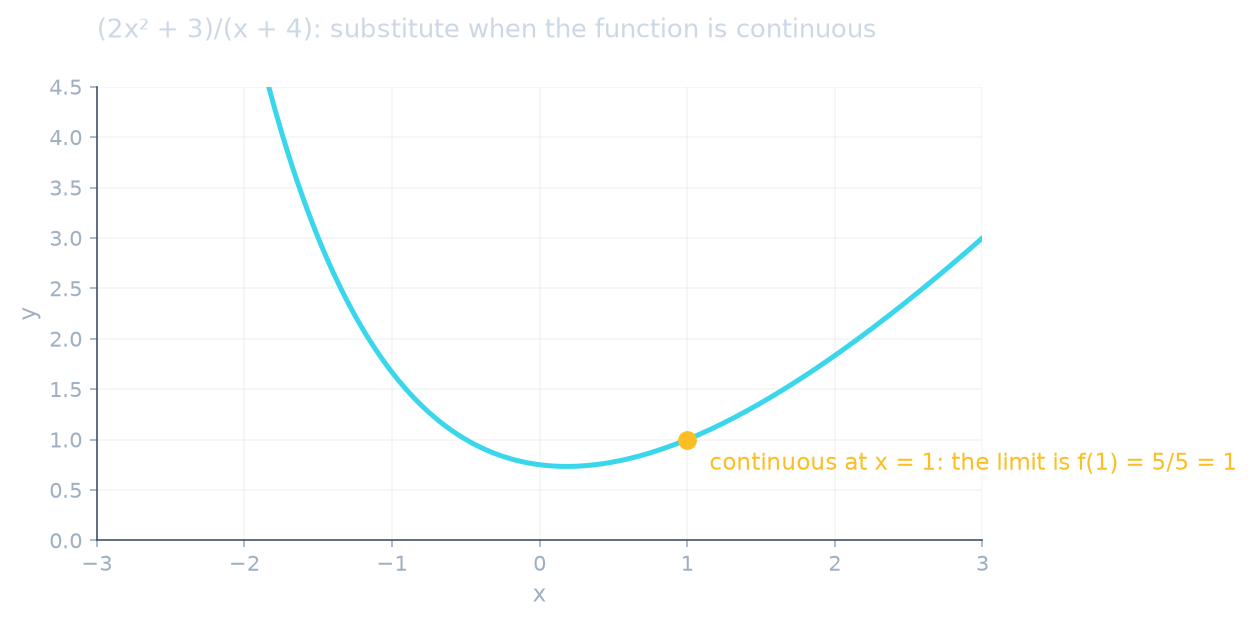
Find $\displaystyle\lim_{x\to 1}\dfrac{2x^2+3}{x+4}$.
- Numerator limit: $2(1)^2+3 = 5$. Denominator limit: $1+4 = 5$.
- The denominator's limit is $5\neq 0$, so the quotient law applies.
- $\displaystyle\lim_{x\to 1}\dfrac{2x^2+3}{x+4} = \dfrac{5}{5} = 1$ by direct substitution.
The limit laws let you split a limit across sums, differences, products, and quotients (quotient needs a non-zero denominator limit). For polynomials and rationals this collapses to direct substitution — always try it first. A result of $\tfrac00$ is an indeterminate form: not an answer, but a cue to simplify.
Write from this case
- f(x) = 2x + 1, a polynomial.
- The input approaches 4.
A favor $f(x)=2x+1$ as $x$ approaches 4, what is the limit, and what would a 0/0 substitution mean instead?
Polynomials are safe to substitute.
The limit of 2x + 1 as x approaches 4 is what?
Dificuldade 1/5 · Moedas 100 + pequeno bônus na primeira conclusão hoje
Polynomials are continuous; substitute $x=4$ to get $2(4)+1=8+1=9$.