Rectification and smoothing · Retificação e suavização
| English | Português |
|---|---|
| diodes/ˈdaɪəʊdz/ | diodos |
| capacitor/kəˈpæsɪtə/ | capacitor |
| rectification/ˌrektɪfɪˈkeɪʃn/ | retificação |
| smoothing/ˈsmuːðɪŋ/ | suavização |
| ripple/ˈrɪpl/ | ondulação |
| forward-biased/ˈfɔːwəd ˈbaɪəst/ | polarizado direto |
| reverse-biased/rɪˈvɜːs ˈbaɪəst/ | polarizado reverso |
| bridge rectifier/brɪdʒ ˈrektɪfaɪə/ | retificador de ponte |
Inside a phone charger
- A phone charger takes mains alternating voltage that reverses fifty times a second, and hands the phone a steady $5\ \text{V}$.
- Between those two things sit exactly the components of this lesson: diodes 二极管 to stop the reversing, and a capacitor 电容器 to iron out what is left.
- Rectification 整流 is the conversion of an alternating current into a direct (one-direction) current. That is the marked definition.
- Smoothing 平滑 is then using a capacitor across the load to reduce the ripple of a rectified output.
Dentro de um carregador de celular
- Um carregador de celular pega tensão alternada da rede que inverte cinquenta vezes por segundo, e entrega ao celular uma tensão contínua estável de $5\ \text{V}$.
- Entre essas duas coisas estão exatamente os componentes desta lição: diodos 二极管 para parar a inversão, e um capacitor 电容器 para alisar o que restar.
- Retificação 整流 é a conversão de uma corrente alternada em uma corrente contínua (numa direção). Essa é a definição marcada.
- Suavização 平滑 é então usar um capacitor em paralelo com a carga para reduzir a ondulação de uma saída retificada.
What a diode does
- A diode conducts only when it is forward-biased 正向偏置: its anode, the flat end of the symbol's triangle, is more positive than its cathode, the bar.
- Otherwise it is reverse-biased 反向偏置 and behaves like an open switch.
- Treat it as ideal: zero resistance one way, infinite the other.
- Conventional current always flows through a diode in the direction the triangle points. Every "complete the circuit" question is that one rule, applied to each diode in turn.
O que um diodo faz
- Um diodo conduz apenas quando está polarizado diretamente 正向偏置: seu ânodo, a extremidade plana do triângulo do símbolo, é mais positivo que seu cátodo, a barra.
- Caso contrário, ele está polarizado reversamente 反向偏置 e se comporta como uma chave aberta.
- Trate-o como ideal: resistência zero num sentido, infinita no outro.
- A corrente convencional sempre flui através de um diodo na direção para a qual o triângulo aponta. Cada questão "complete o circuito" é essa única regra, aplicada a cada diodo sucessivamente.
A diode conducts current: · Um diodo conduz corrente:
This one-way behaviour is what lets diodes rectify a.c. into d.c. · Esse comportamento unidirecional é o que permite aos diodos retificar c.a. em c.c.
Match each term to the definition the examiner marks. · Combine cada termo com a definição que o avaliador marca.
Rectified current still varies; what makes it direct is that it never reverses. · A corrente retificada ainda varia; o que a torna contínua é o fato de nunca inverter.
Half-wave rectification
- A single diode in series with the load passes only the positive half of each cycle. In the negative half it is reverse-biased and no current flows at all.
- The output is positive half-waves separated by flat zero gaps of equal length. Mean output $= V_0/\pi \approx 0.32\,V_0$.
- Half the input is thrown away, and the output is very uneven.
Humps, then nothing, then humps
Retificação meia-onda
- Um diodo único em série com a carga passa apenas a meia-onda positiva de cada ciclo. Na meia-onda negativa, ele está polarizado reversamente e nenhuma corrente flui.
- A saída são ondas positivas separadas por vazios planos de zero de comprimento igual. Saída média $= V_0/\pi \approx 0.32\,V_0$.
- Metade da entrada é descartada, e a saída é muito irregular.

Sobres, depois nada, depois sobres
Half-wave rectification uses ____ diode. · A retificação de meia-onda usa ____ diodo.
A single diode passes the positive half-cycles and blocks the negative ones (leaving gaps). · Um único diodo deixa passar os semiciclos positivos e bloqueia os negativos (deixando lacunas).
Drawing the half-wave circuit
- Source, one diode in series, load, and $V_{\text{OUT}}$ taken across the load. The triangle points the way the output current must flow.
- If a smoothing capacitor is wanted it goes in parallel with the load, never in series. A capacitor in series would block the d.c. altogether, which is the opposite of the point.
One diode in the line, one capacitor across the load
Desenhando o circuito meia-onda
- Fonte, um diodo em série, carga, e $V_{\text{OUT}}$ retirado sobre a carga. O triângulo aponta o caminho pelo qual a corrente de saída deve fluir.
- Se um capacitor de suavização for desejado, ele vai em paralelo com a carga, nunca em série. Um capacitor em série bloquearia a d.c. inteiramente, que é o oposto do objetivo.
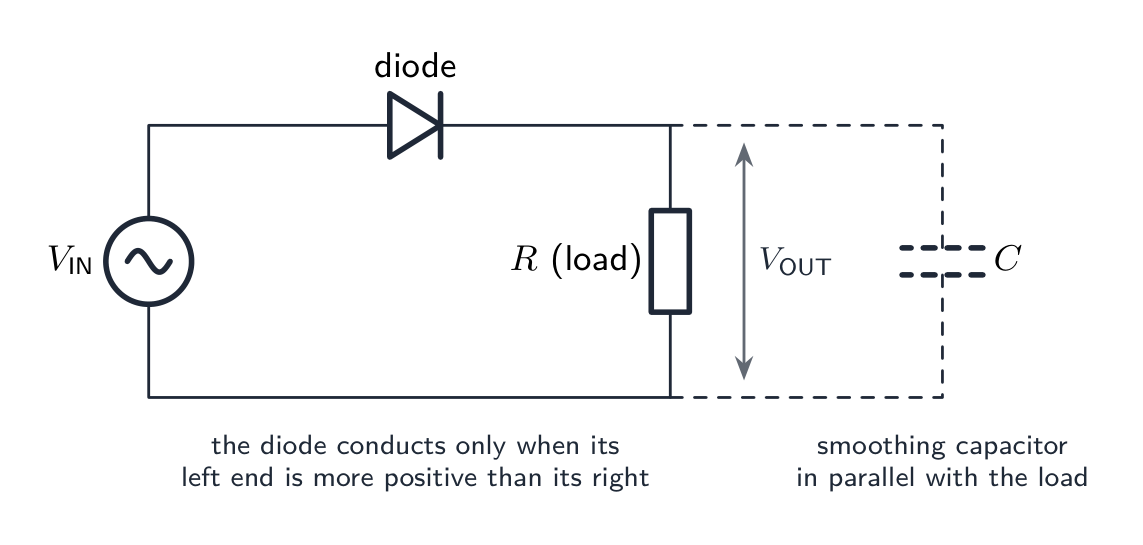
Um diodo na linha, um capacitor sobre a carga
Where does a smoothing capacitor go? · Onde deve ficar um capacitor de suavização?
It must discharge THROUGH the load between peaks, which needs it in parallel. In series it would block the d.c. entirely, which is the opposite of the point. · Ele deve descarregar ATRAVÉS da carga entre os picos, o que exige conexão em paralelo. Em série, ele bloquearia totalmente a c.c., o oposto do objetivo.
Full-wave rectification
- A bridge rectifier 桥式整流器 uses four diodes so that the load current runs the same way whichever input terminal is positive.
- The output is a continuous run of positive humps with no gaps, at twice the input frequency. Mean output $= 2V_0/\pi \approx 0.64\,V_0$, double the half-wave value.
- All of the input is used, and what remains is far easier to smooth.
No gaps, and twice as often
Retificação onda completa
- Um retificador de ponte 桥式整流器 usa quatro diodos para que a corrente da carga flua no mesmo sentido independentemente de qual terminal de entrada seja positivo.
- A saída é uma sequência contínua de sobres positivos sem vazios, em dobro da frequência de entrada. Saída média $= 2V_0/\pi \approx 0.64\,V_0$, dobro do valor da meia-onda.
- Toda a entrada é usada, e o que resta é muito mais fácil de suavizar.

Sem vazios, e duas vezes mais frequente
Rectifier and smoothing route · Caminho do retificador e suavização
Watch alternating input become a smoother direct output. · Observe a entrada alternada se transformando em uma saída contínua mais suave.
How many diodes are in a bridge (full-wave) rectifier? · Quantos diodos há em um retificador de ponte (onda completa)?
Four diodes, arranged so the load current always flows the same way whichever input terminal is positive. · Quatro diodos, dispostos de modo que a corrente na carga flua sempre no mesmo sentido, independentemente de qual terminal de entrada esteja positivo.
A full-wave rectified output repeats at twice the frequency of the a.c. input. · Uma saída retificada de onda completa repete-se com o dobro da frequência da entrada c.a.
Both half-cycles become positive humps, so the output ripples at double the input frequency. · Ambos os semiciclos tornam-se protuberâncias positivas, então a ondulação da saída ocorre com o dobro da frequência de entrada.
Worked example: explaining the bridge
- Explain how the four diodes produce full-wave rectification. This is the standard four-marker, and it is marked on naming the diodes.
- When terminal P is positive: current leaves P, passes through the diode pointing away from P to the top of the load, flows down through the load, and returns to Q through the diode pointing towards Q. The other two are reverse-biased and carry nothing.
- When Q is positive: the other pair conducts, but they are arranged so the current still enters the load at the top.
- So the current in the load is in the same direction in both half-cycles. Say which pair conducts in each half-cycle and which end of the load is positive.
Two diodes at a time, one direction through the load
Exemplo resolvido: explicando a ponte
- Explique como os quatro diodos produzem a retificação onda completa. Esta é a questão padrão de quatro marcas, e é avaliada pelo nomeamento dos diodos.
- Quando o terminal P é positivo: a corrente sai de P, passa pelo diodo apontando longe de P para o topo da carga, flui para baixo através da carga, e retorna a Q através do diodo apontando para Q. Os outros dois estão polarizados reversamente e não conduzem.
- Quando Q é positivo: o outro par conduz, mas eles estão dispostos de forma que a corrente ainda entra na carga pelo topo.
- Então a corrente na carga está na mesma direção em ambos os meios-ciclos. Diga qual par conduz em cada meio-ciclo e qual extremo da carga é positivo.

Dois diodos de cada vez, uma direção através da carga
Put the explanation of one half-cycle of a bridge rectifier in order. · Organize a explicação de um semiciclo de um retificador de ponte em ordem.
The four-mark answer is marked on naming the conducting pair in each half-cycle, not on saying the current "goes the same way". · A resposta de quatro pontos é avaliada pelo nomeamento do par condutor em cada semiciclo, não por dizer que a corrente "vai no mesmo sentido".
Completing a bridge
- Given a bridge with diodes missing, use one rule: both diodes joined to the positive output terminal point towards it, and both joined to the negative output terminal point away from it.
- A single diode the wrong way round either short-circuits the supply on one half-cycle or passes nothing at all.
- Check your answer by tracing one half-cycle right round the loop before you move on.
Completando a ponte
- Dado um retificador com diodos faltantes, use uma regra: ambos os diodos ligados ao terminal de saída positivo apontam para ele, e ambos ligados ao terminal de saída negativo apontam para longe dele.
- Um único diodo na direção errada要么 curto-circuitar a fonte em um meio-ciclo ou não passar nada.
- Verifique sua resposta rastreando um meio-ciclo inteiro ao redor do laço antes de prosseguir.
In a bridge rectifier, both diodes joined to the positive output terminal point towards it. · Em um retificador de ponte, ambos os diodos conectados ao terminal positivo de saída apontam para ele.
And both joined to the negative terminal point away from it. One diode reversed either short-circuits the supply on a half-cycle or passes nothing. · E ambos conectados ao terminal negativo apontam para longe dele. Inverter um diodo causa curto-circuito na fonte em um semiciclo ou impede qualquer passagem.
Smoothing with a capacitor
- Put a capacitor $C$ in parallel with the load $R$. On the rising part of each pulse it charges up to near the peak.
- On the falling part, and through any gap, the diodes are reverse-biased, so the capacitor discharges through the load and keeps the current flowing. That decay has time constant $RC$.
- At the next peak it charges again. The output now sits near the peak with small dips, and the size of the dips is the ripple 纹波.
Never down to zero, never above the peak
Suavização com um capacitor
- Coloque um capacitor $C$ em paralelo com a carga $R$. Na parte ascendente de cada pulso, ele carrega até próximo ao pico.
- Na parte descendente, e através de qualquer lacuna, os diodos estão polarizados reversamente, então o capacitor se descarrega pela carga e mantém a corrente fluindo. Essa decadência tem constante de tempo $RC$.
- No próximo pico, ele carrega novamente. A saída agora fica próxima ao pico com pequenas quedas, e o tamanho dessas quedas é a ondulação 纹波.

Nunca até zero, nunca acima do pico
To smooth a rectified output, you connect a capacitor: · Para suavizar uma saída retificada, você conecta um capacitor:
In parallel, it charges to the peak and then discharges through the load between peaks, holding the voltage up. · Em paralelo, ele carrega até o pico e depois descarrega através da carga entre os picos, mantendo a tensão elevada.
Worked example: how big is the ripple
- A half-wave rectifier fed from a $50\ \text{Hz}$ supply has a $470\ \mu\text{F}$ capacitor across a $1.2\ \text{k}\Omega$ load. Estimate the fractional fall between peaks, and say what a bridge would change.
- Half-wave gives one peak per cycle, so the peaks are $T = 1/50 = 20\ \text{ms}$ apart.
- Time constant: $RC = (1.2\times10^3)(470\times10^{-6}) = 0.56\ \text{s}$.
- Discharge: $V = V_0 e^{-t/RC} = V_0 e^{-0.020/0.56} = 0.965\,V_0$, a fall of about $3.5\%$.
- With a bridge the peaks are only $10\ \text{ms}$ apart, so the fall halves to about $1.8\%$. Because $t \ll RC$, the ripple is roughly $V_0 t/(RC)$: proportional to the time between peaks, and inversely proportional to both $R$ and $C$.
Exemplo resolvido: quão grande é a ondulação
- Um retificador de meia-onda alimentado por uma fonte $50\ \text{Hz}$ tem um capacitor $470\ \mu\text{F}$ em paralelo com uma carga $1.2\ \text{k}\Omega$. Estime a queda fracionária entre os picos e diga o que uma ponte alteraria.
- Meia-onda fornece um pico por ciclo, então os picos estão $T = 1/50 = 20\ \text{ms}$ separados.
- Constante de tempo: $RC = (1.2\times10^3)(470\times10^{-6}) = 0.56\ \text{s}$.
- Descarga: $V = V_0 e^{-t/RC} = V_0 e^{-0.020/0.56} = 0.965\,V_0$, uma queda de cerca de $3.5\%$.
- Com uma ponte, os picos estão apenas $10\ \text{ms}$ separados, então a queda se divide ao meio para cerca de $1.8\%$. Como $t \ll RC$, a ondulação é aproximadamente $V_0 t/(RC)$: proporcional ao tempo entre os picos, e inversamente proporcional tanto a $R$ quanto a $C$.
A full-wave rectifier from a 50 Hz supply feeds a 1.2 kilo-ohm load with a 470 microfarad capacitor. How many milliseconds pass between output peaks? · Um retificador de onda completa alimentado por uma fonte de 50 Hz alimenta uma carga de 1.2 quilo-ohm com um capacitor de 470 microfarad. Quantos milissegundos se passam entre os picos de saída?
Full-wave output runs at twice the input frequency, so 100 peaks per second and 10 ms between them. Half-wave would give 20 ms and about twice the ripple. · A saída de onda completa opera com o dobro da frequência de entrada, ou seja, 100 picos por segundo e 10 ms entre eles. A meia-onda daria 20 ms e cerca do dobro da ondulação.
The mean output of a half-wave rectifier is $V_0$ divided by ____. · A média de saída de um retificador de meia-onda é $V_0$ dividida por ____.
Half-wave gives 0.32 V0; a bridge uses both halves and doubles it to 2V0/pi = 0.64 V0. The bridge also doubles the ripple frequency, which is why the same capacitor smooths it better. · O meio ciclo fornece 0.32 V0; uma ponte utiliza ambos os meios ciclos e o duplica para 2V0/pi = 0.64 V0. A ponte também duplica a frequência da ondulação, razão pela qual o mesmo capacitor a suaviza melhor.
What reduces the ripple, and how to sketch it
- Larger $C$: more stored charge, so a smaller dip between peaks.
- Larger $R$: a smaller load current, so a slower discharge. Note this is the load resistance, so a heavier load (smaller $R$) makes the ripple worse.
- Full-wave instead of half-wave: less time to discharge between peaks.
- To sketch it: draw the humps faintly, then a curve that touches each peak, sags gently, and turns sharply up where the next hump meets it. It never reaches zero and never rises above the peak.
Bigger $RC$ hugs the peak line
O que reduz a ondulação e como esboçá-la
- Maior $C$: mais carga armazenada, logo uma menor queda entre os picos.
- Maior $R$: uma menor corrente na carga, logo uma descarga mais lenta. Note que este é a resistência da carga, então uma carga mais pesada (menor $R$) torna a ondulação pior.
- Onda completa em vez de meia-onda: menos tempo para descargar entre os picos.
- Para esboçar: desenhe as protuberâncias levemente, depois uma curva que toca cada pico, afunda suavemente e vira abruptamente para cima onde a próxima protuberância encontra. Nunca atinge zero e nunca sobe acima do pico.
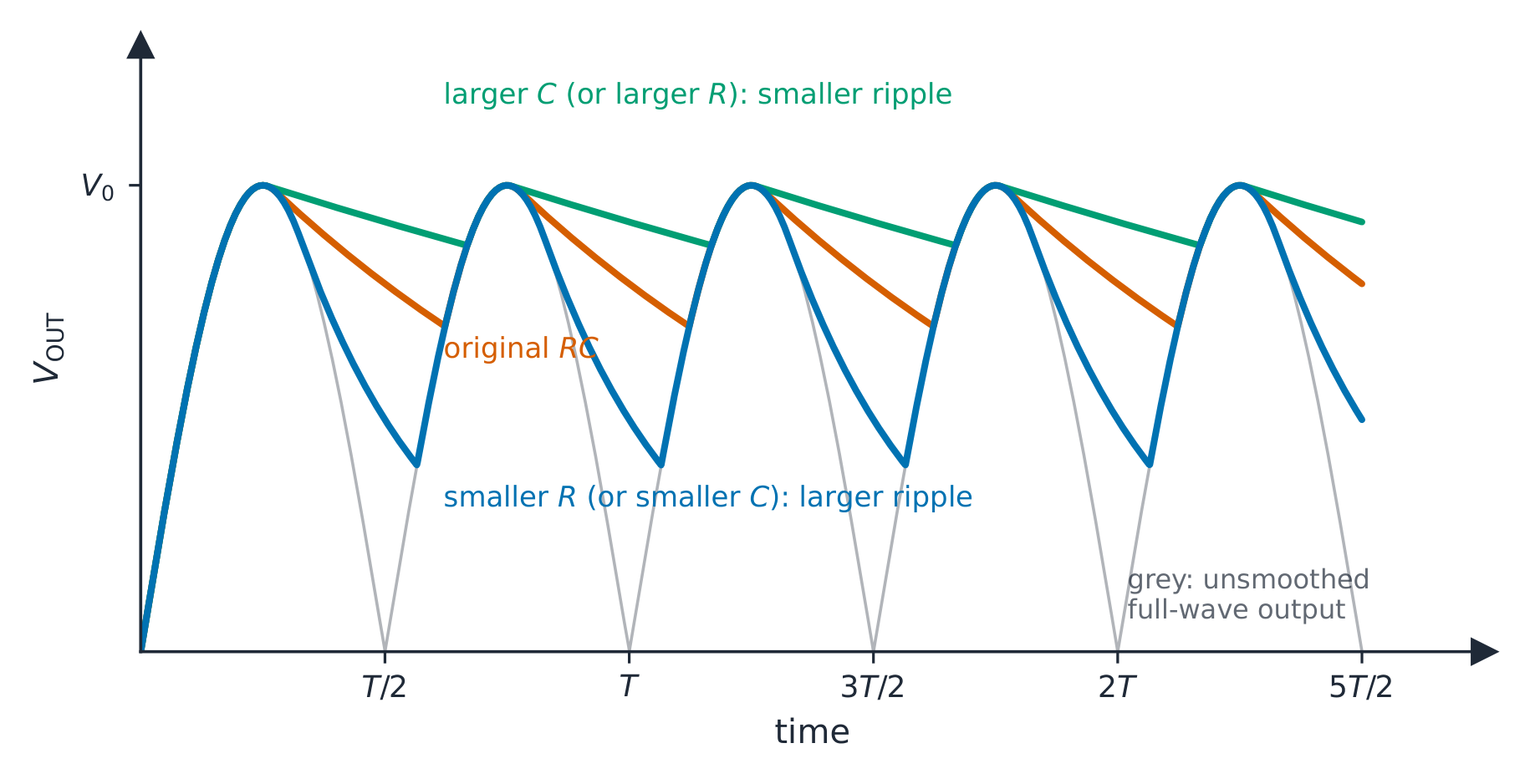
Maior $RC$ abraça a linha do pico
Select all · todos the changes that reduce the ripple. · Selecione todas as alterações que reduzem a ondulação.
A bigger $RC$ (or less time between peaks) makes the capacitor discharge less between peaks — smaller ripple. A smaller capacitor does the opposite. · Um $RC$ maior (ou menos tempo entre picos) faz o capacitor descarregar menos entre os picos — menor ondulação. Um capacitor menor faz o oposto.
Marks that slip away
- The smoothing capacitor goes across the load, in parallel. In series it blocks the d.c. entirely.
- In the bridge explanation, name which pair of diodes conducts in each half-cycle. "The current goes the same way" alone is one mark of four.
- Full-wave output is at twice the input frequency, not the same frequency.
- A smaller load resistance means a larger ripple, because the capacitor discharges faster.
- Half-wave has flat zero gaps; full-wave has none. Draw the gaps the same width as the humps.
Marcas que escapam
- O capacitor de suavização vai em paralelo com a carga, em paralelo. Em série, ele bloqueia totalmente a c.c.
- Na explicação da ponte, nomeie qual par de diodos conduz em cada semiciclo. "A corrente vai no mesmo sentido" sozinho vale apenas uma marca de quatro.
- A saída de onda completa está em dobro da frequência de entrada, não na mesma frequência.
- Uma resistência de carga menor significa uma ondulação maior, porque o capacitor se descarrega mais rápido.
- Meia-onda tem lacunas planas de zero; onda completa não tem. Desenhe as lacunas com a mesma largura das protuberâncias.
You've got it
- rectification converts alternating current into current in one direction; a diode conducts only when forward-biased, in the direction its triangle points
- half-wave uses one diode and passes half of each cycle, mean $V_0/\pi$; a bridge of four diodes passes both halves, mean $2V_0/\pi$, at twice the frequency
- a capacitor in parallel with the load smooths by discharging through the load between peaks, with time constant $RC$
- the ripple shrinks with larger $C$, larger load resistance, and full-wave rather than half-wave rectification
Entendeu?
- retificação converte corrente alternada em corrente em uma direção; um diodo conduz apenas quando está polarizado diretamente, na direção para onde seu triângulo aponta
- meia-onda usa um diodo e passa metade de cada ciclo, média $V_0/\pi$; uma ponte de quatro diodos passa ambas as metades, média $2V_0/\pi$, em dobro da frequência
- um capacitor em paralelo com a carga suaviza descarregando pela carga entre os picos, com constante de tempo $RC$
- a ondulação diminui com maior $C$, maior resistência da carga e onda completa em vez de retificação de meia-onda