Magnetic fields due to currents · Campos magnéticos devidos a correntes
| English | Português |
|---|---|
| iron core/ˈaɪən kɔː/ | núcleo de ferro |
| right-hand grip rule/raɪt hænd ɡrɪp ruːl/ | regra da mão direita para enrolamento |
| bar magnet/bɑː ˈmæɡnɪt/ | ímã em barra |
| solenoid/ˈsəʊlənɔɪd/ | solenoide |
A magnet with an off switch
- A scrapyard crane picks up a tonne of steel, swings it across the yard, and drops it by flicking a switch.
- No permanent magnet can do that. What the crane carries is a coil of wire around an iron core, and its magnetism exists only while the current flows.
- Every field in this lesson comes from a current, which means every one of them can be switched, reversed or made stronger at will.
- This lesson is the field patterns that currents produce, and the forces between two currents.
Um ímã com interruptor
- Uma guindaste de sucata levanta uma tonelada de aço, oscila-o pelo pátio e solta-o piscando um interruptor.
- Nenhum ímã permanente pode fazer isso. O que o guindaste carrega é uma bobina de fio ao redor de um núcleo de ferro, e seu magnetismo existe apenas enquanto a corrente flui.
- Todo campo nesta aula vem de uma corrente, o que significa que todos eles podem ser ligados, invertidos ou tornados mais fortes à vontade.
- Esta aula trata dos padrões de campo que correntes produzem, e das forças entre duas correntes.
The field around a straight wire
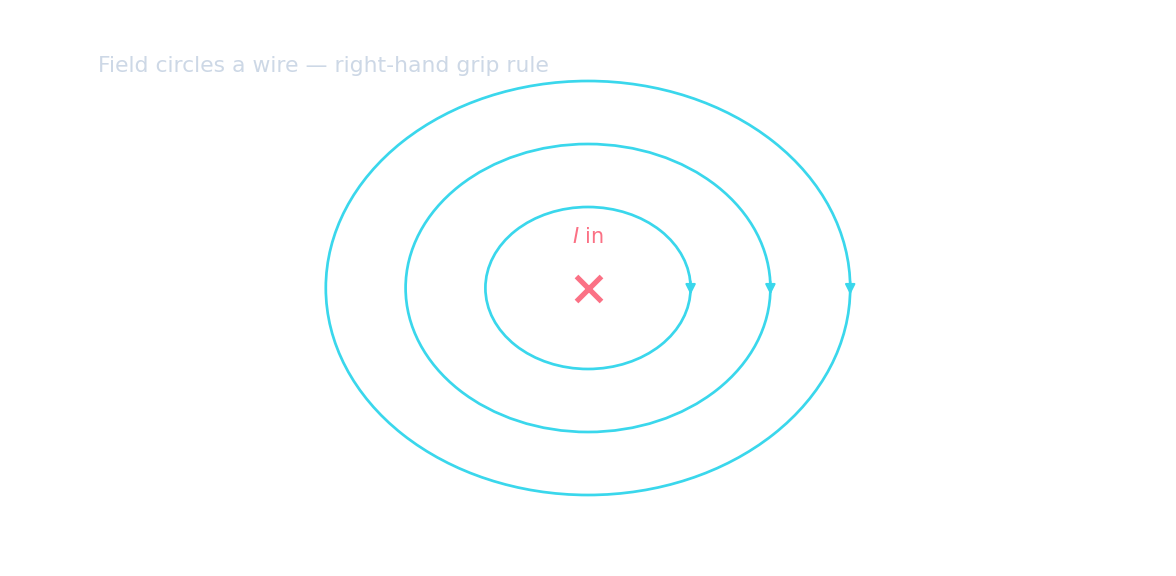
- The field forms concentric circles around the wire, in the plane perpendicular to it.
- Their spacing widens with distance, because the field weakens as you move away.
- The direction comes from the right-hand grip rule 右手定则: grip the wire with your right hand, thumb along the current, and your fingers curl the way the field points.
- For a current into the page, that gives a clockwise field.
Circles, widening, each with an arrow
O campo ao redor de um fio reto
- O campo forma círculos concêntricos ao redor do fio, no plano perpendicular a ele.
- Seu espaçamento aumenta com a distância, porque o campo enfraquece à medida que você se afasta.
- A direção vem da regra do aperto com a mão direita 右手定则: segure o fio com sua mão direita, o polegar ao longo da corrente, e seus dedos se curvam na direção em que o campo aponta.
- Para uma corrente entrando na página, isso resulta em um campo horário.
Círculos, afastando-se uns dos outros, cada um com uma seta
Current field rule lab · Laboratório da regra do campo de corrente
Connect current direction to the circular magnetic field around a wire. · Conecte a direção da corrente ao campo magnético circular ao redor de um fio.
The magnetic field around a long straight wire forms: · O campo magnético ao redor de um fio longo e reto forma:
Concentric circles, with the direction given by the right-hand grip rule. · círculos concêntricos, com a direção dada pela regra da mão direita para preensão.
The right-hand grip rule gives the direction of the field around a current-carrying wire. · A regra da mão direita para preensão dá a direção do campo ao redor de um fio percorrido por corrente.
Thumb along the current, curled fingers show the way the circular field points. · polegar na direção da corrente, dedos curvados mostram a direção do campo circular.
The flat circular coil
- Bend the wire into a loop and the circular fields around each side reinforce through the centre.
- So the field at the centre is at right angles to the plane of the coil, and strongest there.
- Seen from one face the coil behaves as a north pole, since the field leaves it there; from the other face, a south pole. A single loop is already a small bar magnet 条形磁铁.
A bobina circular plana
- Dobre o fio em um laço e os campos circulares ao redor de cada lado se reforçam através do centro.
- Assim, o campo no centro está perpendicular ao plano da bobina e é mais forte ali.
- Visto de uma face, a bobina comporta-se como um polo norte, pois o campo sai dela lá; da outra face, um polo sul. Um único laço já é um pequeno ímã em barra 条形磁铁.
What is the direction of the magnetic field at the centre of a flat circular coil? · Qual é a direção do campo magnético no centro de uma bobina circular plana?
The circular fields around the two sides reinforce through the centre, so the coil acts as a small bar magnet, north from one face and south from the other. · Os campos circulares ao redor dos dois lados reforçam-se através do centro, então a bobina age como um pequeno ímã de barra, norte de uma face e sul da outra.
The solenoid
- A solenoid 螺线管 is many such loops in a row. Their fields add along the axis, so inside the field is nearly uniform and parallel to the axis, exactly like a stretched bar magnet.
- Outside it spreads out and falls off fast, and the ends behave as N and S poles.
- Three things strengthen it: more turns per unit length, a larger current, and an iron core 铁芯.
Uniform down the axis, and poles at the ends
O solenóide
- Um solenóide 螺线管 é muitos desses laços em sequência. Seus campos se somam ao longo do eixo, então dentro dele o campo é quase uniforme e paralelo ao eixo, exatamente como um ímã em barra alongado.
- Fora dele, ele se espalha e diminui rapidamente, e as extremidades comportam-se como polos N e S.
- Três coisas o fortalecem: mais voltas por unidade de comprimento, uma corrente maior e um núcleo de ferro 铁芯.

Uniforme ao longo do eixo, e polos nas extremidades
Inside a long solenoid the magnetic field is nearly ____. · Dentro de um solenóide longo, o campo magnético é quase ____.
Like a stretched bar magnet — the field inside is uniform and parallel to the axis. · Como um ímã de barra esticado — o campo interno é uniforme e paralelo ao eixo.
Adding an iron core greatly increases a solenoid's magnetic field. · Adicionar um núcleo de ferro aumenta muito o campo magnético de um solenóide.
The iron's atomic magnets line up and add to the field — used in electromagnets and transformers. · Os ímãs atômicos do ferro se alinham e somam-se ao campo — usado em eletroímãs e transformadores.
Which changes increase the magnetic field inside a solenoid? Select all · todos that apply. · Quais alterações aumentam o campo magnético dentro de um solenóide? Selecione todas as que se aplicam.
Turns per unit length, current and a ferrous core. A thicker wire lowers the resistance but does not itself change the field for a given current. · Espiras por unidade de comprimento, corrente e um núcleo ferroso. Um fio mais grosso reduz a resistência, mas não altera o campo por si só para uma dada corrente.
Worked example: why the core helps
- Explain why inserting an iron core greatly increases the magnetic field of a solenoid.
- The core is a ferrous material, so the solenoid's field magnetises it: its atomic magnets line up with the field.
- The magnetised core then produces its own magnetic field, which adds to the field of the current.
- The two together are far stronger than the current's field alone. Both steps, magnetised and adds its own field, are needed for the marks. "It concentrates the field lines" is not the marked answer.
Exemplo resolvido: por que o núcleo ajuda
- Explique por que a inserção de um núcleo de ferro aumenta drasticamente o campo magnético de um solenóide.
- O núcleo é um material ferroso, então o campo do solenóide o magnetiza: seus ímãs atômicos alinham-se com o campo.
- O núcleo magnetizado então produz seu próprio campo magnético, que se soma ao campo da corrente.
- Os dois juntos são muito mais fortes do que o campo da corrente sozinho. Ambos os passos, magnetizado e adiciona seu próprio campo, são necessários para obter os pontos. "Ele concentra as linhas de campo" não é a resposta correta.
Put the explanation of why an iron core strengthens a solenoid in order. · Organize a explicação de por que um núcleo de ferro fortalece um solenóide.
Both middle steps are needed for the marks: magnetised, and adding its own field. "It concentrates the field" is not the marked wording. · Ambos os passos intermediários são necessários para os pontos: magnetizado, e adicionando seu próprio campo. "Ele concentra o campo" não é a redação exigida.
Two parallel currents
- Each wire sits in the field of the other, so each experiences a motor-effect force $F = BIL$.
- Apply the left-hand rule to each wire in turn, using the field the other one makes. The result is symmetric, as Newton's third law requires.
- Currents in the same direction attract. Currents in opposite directions repel.
- This force is the basis of the historical definition of the ampere.
Duas correntes paralelas
- Cada fio fica no campo do outro, então cada um experimenta uma força do efeito motor $F = BIL$.
- Aplique a regra da mão esquerda em cada fio sequencialmente, usando o campo que o outro cria. O resultado é simétrico, conforme exige a terceira lei de Newton.
- Correntes na mesma direção se atraem. Correntes em direções opostas se repelem.
- Essa força é a base da definição histórica do ampere.
Two parallel wires carrying currents in the same · mesmo direction: · Dois fios paralelos percorridos por correntes na mesma direção:
Same-direction currents attract; opposite-direction currents repel. This is the basis of the ampere. · Correntes na mesma direção se atraem; correntes em direções opostas se repelem. Esta é a base do ampere.
Match each task to the rule you use. · Combine cada tarefa com a regra que você usa.
A parallel-wires question needs both: the right hand for the field one wire makes, then the left hand for the force it exerts on the other. · Uma questão sobre fios paralelos exige ambas: a mão direita para o campo que um fio cria, depois a mão esquerda para a força que ele exerce no outro.
Worked example: predicting the direction
- Two long parallel wires carry currents in the same direction. Show that they attract.
- Use the right-hand grip rule on the left wire: in the region of the right wire, its field points into the page, say.
- Now use the left-hand rule on the right wire: field into the page, current up the page, so the force on it is towards the left wire.
- Repeat for the other wire and the force is towards the first. They attract. Note that like currents attract, which is the opposite of what like charges do.
Exemplo resolvido: prevendo a direção
- Dois fios longos e paralelos transportam correntes na mesma direção. Mostre que eles se atraem.
- Use a regra do aperto com a mão direita no fio esquerdo: na região do fio direito, seu campo aponta para dentro da página, digamos.
- Agora use a regra da mão esquerda no fio direito: campo para dentro da página, corrente para cima na página, então a força sobre ele é em direção ao fio esquerdo.
- Repita para o outro fio e a força é em direção ao primeiro. Eles se atraem. Note que correntes semelhantes se atraem, o que é o oposto do que cargas iguais fazem.
Marks that slip away
- Right hand for the field a current makes; left hand for the force on a current in a field. Both appear in a parallel-wires question and they are not interchangeable.
- The field around a wire is circles, not lines along the wire, and their spacing widens.
- The iron core is magnetised and adds its own field. Say both parts.
- Currents in the same direction attract, unlike charges of the same sign.
Marcas que escapam
- Mão direita para o campo que uma corrente gera; mão esquerda para a força sobre uma corrente em um campo. Ambos aparecem em questões de fios paralelos e não são intercambiáveis.
- O campo ao redor de um fio são círculos, não linhas ao longo do fio, e seu espaçamento se afasta.
- O núcleo de ferro é magnetizado e adiciona seu próprio campo. Cite ambas as partes.
- Correntes na mesma direção se atraem, diferentemente de cargas do mesmo sinal.
You've got it
- a straight wire's field is concentric circles with widening spacing, direction from the right-hand grip rule
- a flat coil gives a field at right angles through its centre and acts as a small bar magnet; a solenoid is nearly uniform inside and has poles at its ends
- more turns per unit length, a larger current and an iron core all strengthen a solenoid, the core because it is magnetised and adds its own field
- parallel currents attract when in the same direction and repel when opposite, found by using the right-hand rule for the field and the left-hand rule for the force
Entendeu?
- o campo de um fio reto são círculos concêntricos com espaçamento crescente, direção pela regra do aperto com a mão direita
- uma bobina plana dá um campo perpendicular através de seu centro e age como um pequeno ímã em barra; um solenóide é quase uniforme internamente e tem polos em suas extremidades
- mais voltas por unidade de comprimento, uma corrente maior e um núcleo de ferro fortalecem um solenóide, o núcleo porque é magnetizado e adiciona seu próprio campo
- correntes paralelas se atraem quando na mesma direção e se repelem quando opostas, encontradas usando a regra da mão direita para o campo e a regra da mão esquerda para a força