Algebra (Pure 3) · Álgebra (Pure 3)
| English | Português |
|---|---|
| partial fractions/ˈpɑːʃl ˈfrækʃnz/ | frações parciais |
| rational function/ˈræʃənl ˈfʌŋkʃn/ | função racional |
| factorise/ˈfæktəraɪz/ | fatorar |
| repeated factor/rɪˈpiːtɪd ˈfæktə/ | fator repetido |
| irreducible quadratic/ɪrɪˈdjuːsɪbl kwɒˈdrætɪk/ | quadrática irredutível |
| binomial expansion/baɪˈnəʊmɪəl ekˈspænʃn/ | expansão binomial |
Splitting the unsplitable
- You can't integrate $\dfrac{1}{x^2 - 1}$ directly. But split it into $\dfrac{1}{2(x-1)} - \dfrac{1}{2(x+1)}$ and each piece is a simple logarithm.
- Partial fractions 部分分式 turn hard rational functions 有理函数 into easy pieces — essential for integration and series expansion.
Dividindo o indivisível
- Não é possível integrar $\dfrac{1}{x^2 - 1}$ diretamente. Mas divida-o em $\dfrac{1}{2(x-1)} - \dfrac{1}{2(x+1)}$ e cada parte será um logaritmo simples.
- Frações parciais 部分分式 transformam funções racionais 有理函数 difíceis em peças fáceis — essenciais para integração e expansão em séries.
Partial fractions
- A fraction with a factorised 因式分解 bottom splits into simpler fractions:
- This makes a rational function easy to integrate or expand.
Worked example. $\dfrac{x+4}{(x+1)(x-2)} = \dfrac{A}{x+1} + \dfrac{B}{x-2}$. Multiply through: $x+4 = A(x-2) + B(x+1)$. Set $x = -1$: $3 = -3A \Rightarrow A = -1$. Set $x = 2$: $6 = 3B \Rightarrow B = 2$. Result: $\dfrac{2}{x-2} - \dfrac{1}{x+1}$.
The scalar product measures how much of b points along a: |b| cos theta
Frações parciais
- Uma fração com denominador fatorizado 因式分解 divide-se em frações mais simples:
- Isso facilita a integração ou expansão de uma função racional.
Exemplo resolvido. $\dfrac{x+4}{(x+1)(x-2)} = \dfrac{A}{x+1} + \dfrac{B}{x-2}$. Multiplique tudo: $x+4 = A(x-2) + B(x+1)$. Defina $x = -1$: $3 = -3A \Rightarrow A = -1$. Defina $x = 2$: $6 = 3B \Rightarrow B = 2$. Resultado: $\dfrac{2}{x-2} - \dfrac{1}{x+1}$.

O produto escalar mede quanto de b aponta na direção de a: |b| cos theta
Reciprocal curves · Curvas recíprocas
y = a/(x − b) + c
Partial fractions split a hard fraction into simple reciprocal · recíproco pieces — each with a vertical and a horizontal asymptote. · Frações parciais dividem uma fração difícil em partes recíprocas simples — cada uma com uma assíntota vertical e uma horizontal.
Writing (x+4)/((x+1)(x−2)) = A/(x+1) + B/(x−2), substitute x = 2 to find B. · Escrevendo (x+4)/((x+1)(x−2)) = A/(x+1) + B/(x−2), substitua x = 2 para encontrar B.
At x = 2: 2 + 4 = B(2 + 1), so 6 = 3B, giving B = 2. · Em x = 2: 2 + 4 = B(2 + 1), logo 6 = 3B, resultando em B = 2.
Partial fractions make a rational function easier to integrate. · Frações parciais facilitam a integração de uma função racional.
Each simple fraction integrates to a logarithm, so splitting first makes integration easy. · Cada fração simples integra a um logaritmo, então dividir antes facilita a integração.
Repeated and quadratic factors
- Repeated factor 重复因式 $(cx+d)^2$: needs $\dfrac{B}{cx+d} + \dfrac{C}{(cx+d)^2}$.
- Irreducible quadratic 不可约二次式 $(x^2 + a^2)$: needs $\dfrac{Bx + C}{x^2 + a^2}$.
Don't forget the repeated factor term. $\dfrac{1}{x(x+1)^2} = \dfrac{A}{x} + \dfrac{B}{x+1} + \dfrac{C}{(x+1)^2}$. Missing the $\dfrac{C}{(x+1)^2}$ term is a common error.
Holiday figure
Fatores repetidos e quadráticos
- Fator repetido 重复因式 $(cx+d)^2$: precisa de $\dfrac{B}{cx+d} + \dfrac{C}{(cx+d)^2}$.
- Quadrático irredutível 不可约二次式 $(x^2 + a^2)$: precisa de $\dfrac{Bx + C}{x^2 + a^2}$.
Não esqueça o termo do fator repetido. $\dfrac{1}{x(x+1)^2} = \dfrac{A}{x} + \dfrac{B}{x+1} + \dfrac{C}{(x+1)^2}$. Perder o termo $\dfrac{C}{(x+1)^2}$ é um erro comum.
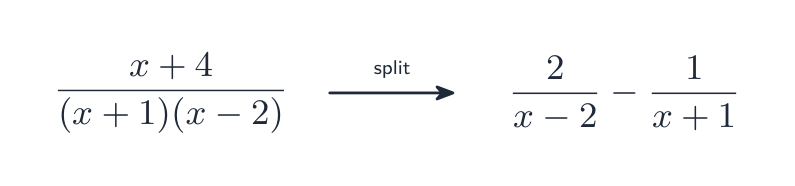
Figura de férias
For 1/(x(x+1)²), the partial fraction form includes: · Para 1/(x(x+1)²), a forma de frações parciais inclui:
A repeated factor (x+1)² needs both B/(x+1) and C/(x+1)² terms. · Um fator repetido (x+1)² precisa tanto de termos B/(x+1) quanto C/(x+1)².
Binomial expansion 二项展开式 for rational powers
- Works for fractional/negative $n$ when $|x| < 1$:
- e.g. $(1+x)^{1/2} = 1 + \tfrac12 x - \tfrac18 x^2 + \cdots$
Expansão binomial 二项展开式 para potências racionais
- Funciona para $n$ fracionários/negativos quando $|x| < 1$:
- e.g. $(1+x)^{1/2} = 1 + \tfrac12 x - \tfrac18 x^2 + \cdots$
The binomial expansion (1+x)ⁿ for a fractional or negative n is valid only when: · A expansão binomial (1+x)ⁿ para um n fracionário ou negativo é válida apenas quando:
For non-positive-integer powers the series converges only for |x| < 1. · Para potências não-inteiras positivas, a série converge apenas para |x| < 1.
In the expansion of (1+x)^(1/2), the coefficient of x² is n(n-1)/2! where n=1/2. Find it. · Na expansão de (1+x)^(1/2), o coeficiente de x² é n(n-1)/2! onde n=1/2. Encontre-o.
(1/2)(1/2 - 1)/2 = (1/2)(-1/2)/2 = -1/8 = -0.125.
Worked example — integrating with partial fractions
- $\displaystyle\int \frac{x+4}{(x+1)(x-2)}\,dx = \int\left(\frac{2}{x-2} - \frac{1}{x+1}\right)dx = 2\ln|x-2| - \ln|x+1| + C$.
allow_no_figure: Algebraic technique (partial fractions decomposition) — the visual content is the algebraic manipulation itself, not a diagram.
- Use the factor theorem and remainder theorem: dividing a polynomial gives a quotient and a remainder.
Exemplo resolvido — integrando com frações parciais
- $\displaystyle\int \frac{x+4}{(x+1)(x-2)}\,dx = \int\left(\frac{2}{x-2} - \frac{1}{x+1}\right)dx = 2\ln|x-2| - \ln|x+1| + C$.
allow_no_figure: Técnica algébrica (decomposição em frações parciais) — o conteúdo visual é a própria manipulação algébrica, não um diagrama.
- Use o teorema do fator e teorema do resto: dividir um polinômio dá um quociente e um resto.
∫ 2/(x-2) dx = 2 ln|x-2| + C. At x = 3, what is 2 ln|x-2| (to 2 dp)? · ∫ 2/(x-2) dx = 2 ln|x-2| + C. Em x = 3, qual é 2 ln|x-2| (2 casas decimais)?
2 ln|3-2| = 2 ln(1) = 2 × 0 = 0.
You've got it
- partial fractions split a rational function for integrating/expanding
- match the form to the bottom (repeated factor → an extra $\dfrac{C}{(cx+d)^2}$ term)
- the binomial works for rational $n$ when $|x| < 1$
Entendeu?
- frações parciais dividem uma função racional para integrar/expandir
- combine a forma com o denominador (fator repetido → termo extra de $\dfrac{C}{(cx+d)^2}$)
- a binomial funciona para $n$ racionais quando $|x| < 1$