Polymerisation and the addition mechanism
Introduzido| English | Significado |
|---|---|
| polymer/ˈpɒlɪmə/ | polímero |
| carbocation/ˌkɑːbəˈkeɪʃn/ | carbocátion |
| Markovnikov's rule/ˈmɑːkəvnɪkɒvz ruːl/ | regra de Markovnikov |
| addition polymerisation/əˈdɪʃn ˌpɒlɪməraɪˈzeɪʃn/ | polimerização por adição |
| inductive effect/ɪnˈdʌktɪv ɪˈfekt/ | efeito indutivo |
Tiny units, giant chains
- Many alkenes can join into one long polymer 聚合物.
- The addition mechanism goes through a carbocation 碳正离子.
- Its stability explains Markovnikov's rule 马氏规则.
Many ethene molecules join to form the polymer poly(______).
Dificuldade 1/5 · Moedas 100 + pequeno bônus na primeira conclusão hoje
Addition polymerisation of the alkene.
Addition polymerisation 加成聚合
- In addition polymerisation, many alkene molecules open their double bonds and join into one long chain — with no other product.
- Ethene → poly(ethene); the long-chain product is a polymer.
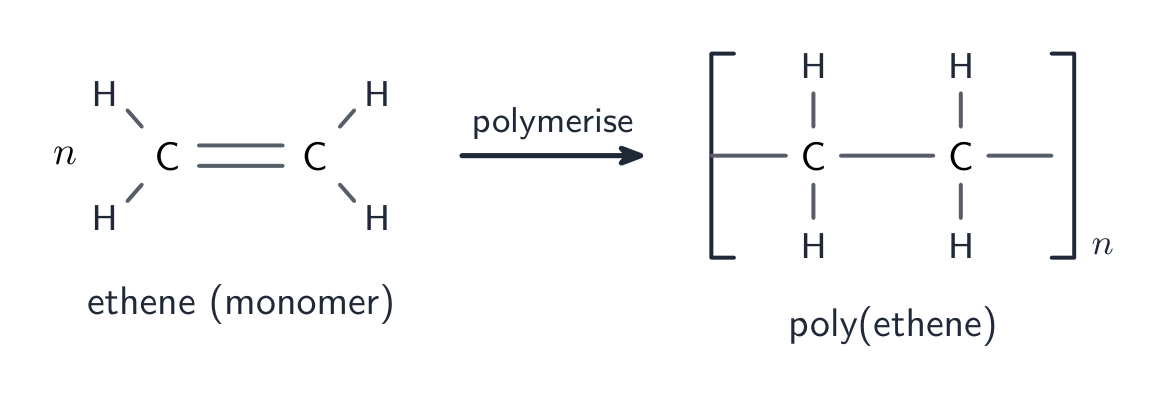
Many ethene molecules join into poly(ethene)
Polimerização por adição
Many alkene monomers open their double bonds and join into one long chain.
In addition polymerisation:
Dificuldade 1/5 · Moedas 100 + pequeno bônus na primeira conclusão hoje
Alkenes open their double bonds and join into a polymer such as poly(ethene); nothing else is formed.
Match each addition idea.
Dificuldade 2/5 · Moedas 140 + pequeno bônus na primeira conclusão hoje
Each item links the term to its correct meaning.
The electrophilic addition mechanism
- The electron-rich C=C attracts the electrophile (e.g. $\text{Br}^{\delta+}$).
- A positive intermediate, a carbocation, forms.
- The negative part (e.g. $\text{Br}^-$) then attacks the carbocation.

Electrophilic addition of bromine to ethene via a carbocation
During electrophilic addition, the positive intermediate formed is called a:
Dificuldade 1/5 · Moedas 100 + pequeno bônus na primeira conclusão hoje
The C=C attacks the electrophile, forming a positively charged carbocation, which the negative ion then attacks.
Carbocation stability and Markovnikov
- Alkyl groups push electrons towards the positive carbon — the inductive effect 诱导效应.
- So tertiary > secondary > primary in stability.
- When HBr adds to propene, the more stable carbocation forms — so H adds to the carbon that already has more H atoms. This is Markovnikov's rule.

Alkyl groups stabilise the positive carbon, so tertiary > secondary > primary — the basis of Markovnikov's rule
Carbocation stability increases in the order:
Dificuldade 1/5 · Moedas 100 + pequeno bônus na primeira conclusão hoje
More alkyl groups push electrons towards the positive carbon (inductive effect), so tertiary is most stable.
Markovnikov's rule predicts that when HBr adds to propene:
Dificuldade 1/5 · Moedas 100 + pequeno bônus na primeira conclusão hoje
The more stable carbocation forms, so the major product follows Markovnikov's rule.
Worked example: HBr and 2-methylpropene
Predict the major product when HBr adds to 2-methylpropene, $(\text{CH}_3)_2\text{C}{=}\text{CH}_2$, and explain.
- $\text{H}^{+}$ can add to either alkene carbon. On the $\text{CH}_2$ end it leaves a tertiary carbocation, $(\text{CH}_3)_3\text{C}^{+}$, held up by three alkyl groups. On the other end it leaves a primary carbocation, $(\text{CH}_3)_2\text{CHCH}_2^{+}$, with only one.
- The tertiary carbocation is far more stable, so it forms almost every time; $\text{Br}^-$ then attacks it. The major product is 2-bromo-2-methylpropane, $(\text{CH}_3)_3\text{CBr}$; 1-bromo-2-methylpropane is the minor product.
HBr adds to but-1-ene, $\text{CH}_2{=}\text{CHCH}_2\text{CH}_3$. What is the major product?
Dificuldade 1/5 · Moedas 100 + pequeno bônus na primeira conclusão hoje
H adds to the CH₂ end, leaving the positive charge on C2, which carries two alkyl groups (secondary, more stable).
HBr adding to but-2-ene, $\text{CH}_3\text{CH}{=}\text{CHCH}_3$, gives only one product.
Dificuldade 1/5 · Moedas 100 + pequeno bônus na primeira conclusão hoje
The alkene is symmetrical: whichever carbon H adds to, both routes give a secondary carbocation and 2-bromobutane.
You've got it
- addition polymerisation: many alkenes join into one long polymer (no other product), e.g. poly(ethene)
- electrophilic addition: C=C attacks the electrophile → carbocation → negative ion attacks
- carbocation stability tertiary > secondary > primary (inductive effect) → Markovnikov's rule