Halogenoalkanes and nucleophilic substitution
Introduzido| English | Significado |
|---|---|
| halogenoalkane/ˈheɪləʊdʒnəʊlkeɪn/ | halogenoalcano |
| nucleophilic substitution/ˌnjuːklɪəˈfɪlɪk ˌsʌbstɪˈtjuːʃn/ | substituição nucleofílica |
| nitrile/ˈnaɪtraɪl/ | nitrila |
| amine/ˈæmaɪn/ | amina |
| reflux/ˈriːflʌks/ | refluxo |
Swapping out a halogen
- A halogenoalkane 卤代烷 is an alkane with a halogen in place of hydrogen (a C–X bond).
- The C–X bond is polar, which makes these compounds react.
- They come in three classes.

A halogenoalkane is:
Dificuldade 1/5 · Moedas 100 + pequeno bônus na primeira conclusão hoje
A halogenoalkane has a polar C–X bond, which is the reactive site.
Halogenoalkanes react with aqueous hydroxide ions by:
Dificuldade 1/5 · Moedas 100 + pequeno bônus na primeira conclusão hoje
OH⁻ is a nucleophile replacing the halogen.
Three classes
- primary, secondary or tertiary, set by how many carbons are joined to the carbon holding the halogen (one, two or three).
- Made by: free-radical substitution of an alkane, electrophilic addition to an alkene, or substitution of an alcohol.
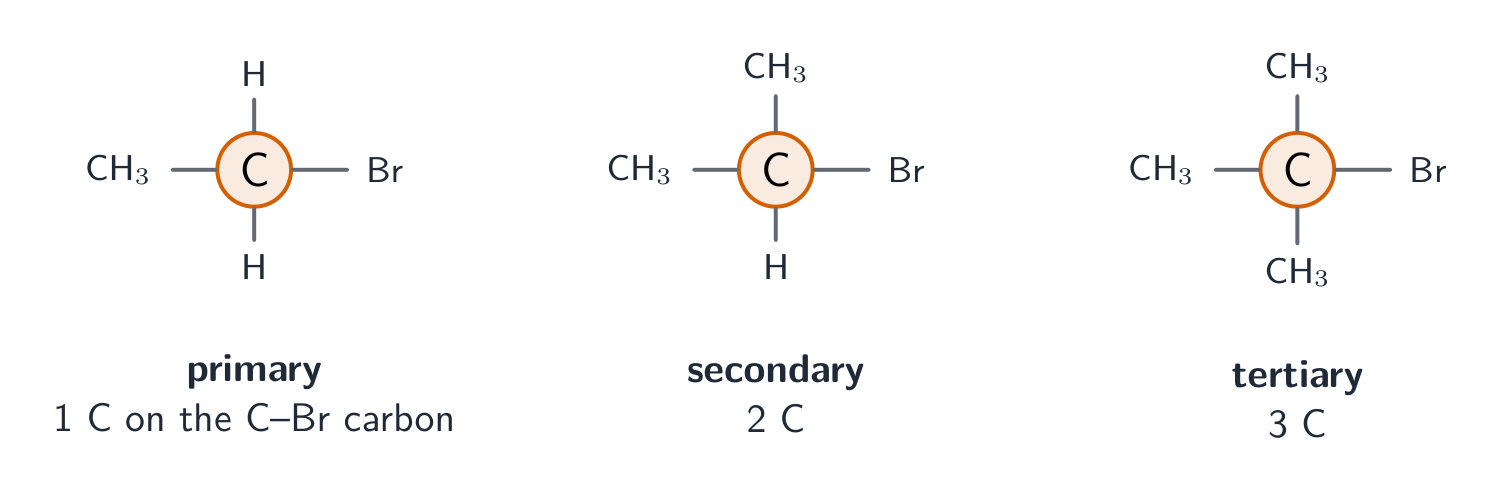
Primary, secondary and tertiary halogenoalkanes
Substituição nucleofílica
A nucleophile swaps in for the leaving group on a halogenoalkane.
A tertiary halogenoalkane has the halogen on a carbon joined to:
Dificuldade 1/5 · Moedas 100 + pequeno bônus na primeira conclusão hoje
Primary = 1 carbon attached, secondary = 2, tertiary = 3, on the carbon bearing the halogen.
Match each halogenoalkane idea.
Dificuldade 2/5 · Moedas 140 + pequeno bônus na primeira conclusão hoje
Each item links the term to its correct meaning.
In nucleophilic substitution, OH⁻ attacks the δ+ carbon and the halogen leaves as a halide ion.
Dificuldade 1/5 · Moedas 100 + pequeno bônus na primeira conclusão hoje
The C–X bond is polar, so the carbon is δ+ — exactly where an electron-pair donor attacks.
Nucleophilic substitution 亲核取代
- The C–X carbon is slightly positive, so a nucleophile (lone-pair species) attacks and replaces the halogen.
| Reagent | Product |
|---|---|
| $\text{NaOH(aq)}$, heat | an alcohol |
| $\text{KCN}$ in ethanol, heat | a nitrile 腈 (adds a carbon) |
| $\text{NH}_3$ in ethanol, heat + pressure | an amine 胺 |

Many halogenoalkane reactions are carried out by heating under reflux 回流.
Warming a halogenoalkane with aqueous NaOH produces:
Dificuldade 1/5 · Moedas 100 + pequeno bônus na primeira conclusão hoje
NaOH(aq) substitutes the halogen for –OH, giving an alcohol.
Reaction with KCN in ethanol gives a nitrile, which is useful because it:
Dificuldade 1/5 · Moedas 100 + pequeno bônus na primeira conclusão hoje
The CN group adds a carbon, lengthening the chain; NH₃ instead gives an amine.
Identifying the halogen
- Warm with silver nitrate in ethanol: a silver halide precipitate forms — white AgCl, cream AgBr, yellow AgI.
- Ethanol lets the halogenoalkane and aqueous silver nitrate mix. Water slowly hydrolyses the C–X bond, releasing $\text{X}^-$ ions, which meet $\text{Ag}^+$ and precipitate.
Worked example: which halogenoalkane reacts fastest?
1-Chlorobutane, 1-bromobutane and 1-iodobutane are warmed with aqueous silver nitrate in ethanol. Predict the order in which precipitates appear.
- Water substitutes for the halogen, and the freed halide ion meets $\text{Ag}^+$. The slow step breaks the C–X bond. Bond energies: C–Cl 340, C–Br 280, C–I 240 $\dfrac{\text{kJ}}{\text{mol}}$.
- So 1-iodobutane gives its yellow AgI first, then the cream AgBr, and the white AgCl last. Bond strength decides the rate, not bond polarity: C–Cl is the most polar but reacts slowest.
Why does 1-iodobutane hydrolyse faster than 1-chlorobutane?
Dificuldade 1/5 · Moedas 100 + pequeno bônus na primeira conclusão hoje
C–I is the least polar bond, but also the weakest (240 against 340 kJ/mol), and breaking it controls the rate.
You've got it
- a halogenoalkane has a polar C–X bond; classes are primary/secondary/tertiary
- nucleophilic substitution: NaOH(aq) → alcohol; KCN → nitrile (+1 carbon); NH₃ → amine
- identify the halogen with silver nitrate (white/cream/yellow precipitate)