Polarity and van der Waals forces
Introduzido| English | Significado |
|---|---|
| intermolecular force/ˌɪntəməˈlekjʊlə fɔːs/ | força intermolecular |
| dipole/ˈdaɪpəʊl/ | dipolo |
| polar/ˈpəʊlə/ | polar |
| non-polar/nɒn ˈpəʊlə/ | apolar |
| van der Waals' forces/ˈvændɜː wɑːlz ˈfɔːsɪz/ | forças de van der Waals |
| London dispersion/ˈlʌndn dɪˈspɜːʃn/ | dispersão de London |
Why some molecules stick together
- Methane is a gas, but water is a liquid at room temperature. To boil a molecular substance, you separate the molecules; you do not break the bonds inside them.
- The attractions between molecules are intermolecular forces 分子间力. They are much weaker than covalent bonds, and they decide boiling points.
Compared with the bonds inside substances, intermolecular forces are:
Dificuldade 1/5 · Moedas 100 + pequeno bônus na primeira conclusão hoje
Intermolecular forces (between molecules) are far weaker than ionic, covalent or metallic bonds within substances.
Polar bonds and dipoles
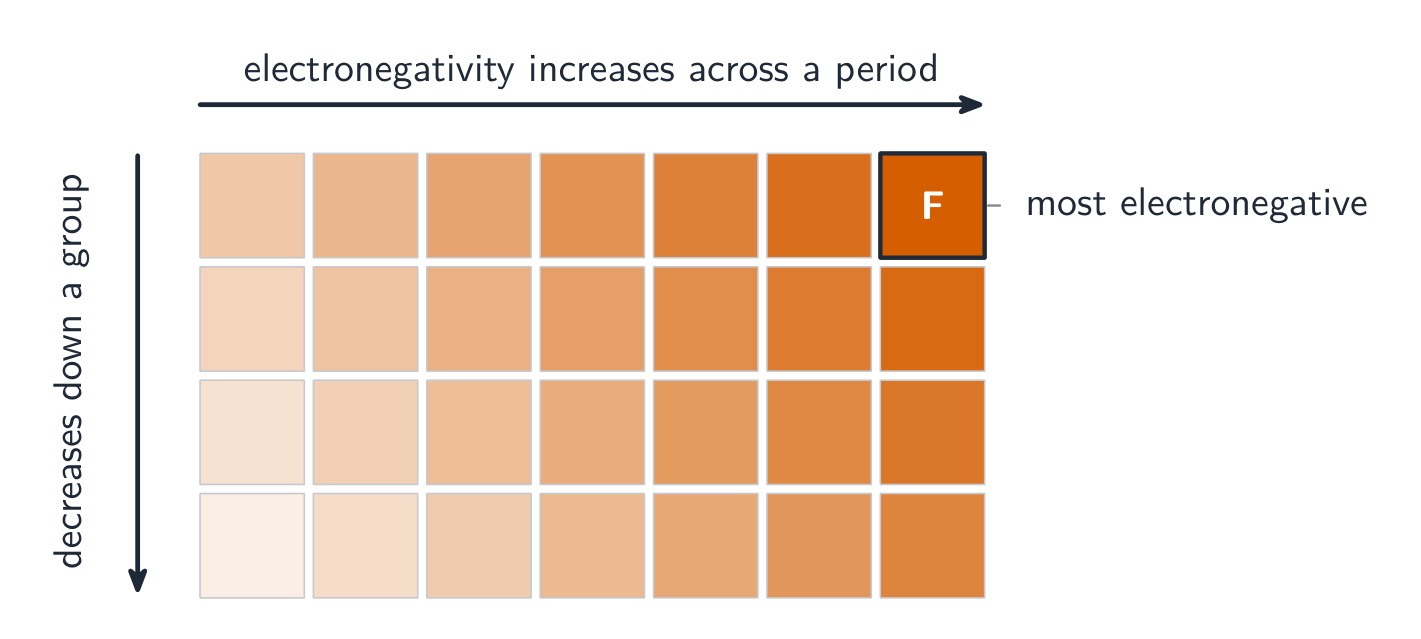
- In a bond between atoms of different electronegativity, the electrons are pulled towards the more electronegative atom. It becomes $\delta-$; the other atom becomes $\delta+$. This is a dipole 偶极.
- A molecule is polar 极性 if its bond dipoles do not cancel. If the shape is symmetrical, they cancel and the molecule is non-polar 非极性.
A polar bond has:
Dificuldade 1/5 · Moedas 100 + pequeno bônus na primeira conclusão hoje
Unequal sharing of electrons gives a dipole: δ− at the more electronegative end, δ+ at the other.
CO₂ is non-polar even though its bonds are polar because:
Dificuldade 1/5 · Moedas 100 + pequeno bônus na primeira conclusão hoje
CO₂ is linear and symmetric, so the two bond dipoles point opposite ways and cancel.
Polar or non-polar?
| Molecule | Shape | Dipoles cancel? | Overall |
|---|---|---|---|
| CO₂ | linear | yes | non-polar |
| BF₃ | trigonal planar | yes | non-polar |
| CCl₄ | tetrahedral | yes | non-polar |
| CHCl₃ | tetrahedral, one H | no | polar |
| H₂O | bent | no | polar |
| NH₃ | pyramidal | no | polar |
- Polar bonds do not guarantee a polar molecule. Check the shape first.
Polarity and intermolecular forces lab
Classify molecules by the feature that controls attractions.
Which of these molecules is polar?
Dificuldade 1/5 · Moedas 100 + pequeno bônus na primeira conclusão hoje
CH₂Cl₂ is tetrahedral, but two C–Cl dipoles and two C–H bonds do not cancel. CCl₄ and CO₂ are symmetrical; C–H bonds are almost non-polar.
Van der Waals' forces 范德华力
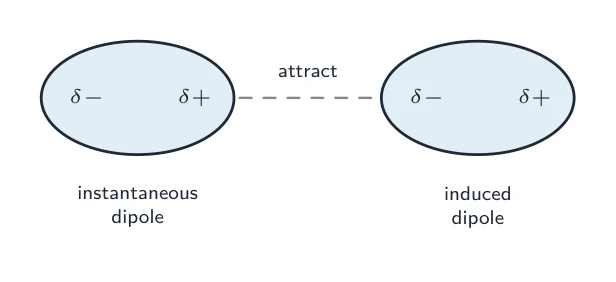
- Instantaneous dipole–induced dipole forces (London dispersion 伦敦色散): electrons move, making a brief dipole that induces one in a neighbour. They act between all molecules and get stronger with more electrons.
- Permanent dipole–permanent dipole forces: the $\delta+$ end of one polar molecule attracts the $\delta-$ end of the next. They are added to the London forces.
The weakest intermolecular forces, present between all molecules, are van der Waals (London) ______ forces.
Dificuldade 1/5 · Moedas 100 + pequeno bônus na primeira conclusão hoje
Caused by temporary induced dipoles.
Match each force to what it is.
Dificuldade 2/5 · Moedas 140 + pequeno bônus na primeira conclusão hoje
Intermolecular forces, weakest to strongest: van der Waals, permanent dipole, hydrogen bond.
More electrons, higher boiling point
| Halogen | F₂ | Cl₂ | Br₂ | I₂ |
|---|---|---|---|---|
| Electrons per molecule | 18 | 34 | 70 | 106 |
| Boiling point / °C | −188 | −34 | 59 | 184 |
| State at 20 °C | gas | gas | liquid | solid |
- More electrons → larger instantaneous dipoles → stronger London forces → more energy needed to separate the molecules.
London dispersion forces get stronger when a molecule has:
Dificuldade 1/5 · Moedas 100 + pequeno bônus na primeira conclusão hoje
More electrons give larger instantaneous dipoles, so London (dispersion) forces are stronger.
Which has the highest boiling point: HCl, HBr or HI?
Dificuldade 1/5 · Moedas 100 + pequeno bônus na primeira conclusão hoje
HI has the most electrons, so the strongest London forces. Here they outweigh HCl's larger permanent dipole.
Explain three boiling points. Butane ($M_r$ 58) boils at −1 °C and propanone ($M_r$ 58) at 56 °C. Pentane boils at 36 °C; its isomer 2,2-dimethylpropane at 10 °C.
- Butane and propanone have similar numbers of electrons, so similar London forces. Propanone's C=O is polar, so it also has permanent dipole–dipole forces: higher boiling point.
- Pentane and 2,2-dimethylpropane have the same electrons. Long pentane molecules touch over a larger area than compact, near-spherical ones, so their London forces are stronger.
- Boiling a molecular substance breaks intermolecular forces, not covalent bonds. "The C–H bonds break" is wrong.
- London forces are not always the weakest overall: I₂'s London forces are stronger than the dipole forces in small polar molecules.
- Compare like with like: same number of electrons before you credit polarity.
Which molecule has polar bonds but is non-polar overall?
Dificuldade 1/5 · Moedas 100 + pequeno bônus na primeira conclusão hoje
In symmetrical $\text{CCl}_4$ the bond dipoles point equally outwards and cancel. The others are not symmetrical, so their dipoles add up.
You've got it
- Intermolecular forces are weak, and boiling separates molecules without breaking bonds.
- A molecule is polar if its bond dipoles don't cancel (H₂O, NH₃, CHCl₃); symmetrical ones are non-polar (CO₂, CCl₄).
- London forces act between all molecules and grow with electrons and contact area; polar molecules also have permanent dipole–dipole forces.