Hydrogen bonding
Introduzido| English | Significado |
|---|---|
| hydrogen bonding/ˈhaɪdrədʒn ˈbɒndɪŋ/ | ligação de hidrogênio |
| electronegative/ɪˈlektrəʊŋɡətɪv/ | strongly attracting the bonding electrons in a covalent bond |
| lone pair/ləʊn peə/ | par de elétrons livres |
| surface tension/ˈsɜːfɪs ˈtenʃn/ | tensão superficial |
A bond with half a hydrogen, 1920
- In 1920 Wendell Latimer and Worth Rodebush at the University of California, Berkeley, suggested that a hydrogen atom could be held between two oxygen atoms in water — bonded to one, attracted to the other. It explained why water, a small molecule, boils at 100 °C when hydrogen sulfide, a heavier one, boils at about −60 °C.
- This attraction is hydrogen bonding 氢键: the strongest type of intermolecular force.
Water boils at a much higher temperature than hydrogen sulfide although H₂S is heavier.
Dificuldade 1/5 · Moedas 100 + pequeno bônus na primeira conclusão hoje
Hydrogen bonds must be broken.
The conditions
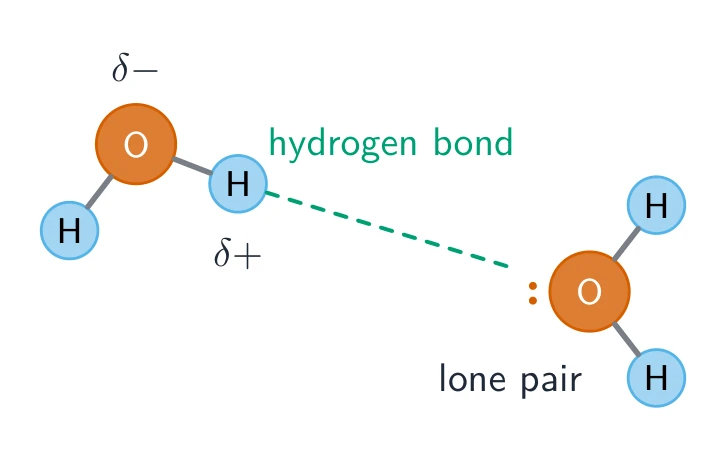
- Hydrogen must be covalently bonded to a small, very electronegative 电负性强的 atom: N, O or F. This leaves H strongly δ+.
- A lone pair 孤对电子 on an N, O or F atom of a neighbouring molecule is attracted to that H. The hydrogen bond is drawn as a dashed line, with O–H···O close to 180°.
Why hydrogen bonds make water special
Step through it. One weak-but-strong force — the hydrogen bond — explains water's high boiling point, why ice floats, and why it dissolves so much.
Hydrogen bonding needs H bonded to which atoms?
Dificuldade 2/5 · Moedas 140 + pequeno bônus na primeira conclusão hoje
Small and very electronegative.
What is the ideal O–H···O angle in a hydrogen bond, in degrees?
Dificuldade 2/5 · Moedas 140 + pequeno bônus na primeira conclusão hoje
The three atoms in a line.
Boiling points
- In Group 16 hydrides, boiling point rises from H₂S to H₂Te with more electrons (stronger instantaneous dipole forces), but H₂O is far higher: hydrogen bonds must be broken.
- The same anomaly appears for NH₃ (Group 15) and HF (Group 17).
Which hydride of Group 17 has an unusually high boiling point?
Dificuldade 1/5 · Moedas 100 + pequeno bônus na primeira conclusão hoje
It forms hydrogen bonds.
Ice and other properties
- In ice, each water molecule forms four hydrogen bonds in an open tetrahedral lattice, so ice is less dense than liquid water and floats.
- Hydrogen bonds also give water a high surface tension 表面张力, a high specific heat capacity, and high solubility of alcohols and sugars.
Why does ice float on water?
Dificuldade 1/5 · Moedas 100 + pequeno bônus na primeira conclusão hoje
Less dense than the liquid.
Worked example: rank three boiling points
Rank ethane (C₂H₆, $M_r$ 30), methanol (CH₃OH, 32) and fluoromethane (CH₃F, 34).
- Ethane: non-polar; only instantaneous dipole–induced dipole forces → lowest.
- Fluoromethane: permanent dipole–dipole forces, but its H atoms are bonded to C, not F, so no hydrogen bonds.
- Methanol: O–H allows hydrogen bonding → highest. Order: ethane < fluoromethane < methanol.
Order from lowest to highest boiling point.
Dificuldade 3/5 · Moedas 200 + pequeno bônus na primeira conclusão hoje
London forces, dipole–dipole, hydrogen bonding.
Hydrogen bonds in biology
- They hold the two strands of DNA together (between bases) and keep protein chains folded.
- They are strong enough to give shape but weak enough to break and re-form, for example when DNA is copied.
A molecule containing F is not automatically hydrogen-bonded. The H must be bonded directly to N, O or F. CH₃F has none; HF and CH₃OH do.
CH₃F molecules hydrogen-bond to each other.
Dificuldade 1/5 · Moedas 100 + pequeno bônus na primeira conclusão hoje
Its H atoms are bonded to C.
Hydrogen bonding needs H bonded to N, O or F and a lone pair on N, O or F in another molecule. It explains the high boiling points of H₂O, NH₃ and HF, ice's low density and water's high surface tension.
Explain why ethanol (M_r 46) has a much higher boiling point than propane (M_r 44).
Comparing forces.