Relative masses
Introduzido| English | Significado |
|---|---|
| atomic mass unit/əˈtɒmɪk mæs ˈjuːnɪt/ | unidade de massa atômica |
| relative isotopic mass/ˈrelətɪv ˌaɪsəˈtɒpɪk mæs/ | massa isotópica relativa |
| relative atomic mass/ˈrelətɪv əˈtɒmɪk mæs/ | massa atômica relativa |
| mass spectrometer/mæs spekˈtrɒmɪtə/ | mass spectrometer |
| mass-to-charge ratio/mæs tə tʃɑːdʒ ˈreɪʃɪəʊ/ | In mass spectrometry, the ion's mass number divided by its charge number, conventionally written m/z. |
| abundance/əˈbʌndəns/ | The amount or relative frequency of a particular entity, such as a species or an isotope. |
| relative formula mass/ˈrelətɪv ˈfɔːmjʊlə mæs/ | massa fórmula relativa |
| relative molecular mass/ˈrelətɪv məˈlekjʊlə mæs/ | massa molecular relativa |
Weighing the unweighable
- One carbon atom has a mass of about $2\times10^{-23}$ g. No balance can weigh that, and numbers this small are hard to use.
- So chemists compare every atom with one standard atom, carbon-12. The masses become simple numbers like 12, 16 and 35.5.
The carbon-12 standard
- The unified atomic mass unit 原子质量单位 (u) is exactly $\tfrac{1}{12}$ of the mass of one carbon-12 atom. On this scale carbon-12 is exactly 12.
- The relative isotopic mass 相对同位素质量 is the mass of an atom of one isotope, compared with $\tfrac{1}{12}$ of a carbon-12 atom. For $^{37}\text{Cl}$ it is 37.0 (close to the mass number).
$A_r$ is a weighted mean
- Most elements are a mix of isotopes. The relative atomic mass 相对原子质量 $A_r$ is the weighted mean mass of the atoms, compared with $\tfrac{1}{12}$ of carbon-12.
- "Weighted" means each isotope counts as often as it occurs: $A_r=\dfrac{\sum(\text{isotopic mass}\times\text{abundance})}{\text{total abundance}}$.
Relative mass lab
relative atomic mass = weighted mean
Change isotope abundance and see the weighted mean move.
The weighted mean mass of an element's atoms, compared with 1/12 of a carbon-12 atom, is the relative ______ mass.
Dificuldade 1/5 · Moedas 100 + pequeno bônus na primeira conclusão hoje
Ar (relative atomic mass) takes the abundance of each isotope into account.
Why is the Ar of chlorine 35.5 and not a whole number?
Dificuldade 1/5 · Moedas 100 + pequeno bônus na primeira conclusão hoje
About three in four chlorine atoms are chlorine-35 and one in four is chlorine-37. The mean of these masses is 35.5.
Reading a mass spectrum
- A mass spectrometer 质谱仪 separates ions by their mass-to-charge ratio 质荷比 $m/z$. Each isotope gives one line; its height shows its abundance 丰度.
- Multiply each $m/z$ by its abundance, add, and divide by the total abundance.
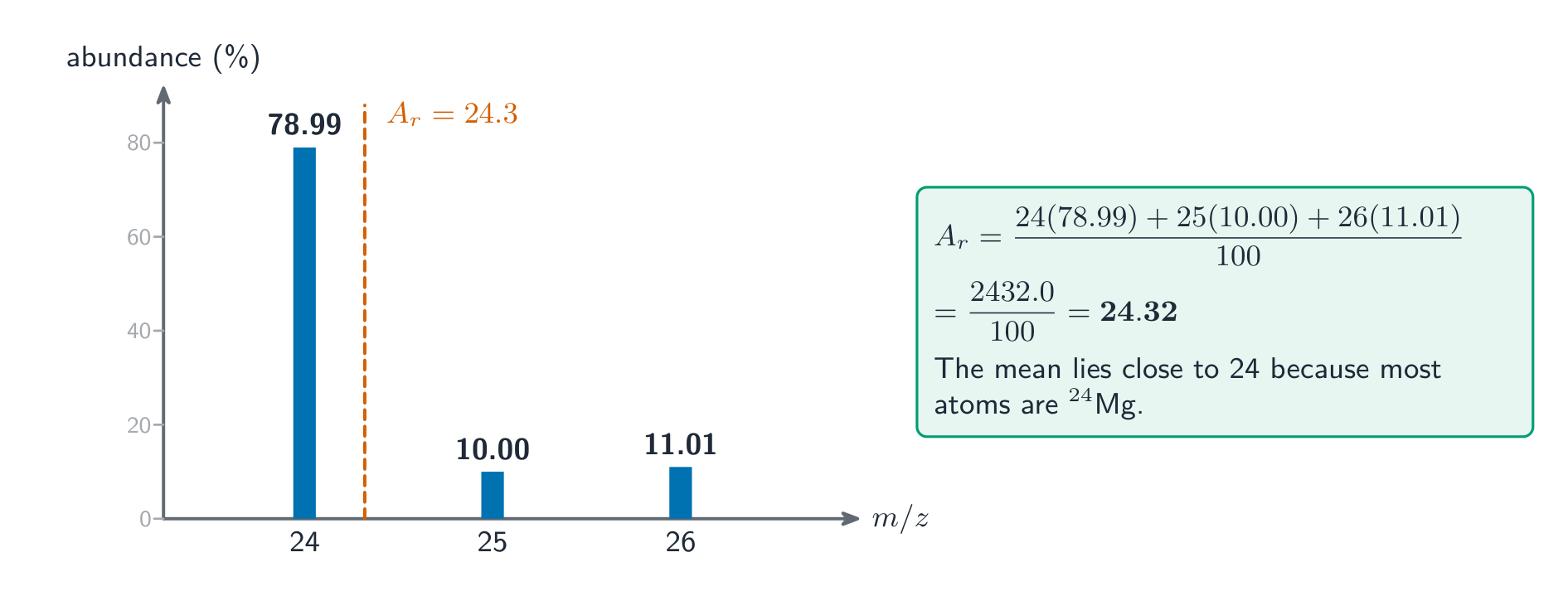
A lithium sample is 7.5% lithium-6 and 92.5% lithium-7. Calculate Ar to 2 decimal places.
Dificuldade 2/5 · Moedas 140 + pequeno bônus na primeira conclusão hoje
Ar = (6 × 7.5 + 7 × 92.5) ÷ 100 = (45 + 647.5) ÷ 100 = 6.925, which is 6.93 to 2 d.p.
Abundances that do not add to 100. A spectrum of boron shows $^{10}\text{B}$ with height 23 and $^{11}\text{B}$ with height 100. Find $A_r$.
- Total abundance $=23+100=123$.
- $A_r=\dfrac{10\times23+11\times100}{123}=\dfrac{1330}{123}=10.8$ (1 d.p.).
- Check: the answer lies between 10 and 11, closer to 11 because $^{11}\text{B}$ is more common ✓
A neon spectrum has lines at m/z 20 (height 90.5), 21 (height 0.3) and 22 (height 9.2). Calculate Ar to 1 decimal place.
Dificuldade 2/5 · Moedas 140 + pequeno bônus na primeira conclusão hoje
Total = 100.0. Ar = (20 × 90.5 + 21 × 0.3 + 22 × 9.2) ÷ 100.0 = (1810 + 6.3 + 202.4) ÷ 100 = 20.19, which is 20.2.
Working backwards. Copper has two isotopes, $^{63}\text{Cu}$ and $^{65}\text{Cu}$, and $A_r=63.55$. Find the percentage of $^{63}\text{Cu}$.
- Let $x$ = % of $^{63}\text{Cu}$, so $^{65}\text{Cu}$ is $(100-x)$%.
- $\dfrac{63x+65(100-x)}{100}=63.55$, so $6500-2x=6355$.
- $2x=145$, so $x=72.5$%. Copper is $72.5\%$ $^{63}\text{Cu}$ and $27.5\%$ $^{65}\text{Cu}$.
Gallium has two isotopes, gallium-69 and gallium-71, and Ar = 69.72. What percentage of gallium atoms are gallium-69?
Dificuldade 2/5 · Moedas 140 + pequeno bônus na primeira conclusão hoje
69x + 71(100 − x) = 6972, so 7100 − 2x = 6972 and x = 64%.
$M_r$ and relative formula mass
- The relative molecular mass 相对分子质量 $M_r$ is the sum of the $A_r$ values of all the atoms in one molecule. $M_r(\text{CO}_2)=12.0+2\times16.0=44.0$.
- Ionic compounds are giant lattices, not molecules, so they have a relative formula mass 相对式量 instead. You add the $A_r$ values in the formula in the same way.
What is the Mr of ethanol, C₂H₅OH? (Ar: C = 12.0, H = 1.0, O = 16.0)
Dificuldade 2/5 · Moedas 140 + pequeno bônus na primeira conclusão hoje
2 C, 6 H and 1 O. Mr = 2 × 12.0 + 6 × 1.0 + 16.0 = 46.0.
Sodium chloride has a relative molecular mass because it is made of NaCl molecules.
Dificuldade 1/5 · Moedas 100 + pequeno bônus na primeira conclusão hoje
False. Sodium chloride is a giant ionic lattice, not separate molecules, so it has a relative formula mass.
Brackets and water of crystallisation. Find the relative formula mass of $\text{Ca(NO}_3)_2$ and of $\text{CuSO}_4\cdot5\text{H}_2\text{O}$. ($A_r$: Ca 40.1, N 14.0, O 16.0, Cu 63.5, S 32.1, H 1.0)
- $\text{Ca(NO}_3)_2$: the 2 multiplies everything in the bracket, so 2 N and 6 O. $40.1+2\times14.0+6\times16.0=164.1$.
- $\text{CuSO}_4\cdot5\text{H}_2\text{O}$: $63.5+32.1+4\times16.0=159.6$, plus $5\times18.0=90.0$ for the water. Total $=249.6$.
Find the relative formula mass of Al₂(SO₄)₃. (Ar: Al = 27.0, S = 32.1, O = 16.0)
Dificuldade 2/5 · Moedas 140 + pequeno bônus na primeira conclusão hoje
2 Al, 3 S and 12 O. 2 × 27.0 + 3 × 32.1 + 12 × 16.0 = 54.0 + 96.3 + 192.0 = 342.3.
Find the relative formula mass of MgSO₄·7H₂O. (Ar: Mg = 24.3, S = 32.1, O = 16.0, H = 1.0)
Dificuldade 2/5 · Moedas 140 + pequeno bônus na primeira conclusão hoje
MgSO₄ = 24.3 + 32.1 + 64.0 = 120.4. 7H₂O = 7 × 18.0 = 126.0. Total = 246.4.
- Use the $A_r$ values the question gives (35.5 for Cl, not 35 or 37).
- Chlorine gas is $\text{Cl}_2$: $M_r=71.0$, not 35.5. The same holds for $\text{H}_2$, $\text{N}_2$, $\text{O}_2$ and the other diatomic elements.
- Relative masses have no units. Molar mass (next lesson) has the same number but units of g/mol.
Match each term to its meaning.
Dificuldade 2/5 · Moedas 140 + pequeno bônus na primeira conclusão hoje
All are compared with 1/12 of a carbon-12 atom; molecules use Mr, ionic compounds use relative formula mass.
What is the Mr of chlorine gas? (Ar: Cl = 35.5)
Dificuldade 2/5 · Moedas 140 + pequeno bônus na primeira conclusão hoje
Chlorine gas is Cl₂, so Mr = 2 × 35.5 = 71.0.
- All relative masses compare with $\tfrac{1}{12}$ of a carbon-12 atom.
- $A_r$ = weighted mean of the isotopic masses. From a spectrum: $\sum(m/z\times\text{abundance})\div\text{total abundance}$.
- $M_r$ (molecules) and relative formula mass (ionic compounds) = sum of the $A_r$ values in the formula. Count brackets and water of crystallisation.