The nerve impulse · O impulso nervoso
| English | Português |
|---|---|
| resting potential/ˈrestɪŋ pəˈtenʃl/ | potencial de repouso |
| action potential/ˈækʃn pəˈtenʃl/ | potencial de ação |
| depolarisation/diːˌpəʊləraɪˈzeɪʃn/ | despolarização |
| repolarisation/rɪˌpəʊləraɪˈzeɪʃn/ | repolarização |
| refractory period/rɪˈfræktəri ˈpɪərɪəd/ | período refratário |
| myelin sheath/ˈmaɪɪlɪn ʃiːθ/ | vaina de mielina |
| saltatory conduction/ˈsɒltətəri kənˈdʌkʃn/ | condução saltatória |
A wave of electricity
- An impulse is a change in the voltage across the neurone's membrane.
- At rest the inside is negative; an impulse flips it briefly positive.
- A fatty sheath can make it travel far faster.
Uma onda de eletricidade
- Um impulso é uma mudança no potencial elétrico através da membrana do neurônio.
- Em repouso, o interior é negativo; um impulso o inverte brevemente para positivo.
- Uma bainha gordurosa pode fazê-lo viajar muito mais rápido.
The brief reversal of charge across a neurone membrane is an action ______. · A inversão breve de carga através da membrana de um neurônio é um potencial de ______.
It travels along the axon as the nerve impulse. · Ele viaja ao longo do axônio como o impulso nervoso.
The resting potential 静息电位
- When no impulse passes, the inside is negative compared with the outside — the resting potential.
- It is kept this way by a pump that moves sodium out and potassium in, and by the membrane being more permeable to potassium.
O potencial de repouso 静息电位
- Quando nenhum impulso passa, o interior é negativo em comparação ao exterior — o potencial de repouso.
- Ele é mantido dessa forma por uma bomba que move sódio para fora e potássio para dentro, e pela membrana ser mais permeável a potássio.
The nerve impulse · O impulso nervoso
resting −70 → spike +40 mV · repouso −70 → pico +40 mV
Scrub the spike: Na⁺ floods in to depolarise, then K⁺ leaves to repolarise. · Rape o pico: Na⁺ inunda para despolarizar, então K⁺ sai para repolarizar.
At the resting potential, the inside of the neurone is: · No potencial de repouso, o interior do neurônio é:
The resting potential keeps the inside negative, maintained by the Na⁺/K⁺ pump and K⁺ permeability. · O potencial de repouso mantém o interior negativo, mantido pela bomba Na⁺/K⁺ e pela permeabilidade ao K⁺.
The action potential 动作电位
- A stimulus opens sodium channels → Na⁺ rushes in → inside briefly positive (depolarisation 去极化).
- Then potassium channels open → K⁺ leaves → the membrane returns to negative (repolarisation 复极化).
- A short refractory period 不应期 follows: sodium channels can't reopen, restoring rest and limiting how often impulses fire.
O potencial de ação 动作电位
- Um estímulo abre canais de sódio → Na⁺ entra rapidamente → o interior fica brevemente positivo (despolarização 去极化).
- Depois, canais de potássio abrem → K⁺ sai → a membrana retorna ao negativo (repolarização 复极化).
- Um curto período refratário 不应期 segue: os canais de sódio não podem se reabrir, restaurando o repouso e limitando a frequência dos impulsos.
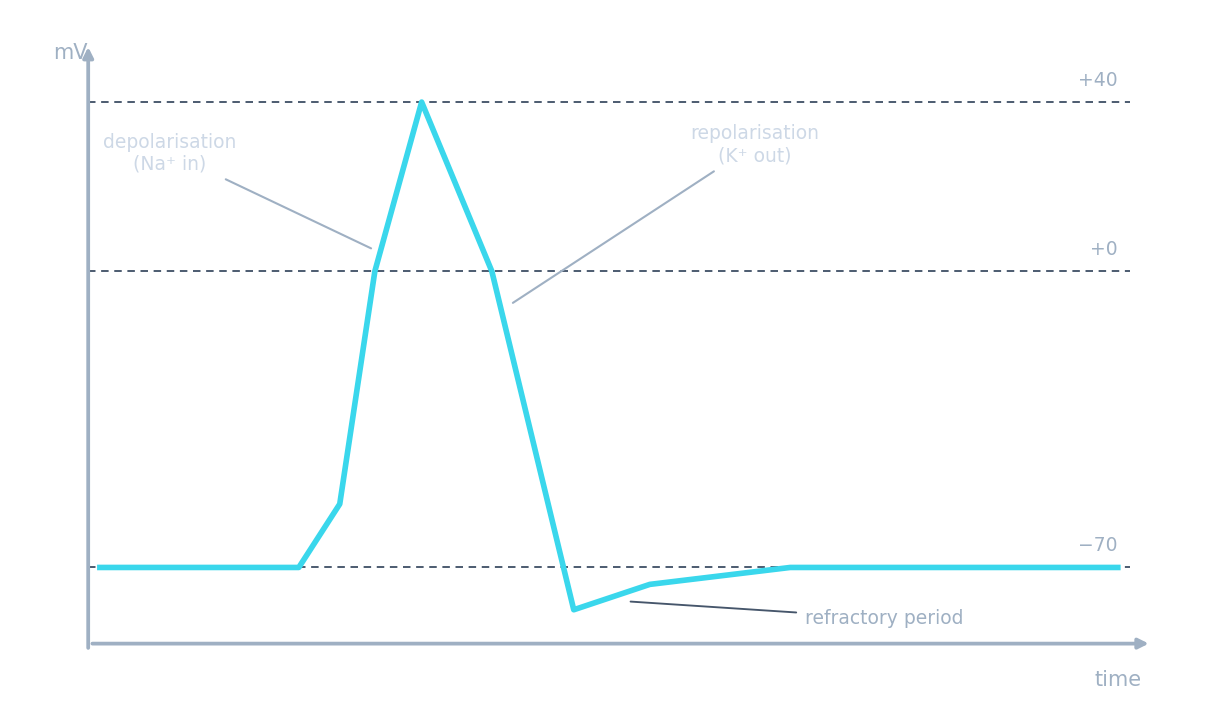
Depolarisation during an action potential is caused by: · A despolarização durante um potencial de ação é causada por:
Sodium channels open and Na⁺ floods in, reversing the charge (depolarisation); then K⁺ leaves to repolarise. · Canais de sódio abrem e Na⁺ inunda a célula, invertendo a carga (despolarização); depois K⁺ sai para repolarizar.
Put the action potential in order. · Coloque o potencial de ação em ordem.
Rest → Na⁺ in (depolarise) → K⁺ out (repolarise) → reset. The spike is brief and all-or-nothing. · Repouso → Na⁺ entra (despolariza) → K⁺ sai (repolariza) → reset. O pico é breve e tudo-ou-nada.
Match each phase to what is happening. · Combine cada fase com o que está acontecendo.
Na⁺ in flips the charge; K⁺ out restores it; the refractory period stops a backward impulse. · Na⁺ entra inverte a carga; K⁺ sai restabelece; o período refratário impede impulso reverso.
The refractory period resets the neurone and limits how often impulses can fire. · O período refratário resetea o neurônio e limita a frequência com que os impulsos podem disparar.
Sodium channels cannot reopen for a moment, so the neurone resets and impulses stay separate and one-way. · Os canais de sódio não podem se reabrir momentaneamente, então o neurônio resetea e os impulsos permanecem separados e unidirecionais.
Faster: myelin
- Some axons are wrapped in a fatty myelin sheath 髓鞘 that the impulse cannot cross.
- So the impulse jumps from one gap (node) to the next — saltatory conduction 跳跃式传导 — travelling much faster.
Saltatory conduction: the impulse jumps between the gaps in the myelin
Mais rápido: mielina
- Alguns axônios são revestidos por uma bainha de mielina gordurosa 髓鞘 que o impulso não pode atravessar.
- Então o impulso salta de uma lacuna (nó) para a próxima — condução saltatória 跳跃式传导 — viajando muito mais rápido.

Condução saltatória: o impulso salta entre as lacunas na mielina
Saltatory conduction makes impulses faster because the impulse: · A condução saltatória torna os impulsos mais rápidos porque o impulso:
The impulse cannot cross the myelin, so it jumps node to node — much faster than along a bare axon. · O impulso não pode atravessar a mielina, então salta de nó em nó — muito mais rápido do que ao longo de um axônio nu.
You've got it
- resting potential: inside negative (Na⁺ pumped out, K⁺ in; membrane leaks K⁺)
- action potential: Na⁺ in → depolarisation (+); K⁺ out → repolarisation (−)
- refractory period: Na⁺ channels can't reopen → limits impulse frequency
- myelin → saltatory conduction (jumps node to node) → much faster
Entendeu?
- potencial de repouso: interior negativo (Na⁺ bombeado para fora, K⁺ para dentro; membrana vaza K⁺)
- potencial de ação: Na⁺ entra → despolarização (+); K⁺ sai → repolarização (−)
- período refratário: canais de Na⁺ não podem se reabrir → limita a frequência do impulso
- mielina → condução saltatória (salta de nó em nó) → muito mais rápido