A sinapse
Introduzido| English | Significado |
|---|---|
| synapse/ˈsɪnæps/ | Sinapse |
| cholinergic/ˌkɒlɪˈnɜːdʒɪk/ | colinérgico |
| neurotransmitter/ˈnjuːrətrænsmɪtə/ | transmissor neural |
| acetylcholine/ˈæsɪtɪlkəliːn/ | acetilcolina |
| neuromuscular junction/ˌnjuːrəˈmʌskjʊlə ˈdʒʌŋkʃn/ | placa motora |
| summation/sʌˈmeɪʃn/ | somatório |
The gap between neurones
- A synapse 突触 is a tiny gap between two neurones.
- The electrical impulse can't jump the gap — so it's carried across by a chemical.
- The same idea connects a neurone to a muscle.
The electrical impulse jumps directly across the synaptic gap to the next neurone.
Dificuldade 1/5 · Moedas 100 + pequeno bônus na primeira conclusão hoje
False. The impulse cannot cross the gap directly; neurotransmitters released from the presynaptic neurone diffuse across the cleft and bind to receptors on the next neurone.
The tiny gap between two neurones at a synapse is the synaptic ______.
Dificuldade 1/5 · Moedas 100 + pequeno bônus na primeira conclusão hoje
The neurotransmitter diffuses across the synaptic cleft to the next neurone.
A cholinergic 胆碱能 synapse
- An action potential arrives at the presynaptic knob and opens voltage-gated Ca²⁺ channels. Calcium ions 钙离子 diffuse in.
- Ca²⁺ makes vesicles move to the membrane and release acetylcholine (ACh) 乙酰胆碱 into the synaptic cleft by exocytosis.
- ACh diffuses across the cleft and binds to receptor proteins on the postsynaptic membrane.
- The receptors open Na⁺ channels. Na⁺ ions flood in and depolarise the membrane. If the depolarisation reaches the threshold, a new action potential starts.
- The enzyme acetylcholinesterase hydrolyses ACh into acetate and choline, so the signal stops. These diffuse back and are recycled into new ACh, using ATP from the many mitochondria in the knob.
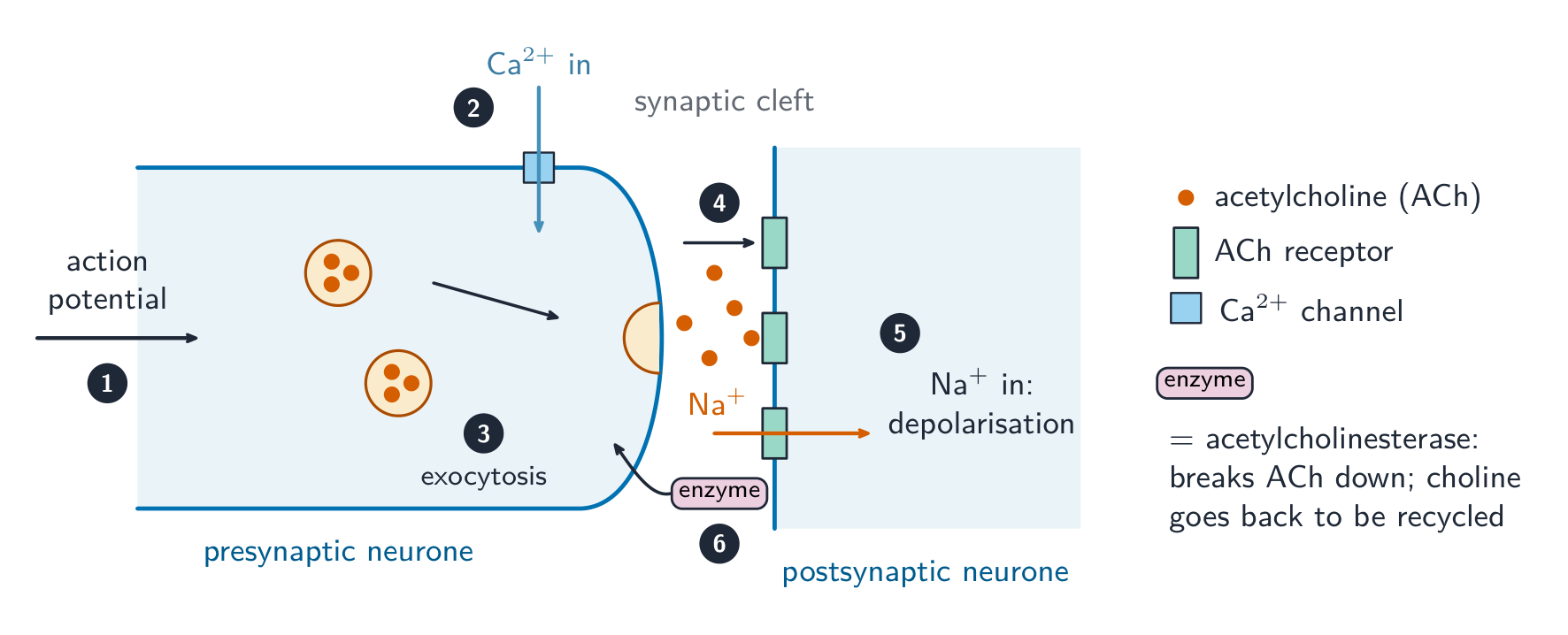
A cholinergic synapse passing a signal across the cleft
Across a synapse
Step through it. The electrical impulse becomes a chemical one — neurotransmitter carries the signal across the gap.
When an impulse arrives at a synapse, the first thing that happens is:
Dificuldade 1/5 · Moedas 100 + pequeno bônus na primeira conclusão hoje
Ca²⁺ entering the presynaptic neurone causes vesicles to release acetylcholine into the cleft.
Acetylcholine carries the signal across the synapse by:
Dificuldade 1/5 · Moedas 100 + pequeno bônus na primeira conclusão hoje
The neurotransmitter diffuses across the cleft and binds receptors, starting a new impulse.
Put the events at a cholinergic synapse in order.
Dificuldade 3/5 · Moedas 200 + pequeno bônus na primeira conclusão hoje
Impulse → Ca²⁺ in → ACh released → ACh binds receptors → new impulse.
Match each part of the synapse to its role.
Dificuldade 2/5 · Moedas 140 + pequeno bônus na primeira conclusão hoje
Ca²⁺ triggers release, ACh crosses and binds receptors, then the enzyme clears it so signals stay separate.
Acetylcholinesterase breaks down acetylcholine in the synaptic cleft, so the postsynaptic membrane is not stimulated continuously.
Dificuldade 1/5 · Moedas 100 + pequeno bônus na primeira conclusão hoje
It hydrolyses ACh into acetate and choline, which are recycled.
The neuromuscular junction 神经肌肉接头
- A neuromuscular junction is a synapse between a motor neurone and a muscle fibre. ACh depolarises the sarcolemma (muscle cell membrane), and the muscle fibre contracts.
- Differences from a synapse between neurones: one impulse is always enough to make the muscle fibre respond (no summation is needed); the postsynaptic membrane is folded, giving more receptors; and it is always excitatory.
A neuromuscular junction is a synapse between:
Dificuldade 1/5 · Moedas 100 + pequeno bônus na primeira conclusão hoje
It works like any synapse, but the second cell is a muscle that is made to contract.
Why synapses matter
- One-way transmission: only the presynaptic knob has vesicles of transmitter, and only the postsynaptic membrane has receptors. So impulses cross in one direction only.
- Summation 总和: one small release may not reach threshold. Several impulses arriving quickly from one neurone (temporal summation), or from several neurones at once (spatial summation), can add up to reach it. This lets the nervous system filter out weak, background signals and integrate information.
Why does the synapse transmit one way?
Only one side can release the transmitter.
Three presynaptic neurones release acetylcholine onto one postsynaptic neurone at the same time, and it reaches threshold. What is this called?
Dificuldade 1/5 · Moedas 100 + pequeno bônus na primeira conclusão hoje
Several neurones at once = spatial summation; one neurone firing rapidly = temporal summation.
Worked example: a drug at the synapse
Some insecticides block acetylcholinesterase, the enzyme that breaks down acetylcholine (ACh) in the synaptic cleft. Predict and explain the effect on an insect's muscles.
- Normally, an impulse arriving at the presynaptic knob opens Ca²⁺ channels; Ca²⁺ enters and vesicles release ACh by exocytosis. ACh diffuses across the cleft, binds to receptors and opens Na⁺ channels, depolarising the next cell. Acetylcholinesterase then breaks ACh down, ending the signal.
- With the enzyme blocked, ACh stays bound, so the muscle membrane stays depolarised and the muscles keep contracting (spasms), then fail: the insect is paralysed and dies.
What triggers vesicles to release acetylcholine?
Dificuldade 1/5 · Moedas 100 + pequeno bônus na primeira conclusão hoje
Ca²⁺ influx makes vesicles fuse with the membrane.
Synapses pass impulses in one direction because only the presynaptic side releases neurotransmitter.
Dificuldade 1/5 · Moedas 100 + pequeno bônus na primeira conclusão hoje
The receptors are only on the postsynaptic membrane.
Worked exam question: one-way and fatigue
Question (4 marks). (a) Explain why impulses can cross a cholinergic synapse in one direction only. (b) After very rapid stimulation for a long time, a synapse stops transmitting impulses. Suggest why.
- (a) Vesicles of acetylcholine are found only in the presynaptic knob, so only that side can release transmitter (1 mark).
- Receptors for acetylcholine are only on the postsynaptic membrane, so only that side can respond (1 mark).
- (b) Acetylcholine is released faster than it can be resynthesised, so the vesicles run out (1 mark).
- Not enough ACh binds to reach the threshold, so no action potential starts in the next neurone (1 mark).
Why answers lose marks: "the impulse can only travel one way" just repeats the question. Name where the vesicles and the receptors are.
Without looking back: describe the events at a cholinergic synapse from the arrival of an action potential to a new action potential in the next neurone (5 marks).
Five clear steps, each a mark.
You've got it
- a synapse is a gap between neurones; the signal crosses it as a chemical
- cholinergic synapse: impulse → Ca²⁺ in → exocytosis of ACh → diffuses, binds receptors → Na⁺ in → depolarisation → new action potential if threshold reached
- acetylcholinesterase breaks ACh down; products recycled using ATP
- one-way: vesicles only presynaptic, receptors only postsynaptic; summation (temporal, spatial) filters weak signals
- a neuromuscular junction is a synapse between a motor neurone and a muscle
Why is synaptic transmission one way?
Dificuldade 1/5 · Moedas 100 + pequeno bônus na primeira conclusão hoje
The release machinery is on one side only.