Coordination systems and neurones
Introduzido| English | Significado |
|---|---|
| endocrine system/ˈendəʊkraɪn ˈsɪstəm/ | sistema endócrino |
| nervous system/ˈnɜːvəs ˈsɪstəm/ | Sistema nervoso |
| neurone/ˈnjuːrəʊn/ | Neurônio |
| axon/ˈæksɒn/ | Axônio |
| sensory neurone/ˈsensəri ˈnjuːrəʊn/ | Neurônio sensorial |
| motor neurone/ˈməʊtə ˈnjuːrəʊn/ | Neurônio motor |
| effector/ɪˈfektə/ | efeitor |
| reflex arc/ˈriːfleks ɑːk/ | Arco reflexo |
Control and coordination
- The body has two coordination systems.
- The endocrine system 内分泌系统 sends chemical hormones in the blood.
- The nervous system 神经系统 sends fast electrical signals along nerve cells.
A neurone that carries impulses from a receptor to the CNS is a:
Dificuldade 1/5 · Moedas 100 + pequeno bônus na primeira conclusão hoje
Sensory neurones carry signals into the CNS.
Nervous vs endocrine
| Feature | Nervous | Endocrine |
|---|---|---|
| signal | electrical impulse | chemical hormone |
| transport | along nerve cells | in the blood |
| speed | very fast | slower |
| lasts | short | longer |
Compared with the endocrine system, the nervous system is:
Dificuldade 1/5 · Moedas 100 + pequeno bônus na primeira conclusão hoje
Nervous signals are fast electrical impulses with short-lived effects; hormones are slower and longer-lasting.
The hormonal system gives a faster but shorter-lasting response than the nervous system.
Dificuldade 1/5 · Moedas 100 + pequeno bônus na primeira conclusão hoje
False. Nervous impulses are fast and brief; hormones travel in the blood, so their response is slower but longer-lasting.
Neurones 神经元
- A neurone is a nerve cell, with a long fibre (the axon 轴突) the impulse travels along. Three kinds:
- sensory neurone 感觉神经元 — carries impulses from a receptor towards the brain/spinal cord.
- motor neurone 运动神经元 — carries impulses out to an effector 效应器 (e.g. a muscle).
- intermediate (relay) neurones — connect sensory to motor neurones.
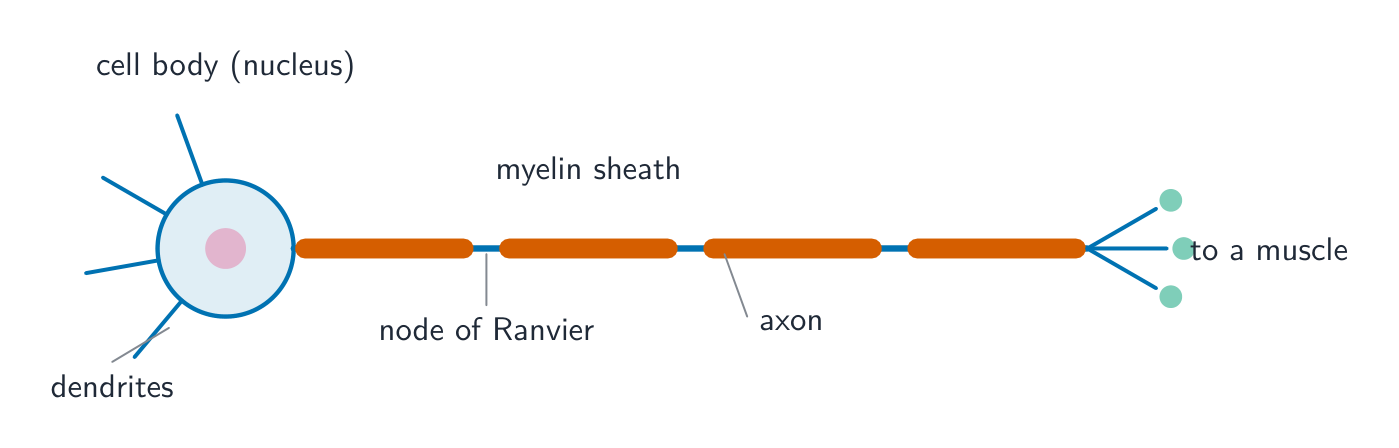
A motor neurone: dendrites, a cell body, and a long myelinated axon carrying the impulse to a muscle
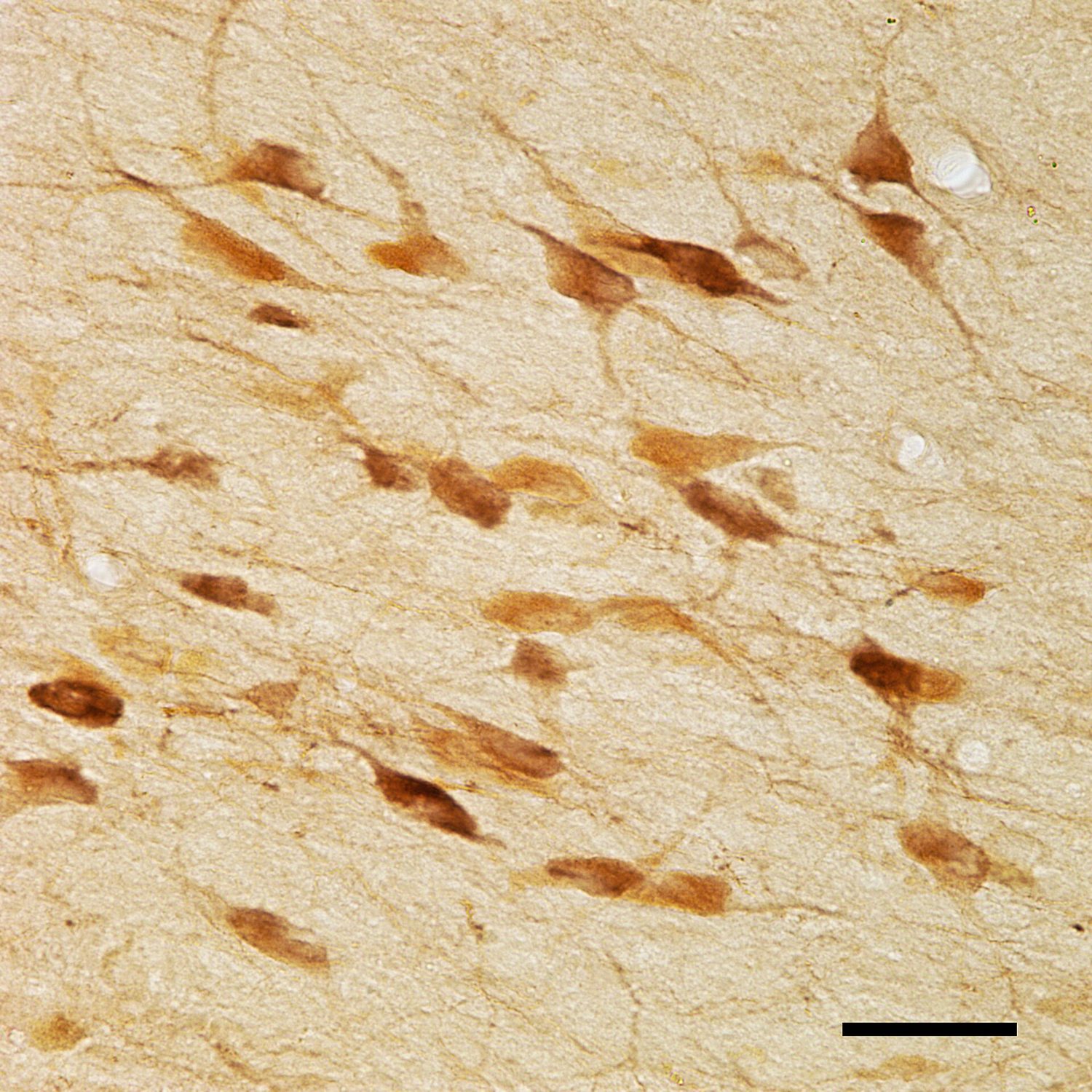
Real neurones stained brown under the microscope, showing their cell bodies and processes
Explore a motor neurone
Tap each part. The impulse travels from the cell body down the long axon to the terminals, jumping between the myelin gaps.
A motor neurone:
Dificuldade 1/5 · Moedas 100 + pequeno bônus na primeira conclusão hoje
Motor neurones carry impulses from the CNS out to effectors; sensory neurones carry them in.
Match each neurone or part to its job.
Dificuldade 2/5 · Moedas 140 + pequeno bônus na primeira conclusão hoje
Sensory in, motor out, relay between; the myelin sheath makes the impulse travel faster.
The reflex arc 反射弧
- A sensory receptor detects a stimulus and starts an impulse.
- The reflex arc: stimulus → receptor → sensory neurone → relay neurone → motor neurone → effector → response.
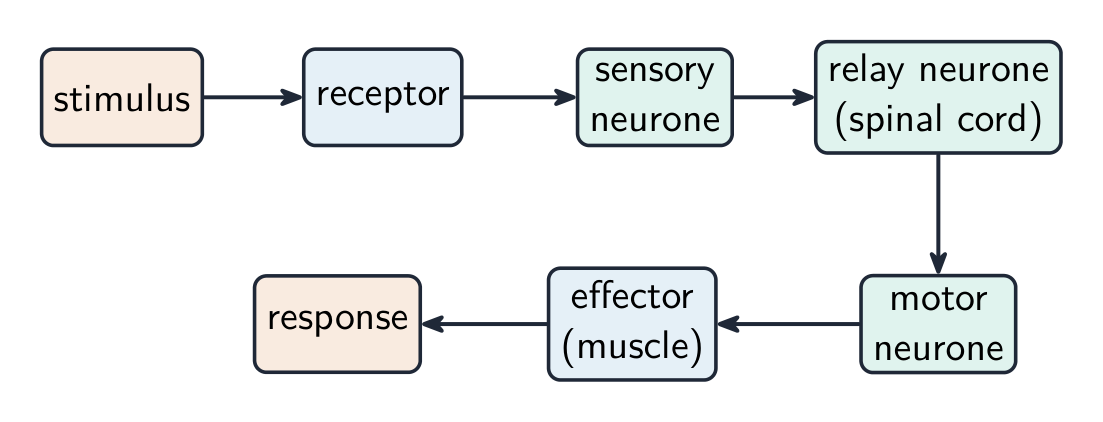
A reflex arc: stimulus → receptor → sensory → relay → motor → effector
Put the reflex arc in order.
Dificuldade 3/5 · Moedas 200 + pequeno bônus na primeira conclusão hoje
Stimulus → receptor → sensory → relay → motor → effector → response.
A sensory receptor:
Dificuldade 1/5 · Moedas 100 + pequeno bônus na primeira conclusão hoje
A receptor detects the stimulus (e.g. chemicals in a taste bud) and triggers an action potential.
Worked example: a hand on a hot pan
You touch a hot pan and pull your hand away before you feel pain. Trace the reflex arc, and explain why it is fast.
- Stimulus: heat. Receptor: temperature receptors in the skin start impulses. Sensory neurone carries them to the spinal cord, where a relay neurone passes them straight to a motor neurone. Effector: the biceps contracts and the hand is pulled away.
- It is fast because the route is short and goes through the spinal cord, not the conscious brain, with few synapses. The brain is informed afterwards, so you feel the pain a moment later.
In a reflex arc, where is the relay neurone?
Dificuldade 1/5 · Moedas 100 + pequeno bônus na primeira conclusão hoje
Relay neurones connect sensory and motor neurones inside the CNS.
Hormonal responses are usually slower but longer-lasting than nervous responses.
Dificuldade 1/5 · Moedas 100 + pequeno bônus na primeira conclusão hoje
Hormones travel in the blood and act until they are broken down.
You've got it
- nervous = fast electrical impulses, short-lived; endocrine = slower hormones, longer-lasting
- sensory neurone → towards CNS; motor → out to effector; relay connects them
- a receptor detects a stimulus and starts the impulse
- reflex arc: stimulus → receptor → sensory → relay → motor → effector → response
Write from this case
- A receptor detects a stimulus.
- A muscle then contracts.
Which neurone carries the impulse to the muscle?
Motor neurones output to effectors.
Which neurone reaches the muscle?
Dificuldade 1/5 · Moedas 100 + pequeno bônus na primeira conclusão hoje
The motor neurone is the output cell.