Antibodies and monoclonal antibodies
Introduzido| English | Significado |
|---|---|
| antibody/ˈæntɪbɒdi/ | anticorpo |
| antigen-binding site/ˈæntɪdʒen ˈbaɪndɪŋ saɪt/ | sítio de ligação ao antígeno |
| variable region/ˈveərɪəbl ˈriːdʒn/ | região variável |
| monoclonal antibody/ˈmɒnəʊklɒnl ˈæntɪbɒdi/ | anticorpo monoclonal |
| hybridoma/ˌhaɪbrɪˈdəʊmə/ | híbrido |
Custom-made molecules
- An antibody 抗体 is a protein made and secreted by plasma cells. Each one binds to one specific antigen.
- Your body can make millions of different antibodies, each with a slightly different shape at its tips.
- Scientists can also mass-produce one antibody in the lab. These monoclonal antibodies are used in pregnancy tests and cancer drugs.
Antibody structure
- An antibody is made of four polypeptide chains: two long heavy chains and two short light chains. Disulfide bonds 二硫键 hold the chains together, so it has a quaternary structure.
- At the tip of each arm is a variable region 可变区. Its amino-acid sequence, and so its shape, is different in each type of antibody. This makes the antigen-binding site 抗原结合位点 complementary to one antigen.
- The rest is the constant region, the same in all antibodies of one class; phagocytes have receptors that bind to it. The hinge region lets the two arms move, so one antibody can bind antigens on two different pathogens.

Inside an antibody
Tap each part. The variable tips bind one specific antigen; the constant stem is the same in every antibody.
The variable region of an antibody:
Dificuldade 1/5 · Moedas 100 + pequeno bônus na primeira conclusão hoje
The two tips of the Y are variable regions — each shaped to bind one specific antigen.
How many polypeptide chains make up one antibody molecule?
Dificuldade 2/5 · Moedas 140 + pequeno bônus na primeira conclusão hoje
Two heavy chains and two light chains, held together by disulfide bonds.
How antibodies help
| Action | How it helps |
|---|---|
| neutralisation | antibodies cover a toxin or a virus's binding sites, so it cannot enter or harm cells |
| agglutination 凝集 | each antibody has two binding sites, so it links pathogens together into clumps that cannot spread and are easier to engulf |
| opsonisation | antibodies coat a pathogen; phagocytes bind the constant regions, so the pathogen is engulfed faster |
- Antibodies do not kill pathogens by themselves. They disable them and make the phagocytes' job easier.
Select todos the ways antibodies help destroy pathogens.
Dificuldade 2/5 · Moedas 140 + pequeno bônus na primeira conclusão hoje
Antibodies agglutinate pathogens, mark them for phagocytes and neutralise toxins — they do not build cell walls.
Match each term to its meaning.
Dificuldade 2/5 · Moedas 140 + pequeno bônus na primeira conclusão hoje
The variable tip is specific; the constant stem calls phagocytes; agglutination clumps; monoclonal = all identical.
Which feature of an antibody allows it to cause agglutination?
Dificuldade 1/5 · Moedas 100 + pequeno bônus na primeira conclusão hoje
Two binding sites let one antibody link two pathogens, so many antibodies build clumps.
Making monoclonal antibodies 单克隆抗体
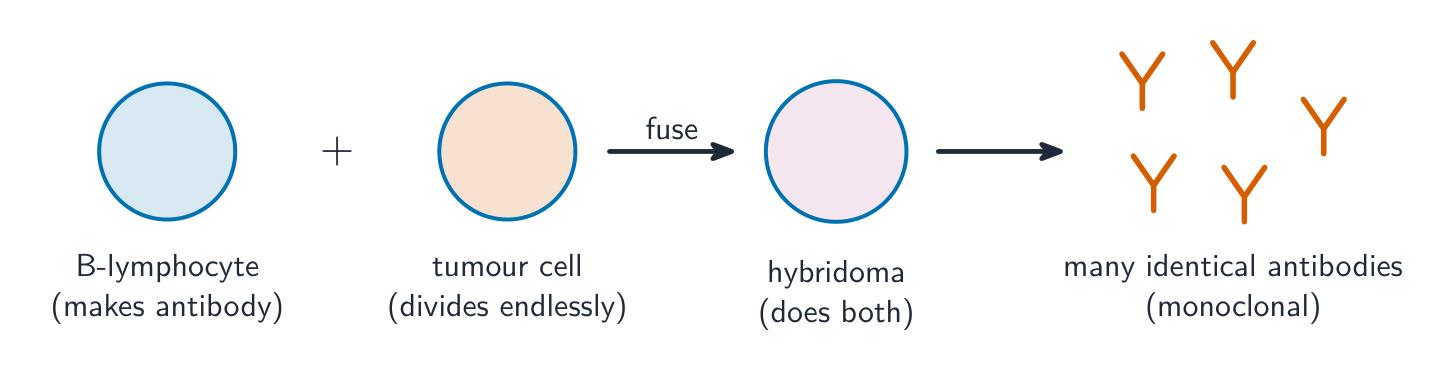
- A monoclonal antibody is many copies of one type of antibody, made by a clone of identical cells. The hybridoma 杂交瘤 method solves a problem: plasma cells make antibodies but do not divide; cancer (myeloma) cells divide without limit.
- A mouse is injected with the antigen, so its B-lymphocytes that match it divide into plasma cells.
- Plasma cells are taken from the mouse's spleen.
- They are fused with myeloma cells to form hybridoma cells.
- Hybridoma cells are screened to find one that makes the wanted antibody.
- That cell is cloned and grown in culture, so it secretes large amounts of the antibody.
Monoclonal antibodies are:
Dificuldade 1/5 · Moedas 100 + pequeno bônus na primeira conclusão hoje
Monoclonal = "one clone" — all identical, so they all bind the same target.
A hybridoma is made by:
Dificuldade 1/5 · Moedas 100 + pequeno bônus na primeira conclusão hoje
The B-lymphocyte supplies the wanted antibody; the tumour cell makes it divide endlessly — together a hybridoma.
A B-lymphocyte fused with a tumour cell, so it both makes antibody and divides endlessly, is a ______.
Dificuldade 1/5 · Moedas 100 + pequeno bônus na primeira conclusão hoje
The hybridoma is cloned to mass-produce one (monoclonal) antibody.
Explain why every antibody in a monoclonal antibody preparation binds the same antigen.
One clone means one variable region, so one antigen.
A hybridoma cell is made by fusing:
Dificuldade 1/5 · Moedas 100 + pequeno bônus na primeira conclusão hoje
The B-cell makes the antibody; the tumour cell divides indefinitely.
Why are plasma cells fused with myeloma cells to make monoclonal antibodies?
Dificuldade 1/5 · Moedas 100 + pequeno bônus na primeira conclusão hoje
The hybridoma keeps both abilities: it secretes the antibody and keeps dividing.
Uses in diagnosis and treatment
- Diagnosis: monoclonal antibodies bind one specific molecule, so they can detect it: hCG in a pregnancy test, or a virus antigen in a rapid test for COVID-19 or HIV. With a radioactive or fluorescent label attached, they show where a blood clot or a tumour is.
- Treatment: a monoclonal antibody can bind to an antigen found only on certain cells. Trastuzumab (Herceptin) binds to the HER2 receptor on some breast cancer cells. It blocks the growth signal and marks the cells for the immune system. Other antibodies carry a drug straight to cancer cells, so healthy cells are less harmed.
Monoclonal antibodies are used in:
Dificuldade 1/5 · Moedas 100 + pequeno bônus na primeira conclusão hoje
They detect specific molecules for diagnosis, and can carry drugs to specific target cells for treatment.
Worked exam question: a pregnancy test strip
Question (4 marks). A pregnancy test detects the hormone hCG in urine. Explain how monoclonal antibodies give a coloured line for a positive result, and why there is a control line.
- Near the tip, mobile monoclonal antibodies, complementary to hCG, carry a coloured bead. hCG in the urine binds to them (1 mark).
- The urine carries the bead–antibody–hCG complex up the strip. At the test line, fixed (immobilised) antibodies also bind hCG and trap the complex, so the beads collect and a coloured line appears (1 mark).
- With no hCG, nothing binds the mobile antibodies to the test line, so no line forms there (1 mark).
- At the control line, fixed antibodies bind the mobile antibodies themselves, so a line always forms if the test works correctly (1 mark).
If only the control line appears, the test has worked and hCG was not detected.
Dificuldade 1/5 · Moedas 100 + pequeno bônus na primeira conclusão hoje
The control line shows the antibodies flowed; no test line means no hCG was trapped.
Worked exam question: structure and function
Question (4 marks). Explain how the structure of an antibody is related to its function.
- The variable region has a specific amino-acid sequence, giving an antigen-binding site complementary to one antigen (1 mark).
- There are two binding sites, so one antibody can bind two pathogens and cause agglutination (1 mark).
- The hinge region gives flexibility, so the arms can reach antigens at different distances apart (1 mark).
- The constant region binds to receptors on phagocytes, which helps them engulf the pathogen; disulfide bonds hold the chains in a stable shape (1 mark).
Why answers lose marks: saying the binding site is "the same shape as" the antigen. It is complementary to it.
Without looking back: explain how the structure of an antibody is related to its function (4 marks).
Every structure needs its function in the same sentence.
You've got it
- antibody: 2 heavy + 2 light chains, held by disulfide bonds; variable regions form two antigen-binding sites; constant region; hinge
- actions: neutralisation (blocks toxins), agglutination (clumps; two sites), opsonisation (marks for phagocytes)
- monoclonal: plasma cell + myeloma cell → hybridoma → screen → clone; it makes the antibody and divides
- uses: diagnosis (pregnancy and virus tests, locating tumours) and treatment (e.g. trastuzumab; carrying drugs to cancer cells)
What do the antibodies in one monoclonal preparation bind?
Dificuldade 1/5 · Moedas 100 + pequeno bônus na primeira conclusão hoje
A single clone has a single specificity.