Skip to content · ⁨Pular para o conteúdo⁩
Subjects · ⁨Matérias⁩

English Grammar · A2 · ⁨Gramática Inglesa · Nível A2⁩

  • 1 Present simple
    1.1

    Hábitos e Fatos (Habits & facts)

    English

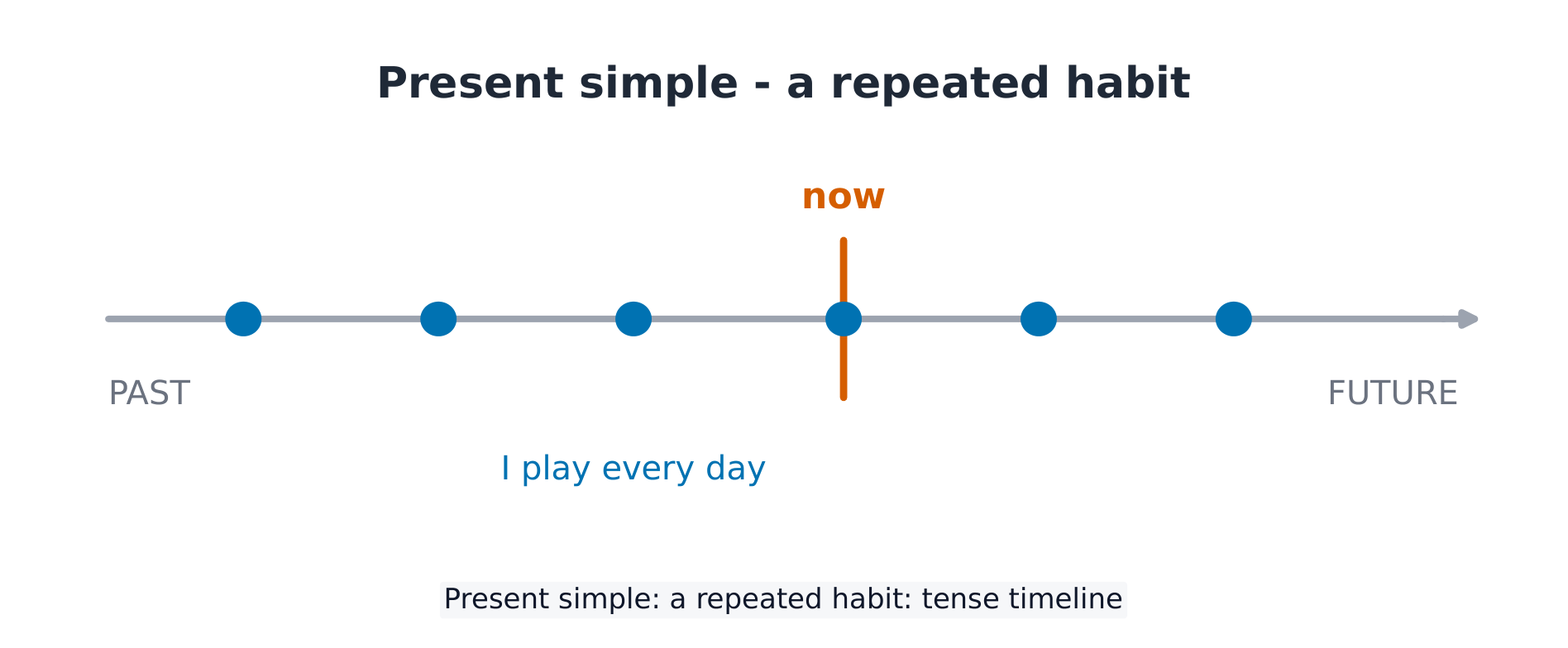
    The present simple tense is used to talk about things that happen regularly and facts that are always true: daily habits, schedules, scientific facts.

    Structure: 主语 + 动词原形

    我I 喝drink 咖啡coffee 每every 早上morning.

    I drink coffee every morning.

    我们We 住live 在in 上海Shanghai.

    We live in Shanghai.

    Scientific facts also use the present simple:

    水Water 沸腾boils 在at 一one 百hundred 度degrees.

    Water boils at one hundred degrees Celsius.

    It is often used with adverbs of frequency: always, usually, often, sometimes, never.

    她She 总是always 乘坐takes (冠词)the 公交车bus.

    She always takes the bus.

    Note

    • When talking about current habits, do not add a be verb: ~~I am drink coffee~~ ✗ → I drink coffee ✓.
    • Adverbs of frequency usually go before the main verb, but after the be verb: She is often late.
    Português
    一般现在时:反复的习惯

    Present simple é usado para falar sobre coisas que acontecem com frequência e fatos sempre verdadeiros: hábitos diários, horários,常识 científicas。

    结构: 主语 + 动词原形

    我I 喝drink 咖啡coffee 每every 早上morning.

    我每天早上喝咖啡。

    我们We 住live 在in 上海Shanghai.

    我们住在上海。

    科学事实也用一般现在时:

    水Water 沸腾boils 在at 一one 百hundred 度degrees.

    水在一百度时沸腾。

    Frequentemente combinado com adverbs of frequency: always(sempre), usually(costume), often(frequentemente), sometimes(às vezes), never(nunca)。

    她She 总是always 乘坐takes (冠词)the 公交车bus.

    她总是乘公交车。

    注意

    • Para falar sobre hábitos atuais, não use verbo be:~~I am drink coffee~~ ✗ → I drink coffee ✓。
    • Adverbs of frequency geralmente vêm antes do verbo principal, mas depois do verbo be:She is often late.(Ela frequentemente chega atrasada。)
    1.2

    Terceira pessoa do singular -s (Third person -s)

    English

    When the subject is he / she / it (third person singular), the verb takes -s or -es.

    Structure: He / She / It + 动词 + -s

    他He 工作works 在in 一家a 银行bank.

    He works at a bank.

    我的My 姐姐sister 喜欢likes 音乐music.

    My sister likes music.

    Spelling rules:

    • Generally add -s directly: work → works, play → plays.
    • Ends in -s / -sh / -ch / -x / -o, add -es: watch → watches, go → goes.
    • Consonant letter + -y ending, change y to i and add -es: study → studies, fly → flies.

    她She 看watches 电视TV 在at 晚上night.

    She watches TV at night.

    Note

    • Only he / she / it takes -s; I / you / we / they do not take it: ~~They likes~~ ✗ → They like ✓.
    • have is special: he / she / it uses has (not ~~haves~~).
    Português

    Quando o sujeito é he / she / it(terceira pessoa do singular), o verbo recebe -s ou **-es。

    结构: He / She / It + 动词 + -s

    他He 工作works 在in 一家a 银行bank.

    他在一家银行工作。

    我的My 姐姐sister 喜欢likes 音乐music.

    我姐姐喜欢音乐。

    拼写规则:

    • Geralmente adiciona diretamente -s:work → works,play → plays。
    • Terminados em -s / -sh / -ch / -x / -o, adiciona -es:watch → watches,go → goes。
    • Consoante + terminação -y, muda y para i e adiciona -es:study → studies,fly → flies。

    她She 看watches 电视TV 在at 晚上night.

    她晚上看电视。

    注意

    • Apenas he / she / it adiciona -s;I / you / we / they não adicionam:~~They likes~~ ✗ → They like ✓。
    • have é especial:he / she / it usa has(não ~~haves~~)。
    1.3

    Negação e Pergunta (Negatives & questions)

    English

    For negative and interrogative forms in the Present Simple, use the auxiliary verb do / does. Use does for he / she / it, and do for other subjects.

    Negative structure: 主语 + don't / doesn't + 动词原形

    我I 不don't 吃eat 肉meat.

    I don't eat meat.

    他He 不doesn't 喜欢like 咖啡coffee.

    He doesn't like coffee.

    Interrogative structure: Do / Does + 主语 + 动词原形 ?

    (助动词)Do 你you 说speak 英语English?

    Do you speak English?

    (助动词)Does 她she 工作work 这里here?

    Does she work here?

    Short answers: Yes, I do. / No, he doesn't.

    Note

    • After using do / does, the verb returns to its base form (no longer adds -s): ~~He doesn't likes~~ ✗ → He doesn't like ✓.
    • Don't forget the auxiliary verb: in formal contexts say Do you…?, not just ~~You speak English?~~.

    Common Errors

    • ❌ ~~She don't like it.~~ → ✓ She doesn't like it. — For third-person singular negatives, use doesn't, not don't.
    • ❌ ~~Does he has a car?~~ → ✓ Does he have a car? — When using does, even has reverts to the base form have.
    • ❌ ~~Everyone know the answer.~~ → ✓ Everyone knows the answer. — everyone / everybody / nobody are treated as singular, so add -s to the verb.
    • ❌ ~~I am usually going to school by bike.~~ → ✓ I usually go to school by bike. — Repeated habits use the Present Simple, not the continuous tense.
    Português

    Negações e perguntas no present simple exigem o auxiliar do / does.he / she / it usa does, outros sujeitos usam **do。

    否定结构: 主语 + don't / doesn't + 动词原形

    我I 不don't 吃eat 肉meat.

    我不吃肉。

    他He 不doesn't 喜欢like 咖啡coffee.

    他不喜欢咖啡。

    疑问结构: Do / Does + 主语 + 动词原形 ?

    (助动词)Do 你you 说speak 英语English?

    你会说英语吗?

    (助动词)Does 她she 工作work 这里here?

    她在这里工作吗?

    Respostas curtas:Yes, I do. / No, he doesn't。

    注意

    • Após usar do / does, o verbo volta para a forma base(sem -s):~~He doesn't likes~~ ✗ → He doesn't like ✓。
    • Não esqueça o auxiliar: em contextos formais diga Do you…?, não apenas ~~You speak English?~~

    常见错误

    • ❌ ~~She don't like it.~~ → ✓ She doesn't like it. — A negação na terceira pessoa do singular usa doesn't, não don't。
    • ❌ ~~Does he has a car?~~ → ✓ Does he have a car? — Após usar does, even has volta para a forma base have。
    • ❌ ~~Everyone know the answer.~~ → ✓ Everyone knows the answer. — everyone / everybody / nobody são tratados como singular, o verbo adiciona -s。
    • ❌ ~~I am usually going to school by bike.~~ → ✓ I usually go to school by bike. — Hábitos repetitivos usam present simple, não continuous。
  • 2 Present continuous
    2.1

    Estrutura (be + V-ing)

    English

    The Present Continuous tense describes actions that are happening right now.

    Structure: 主语 + am / is / are + 动词-ing(I → am; he / she / it → is; you / we / they → are)

    我I 正在am 读reading 一本a 书book.

    I am reading a book.

    他们They 正在are 踢playing 足球football.

    They are playing football.

    Spelling of -ing:

    • Generally add -ing directly: read → reading.
    • End in silent -e, drop e and add -ing: make → making, write → writing.
    • Stressed closed syllable (consonant + vowel + consonant), double the final consonant: run → running, sit → sitting.

    她She 正在is 写writing 一封an 电子邮件email.

    She is writing an email.

    Note

    • Don't forget the be verb: ~~I reading~~ ✗ → I am reading ✓.
    • State verbs (like, know, want, have = possess) generally do not use the continuous tense: ~~I am knowing~~ ✗ → I know ✓.
    Português
    She is reading a book — uma ação acontecendo agora.

    Present continuous indica ações que estão **ocorrendo neste momento。

    Estrutura: 主语 + am / is / are + 动词-ing(I → am;he / she / it → is;you / we / they → are)

    我I 正在am 读reading 一本a 书book.

    我正在读一本书。

    他们They 正在are 踢playing 足球football.

    他们正在踢足球。

    Ortografia de -ing:

    • Geralmente adiciona diretamente -ing:read → reading。
    • Terminados em -e mute, retire o e e adicione -ing:make → making,write → writing。
    • Sílabas fechadas tônicas(consoante + vogal + consoante), duplica a última consoante:run → running,sit → sitting。

    她She 正在is 写writing 一封an 电子邮件email.

    她正在写一封电子邮件。

    注意

    • Não esqueça o verbo be:~~I reading~~ ✗ → I am reading ✓。
    • Verbs de estado(like, know, want, have = possuir) geralmente não usam continuous:~~I am knowing~~ ✗ → I know ✓。
    2.2

    Present continuous vs Present simple

    English

    Both tenses relate to "now," but their meanings differ:

    • Present Simple: Habits or repeated actions.
    • Present Continuous: Actions happening at this very moment.

    他He 通常usually 步行walks 去to 上班work.

    He usually walks to work. (Habit → Present Simple)

    今天Today 他he 正在is 乘坐taking (冠词)the 公交车bus.

    He is taking the bus today. (Right now → Present Continuous)

    Time expressions help distinguish them:

    • Present Simple: every day, usually, often, always.
    • Present Continuous: now, right now, at the moment, today.

    Note

    • Temporary situations use the continuous tense: She is living with her aunt this month. (She is temporarily staying with her aunt this month.)
    • Long-term facts use the Present Simple: She lives in Beijing. (She lives in Beijing.)

    Common Errors

    • ❌ ~~They are play football now.~~ → ✓ They are playing football now. — With be, the verb must also take -ing; both elements are required.
    • ❌ ~~She is cooking every day.~~ → ✓ She cooks every day. — every day signals a habit, so use the Present Simple.
    • ❌ ~~Where is Tom? — He plays football.~~ → ✓ He is playing football. — To answer "what is he doing right now?", use the continuous tense.
    • ❌ ~~He is writeing a letter.~~ → ✓ He is writing a letter. — Verbs ending in a silent -e drop the e before adding -ing.
    Português

    两个时态都和"现在"有关,但意思不同:

    • 一般现在时:习惯、反复发生的事。
    • 现在进行时:此刻正在做的事。

    他He 通常usually 步行walks 去to 上班work.

    他通常步行上班。(习惯 → 一般现在时)

    今天Today 他he 正在is 乘坐taking (冠词)the 公交车bus.

    今天他在坐公交车。(此刻 → 现在进行时)

    时间词帮你判断:

    • Present simple: every day, usually, often, always。
    • Present continuous: now, right now, at the moment, today。

    注意

    • Situações temporárias usam continuous:She is living with her aunt this month.(Este mês ela mora temporariamente com a tia。)
    • Fatos de longo prazo usam present simple:She lives in Beijing.(Ela mora em Pequim。)

    常见错误

    • ❌ ~~They are play football now.~~ → ✓ They are playing football now. — Com be, o verbo ainda precisa de -ing; ambos são indispensáveis。
    • ❌ ~~She is cooking every day.~~ → ✓ She cooks every day. — every day é sinal de hábito, use present simple。
    • ❌ ~~Where is Tom? — He plays football.~~ → ✓ He is playing football. — Responder "o que ele está fazendo agora" exige continuous。
    • ❌ ~~He is writeing a letter.~~ → ✓ He is writing a letter. — Verbos terminados em -e mute retiram o e antes de adicionar -ing。
  • 3 Past simple
    3.1

    Verbos Regulares (-ed)

    English

    The Past Simple tense describes actions or states that were completed in the past. Regular verbs add -ed to the end.

    Structure: 主语 + 动词-ed(same for all persons)

    我I 看watched 一部a 电影film 昨天yesterday.

    I watched a movie yesterday.

    我们We 打played 篮球basketball 上last 周week.

    We played basketball last week.

    Spelling of -ed:

    • Generally add -ed directly: work → worked, play → played.
    • End in -e, only add -d: like → liked, live → lived.
    • Consonant + -y ending, change y to i and add -ed: study → studied, try → tried.
    • Stressed closed syllable, double the final consonant: stop → stopped, plan → planned.

    Note

    • The past tense form does not change based on person: I worked, she worked (no -s).
    • Often used with past time markers: yesterday, last week, in 2019, two days ago.
    Português
    一般过去时:已结束的动作

    Past simple indica ações ou estados concluídos no passado. Verbos regulares adicionam -ed ao final。

    结构: 主语 + 动词-ed(所有人称都一样)

    我I 看watched 一部a 电影film 昨天yesterday.

    我昨天看了一部电影。

    我们We 打played 篮球basketball 上last 周week.

    我们上周打了篮球。

    Ortografia de -ed:

    • Geralmente adiciona diretamente -ed:work → worked,play → played。
    • Terminados em -e, adicionam apenas -d:like → liked,live → lived。
    • Consoante + terminação -y, muda y para i e adiciona -ed:study → studied,try → tried。
    • Sílabas fechadas tônicas, duplicam a última consoante:stop → stopped,plan → planned。

    注意

    • A forma do verbo no passado não varia por pessoa:I worked, she worked(sem -s)。
    • Frequentemente combinado com expressões de tempo passado:yesterday, last week, in 2019, two days ago。
    3.2

    不规则动词

    English

    Many common verbs are irregular; their past forms must be memorized individually without adding -ed.

    我I 去went (介词)to 北京Beijing 上last 月month.

    I went to Beijing last month.

    她She 看见saw 她的her 朋友friends.

    She met her friend.

    High-frequency irregular verbs you must memorize:

    • go → went, have → had, do → did, make → made.
    • see → saw, come → came, get → got, take → took.
    • eat → ate, buy → bought, think → thought, say → said.

    我们We (吃了)had 一顿a 丰盛的big 晚餐dinner.

    We had a big dinner.

    Note these follow no pattern; practice reading and memorizing them frequently.

    Português

    Muitos verbos comuns são irregulares, seu passado deve ser memorizado separadamente, sem -ed。

    我I 去went (介词)to 北京Beijing 上last 月month.

    我上个月去了北京。

    她She 看见saw 她的her 朋友friends.

    她见到了她的朋友。

    一定要背的高频不规则动词:

    • go → went,have → had,do → did,make → **made。
    • see → saw,come → came,get → got,take → **took。
    • eat → ate,buy → bought,think → thought,say → **said。

    我们We (吃了)had 一顿a 丰盛的big 晚餐dinner.

    我们吃了一顿丰盛的晚餐。

    注意 这些没有规律,只能多读多记。

    3.3

    Negação e Pergunta (did)

    English

    For negative and interrogative forms in the Past Simple, use the auxiliary did (past form). The following verb returns to its base form.

    Negative structure: 主语 + didn't + 动词原形

    我I 没有didn't 去go (介词)to 上学school.

    I didn't go to school.

    Interrogative structure: Did + 主语 + 动词原形 ?

    (助动词)Did 你you 看见see (冠词)the 电影film?

    Did you see that movie?

    Short answers: Yes, I did. / No, I didn't.

    Note

    • After using did / didn't, the verb must be in the base form: ~~I didn't went~~ ✗ → I didn't go ✓.
    • The past tense of the be verb (was / were) does not use did: Were you tired? (Were you tired?)

    Common Errors

    • ❌ ~~I go to Beijing last month.~~ → ✓ I went to Beijing last month. — Chinese verbs do not change form, but in English, once a past time marker is present, you must switch to the past tense. This is the most common error.
    • ❌ ~~She buyed a new phone.~~ → ✓ She bought a new phone. — Irregular verbs cannot simply add -ed.
    • ❌ ~~I didn't was hungry.~~ → ✓ I wasn't hungry. — For negative sentences with the verb 'be', use wasn't / weren't directly, not didn't.
    • ❌ ~~yesterday night~~ → ✓ last night — Fixed expression: 'last night' is used for last evening, not 'yesterday night' (though 'yesterday morning/afternoon' is correct).
    Português

    Negativo e interrogativo no passado simples, usa o auxiliar did (passado). O verbo seguinte volta para a forma base.

    否定结构: 主语 + didn't + 动词原形

    我I 没有didn't 去go (介词)to 上学school.

    我没去上学。

    疑问结构: Did + 主语 + 动词原形 ?

    (助动词)Did 你you 看见see (冠词)the 电影film?

    你看那部电影了吗?

    Resposta curta: Yes, I did. / No, I didn't.

    注意

    • Ao usar did / didn't, o verbo deve estar obrigatoriamente na forma base: ~~I didn't went~~ ✗ → I didn't go ✓.
    • O verbo ser/estar (was / were) no passado não usa did: Were you tired?(Você estava cansado?)

    常见错误

    • ❌ ~~I go to Beijing last month.~~ → ✓ Eu fui a Pequim mês passado. — O verbo chinês não se flexiona, mas em inglês, ao indicar tempo passado, é obrigatório mudar para o passado simples; este é o erro mais comum de hábito.
    • ❌ ~~She buyed a new phone.~~ → ✓ Ela comprou um celular novo. — Verbos irregulares não aceitam -ed adicionado forçosamente.
    • ❌ ~~I didn't was hungry.~~ → ✓ Eu não estava com fome. — Para negar o verbo ser/estar, usa-se wasn't / weren't diretamente, sem did.
    • ❌ ~~yesterday night~~ → ✓ last night — Expressão fixa: "ontem à noite" é last night, não yesterday night (mas yesterday morning / afternoon está correto).
  • 4 Past continuous
    4.1

    Estrutura (was / were + V-ing)

    English

    The past continuous tense describes an action in progress at a specific moment in the past.

    Structure: 主语 + was / were + 动词-ing(I / he / she / it → was; you / we / they → were)

    在At 八点eight 我I (过去进行)was 做饭cooking.

    I was cooking at eight o'clock.

    他们They (过去进行)were 看watching 电视TV.

    They were watching TV at that time.

    Note

    • Don't mix up was and were: Use was for I / he / she / it; use were for you / we / they.
    • Negative: wasn't / weren't + V-ing. Question: Was / Were + subject + V-ing?
    Português
    Passado Contínuo: was / were + V-ing

    O Passado Contínuo (past continuous) indica uma ação que estava sendo realizada em um momento específico do passado.

    Estrutura: 主语 + was / were + 动词-ing(I / he / she / it → was; you / we / they → were)

    在At 八点eight 我I (过去进行)was 做饭cooking.

    八点的时候我正在做饭。

    他们They (过去进行)were 看watching 电视TV.

    他们当时正在看电视。

    注意

    • Não confunda was e were: I / he / she / it usa was; you / we / they usa were.
    • Negativo: wasn't / weren't + V-ing. Interrogativo: Was / Were + sujeito + V-ing?
    4.2

    when vs while

    English

    The past continuous is often used with the simple past to describe "an ongoing action interrupted by another event".

    • while + past continuous (the longer background action).
    • when + simple past (the sudden, short action).

    当...时While 我I (过去进行)was 睡觉sleeping (冠词), the 电话phone 响了rang.

    The phone rang while I was sleeping.

    她She (过去进行)was 做饭cooking 当...时when 我I 到达arrived.

    When I arrived, she was cooking.

    Compare the two tenses:

    • The ongoing background action → Past continuous (was cooking).
    • The short action that interrupts it → Simple past (arrived).

    Note

    • Two long actions happening simultaneously both use the past continuous: While I was reading, she was writing (I was reading, and she was writing).
    • 'when' can also be followed by the past continuous, but the meaning changes. Beginners should first memorize the common collocations mentioned above.

    Common Errors

    • ❌ ~~I was watch TV when he called.~~ → ✓ I was watching TV when he called. — After was / were, you must use the -ing form.
    • ❌ ~~They was playing games.~~ → ✓ They were playing games. — Use were for you / we / they.
    • ❌ ~~When I was arriving, she was cooking.~~ → ✓ When I arrived, she was cooking. — Arriving is a brief, instantaneous action, so use the simple past; only the longer background action uses the continuous form.
    • ❌ ~~I was knowing the answer.~~ → ✓ I knew the answer. — Stative verbs (know, like, want) are also generally not used in the continuous form in the past tense.
    Português

    过去进行时常和一般过去时一起用,描述"一件事发生时,另一件正在进行"。

    • while + passado contínuo(ação longa de fundo).
    • when + passado simples(ação curta e súbita).

    当...时While 我I (过去进行)was 睡觉sleeping (冠词), the 电话phone 响了rang.

    我睡觉的时候,电话响了。

    她She (过去进行)was 做饭cooking 当...时when 我I 到达arrived.

    我到的时候她正在做饭。

    对比两个时态:

    • Ação de fundo em andamento → passado contínuo (was cooking).
    • Ação curta que interrompe → passado simples (arrived).

    注意

    • Duas ações longas ocorrendo simultaneamente usam ambos o passado contínuo: While I was reading, she was writing.(Eu estava lendo, ela estava escrevendo.)
    • When também pode vir acompanhado de passado contínuo, mas o sentido muda; para iniciantes, memorize as combinações comuns acima primeiro.

    常见错误

    • ❌ ~~I was watch TV when he called.~~ → ✓ Eu estava assistindo TV quando ele ligou. — Após was / were deve haver a forma -ing.
    • ❌ ~~They was playing games.~~ → ✓ Eles estavam jogando jogos. — you / we / they usa were.
    • ❌ ~~When I was arriving, she was cooking.~~ → ✓ Quando eu cheguei, ela estava cozinhando. — Chegar é uma ação curta instantânea, usa-se passado simples; apenas ações longas de fundo usam o contínuo.
    • ❌ ~~I was knowing the answer.~~ → ✓ Eu sabia a resposta. — Verbos de estado (know, like, want) também não usam contínuo no passado.
  • 5 Present perfect
    5.1

    Estrutura (have / has + particípio passado)

    English

    The present perfect tense connects the past and the present: a past action has an effect on the present now, or it refers to life experience.

    Structure: 主语 + have / has + 过去分词(he / she / it → has)

    我I (完成时)have 完成finished 我的my 作业homework.

    I have finished my homework. (So I am free now)

    她She (完成时)has 丢失lost 她的her 钥匙keys.

    She has lost her keys. (She hasn't found them yet)

    Past Participle:

    • Regular verbs = -ed: work → worked, finish → finished.
    • Irregular verbs must be memorized: go → gone, see → seen, do → done, be → been, eat → eaten.

    Note: Present perfect usually does not specify exact times. If you mention a specific past time (yesterday, in 2019), use the simple past instead.

    Português
    现在完成时:连接过去与现在

    O Presente Perfeito (present perfect) conecta o passado ao presente: algo feito no passado tem impacto agora, ou trata-se de uma experiência.

    Estrutura: 主语 + have / has + 过去分词(he / she / it → has)

    我I (完成时)have 完成finished 我的my 作业homework.

    我已经做完作业了。(所以现在我有空)

    她She (完成时)has 丢失lost 她的her 钥匙keys.

    她把钥匙弄丢了。(现在还没找到)

    Particípio Passado (past participle):

    • Verbos regulares = -ed: work → worked, finish → finished.
    • Irregulares devem ser decorados: go → gone, see → seen, do → done, be → been, eat → eaten.

    Atenção o Presente Perfeito geralmente não usa tempo específico; se quiser dizer tempo passado exato (yesterday, in 2019), use o Passado Simples.

    5.2

    ever / never / just / already / yet

    English

    These words are frequently used with the present perfect tense:

    • ever: Used in questions to mean "at any time." never: "not ever."
    • just: "just now." already: "already." yet: Used at the end of negative or interrogative sentences to mean "not yet."

    (完成时)Have 你you 曾经ever 去过been (介词)to 伦敦London?

    Have you ever been to London?

    我I (完成时)have 刚刚just 吃过eaten 午饭lunch.

    I have just had lunch.

    他He 还没hasn't 完成finished (句末"还没")yet.

    He hasn't finished yet.

    Português

    这几个词常和现在完成时连用:

    • ever: em perguntas significa "já/alguém alguma vez". never: "nunca".
    • just: "acabar de". already: "já". yet: usado no final de frases negativas/interrogativas, "ainda (não)".

    (完成时)Have 你you 曾经ever 去过been (介词)to 伦敦London?

    你去过伦敦吗?

    我I (完成时)have 刚刚just 吃过eaten 午饭lunch.

    我刚吃过午饭。

    他He 还没hasn't 完成finished (句末"还没")yet.

    他还没做完。

    5.3

    for vs since

    English

    To say how long something has "continued," use for or since:

    • for + a period of time: for three years, for a week.
    • since + starting point: since 2020 (from the year 2020), since Monday (from Monday).

    我I (完成时)have 住lived 这里here (持续)for 五five 年years.

    I have lived here for five years. (And I still live here)

    我们We (完成时)have 认识known 彼此each other 自从since 2018年2018.

    We have known each other since 2018.

    Note: Use 'for' with duration and 'since' with a starting point; don't mix them up: ~~for 2018~~ ✗ → since 2018 ✓.

    Common Errors

    • ❌ ~~I have seen him yesterday.~~ → ✓ I saw him yesterday. — Once a specific past time is mentioned (yesterday, last week, in 2019), switch to the simple past.
    • ❌ ~~I live here for ten years.~~ → ✓ I have lived here for ten years. — "Lived here for ten years and still live here" requires the present perfect. Chinese lacks this distinction, making it easy to overlook.
    • ❌ ~~She has go home.~~ → ✓ She has gone home. — After have / has, use the past participle, not the base form.
    • ❌ ~~Have you ever went to Beijing?~~ → ✓ Have you ever been to Beijing? — Use have been to for "visited a place."
    • Distinguish gone and been: He has gone to Beijing. (He went there and hasn't returned yet) vs He has been to Beijing. (He visited there and has come back).
    Português

    Para dizer quanto tempo algo "durou", use for ou since:

    • for + período de tempo: for three years (três anos), for a week (uma semana).
    • since + ponto de partida: since 2020 (desde 2020), since Monday (desde segunda-feira).

    我I (完成时)have 住lived 这里here (持续)for 五five 年years.

    我在这里住了五年了。(现在还住着)

    我们We (完成时)have 认识known 彼此each other 自从since 2018年2018.

    我们从 2018 年就认识了。

    Atenção for pede "quanto tempo", since pede "de quando"; não misture: ~~for 2018~~ ✗ → since 2018 ✓.

    常见错误

    • ❌ ~~I have seen him yesterday.~~ → ✓ Eu o vi ontem. — Ao citar tempo passado específico (yesterday, last week, in 2019), mude para o Passado Simples.
    • ❌ ~~I live here for ten years.~~ → ✓ Eu morro aqui há dez anos. — "Mora há dez anos e ainda mora" exige Presente Perfeito; em chinês não há essa distinção,容易漏易漏 (fácil esquecer).
    • ❌ ~~She has go home.~~ → ✓ Ela foi para casa. — After have / has comes o particípio passado, não a forma base.
    • ❌ ~~Have you ever went to Beijing?~~ → ✓ Você já foi a Pequim? — "Ir a algum lugar" usa have been to.
    • Diferença entre gone e been: He has gone to Beijing.(Foi, ainda não voltou) vs He has been to Beijing.(Já esteve/voltou).
  • 6 Talking about the future
    6.1

    will

    English

    will is used to talk about the future, especially spontaneous decisions, predictions, and promises.

    Structure: 主语 + will + 动词原形(Same for all persons; will not = won't)

    我I 将will 打电话call (给你)you 今晚tonight.

    I will call you tonight.

    (天气it)It 将will 下雨rain 明天tomorrow.

    It will rain tomorrow.

    Note

    • Use the base form of the verb after will: ~~will to go~~ ✗ → will go ✓.
    • Negative uses won't: I won't be late. (I will not be late.)
    Português
    Futuro: will / going to

    will usa-se para falar do futuro, especialmente decisões momentâneas, previsões e promessas.

    Estrutura: 主语 + will + 动词原形(todos os sujeitos iguais; will not = won't)

    我I 将will 打电话call (给你)you 今晚tonight.

    我今晚给你打电话。

    (天气it)It 将will 下雨rain 明天tomorrow.

    明天会下雨。

    注意

    • Após will usa-se a forma base do verbo: ~~will to go~~ ✗ → will go ✓.
    • Negativo usa won't: I won't be late.(Não chegarei atrasado.)
    6.2

    be going to

    English

    be going to is used to talk about plans and predictions based on current evidence.

    Structure: 主语 + am / is / are + going to + 动词原形

    我们We (be)are 打算going to 拜访visit 我们的our 奶奶grandma.

    We are going to visit Grandma. (A plan already made)

    看Look (介词)at (冠词)the 云clouds (天气it)! It (be)is 将要going to 下雨rain.

    Look at those clouds! It's going to rain. (Based on current signs)

    will or going to?

    • Spontaneous decision → will: The phone is ringing. I'll get it. (Phone rings, I decide now to answer.)
    • Pre-planned intention → going to: I'm going to study tonight. (I have planned to study tonight.)
    Português

    be going to usa-se para falar de planos e previsões baseadas no cenário atual.

    结构: 主语 + am / is / are + going to + 动词原形

    我们We (be)are 打算going to 拜访visit 我们的our 奶奶grandma.

    我们打算去看奶奶。(已有计划)

    看Look (介词)at (冠词)the 云clouds (天气it)! It (be)is 将要going to 下雨rain.

    看那些云!要下雨了。(有现状作依据)

    will ou going to?

    • Decisão momentânea → will: The phone is ringing. I'll get it.(O telefone está tocando. Vou atender.)
    • Plano prévio → going to: I'm going to study tonight.(Vou estudar esta noite.)
    6.3

    现在进行时表将来计划

    English

    The present continuous can also express scheduled future events (especially when there is a definite time or place).

    Structure: 主语 + am / is / are + 动词-ing + 将来时间

    我I (be)am 见面meeting 汤姆Tom 明天tomorrow.

    I am meeting Tom tomorrow. (An appointment has been set)

    我们We (be)are 飞flying 去to 东京Tokyo 在on 周五Friday.

    We are flying to Tokyo on Friday. (Tickets are booked)

    Note: This usage emphasizes that something is "already arranged," which is similar to 'be going to'; the key factor is having a definite future time.

    Common Errors

    • ❌ ~~I go to Shanghai tomorrow.~~ → ✓ I am going to Shanghai tomorrow. / I will go… — The Chinese "I go to Shanghai tomorrow" lacks a future marker; English requires adding (will / going to / present continuous).
    • ❌ ~~We will going to visit grandma.~~ → ✓ We are going to visit… / We will visit… — will and be going to are separate structures and cannot be combined.
    • ❌ ~~She will comes tomorrow.~~ → ✓ She will come tomorrow. — After will, use the base form of the verb; no -s is added for any person.
    • Exception: Timetables (trains, flights, classes) can use the simple present to express the future: The train leaves at 9. (The train leaves at nine o'clock.)
    Português

    现在进行时也能表示已经安排好的将来(尤其有明确时间 / 地点时)。

    结构: 主语 + am / is / are + 动词-ing + 将来时间

    我I (be)am 见面meeting 汤姆Tom 明天tomorrow.

    我明天要见汤姆。(已约好)

    我们We (be)are 飞flying 去to 东京Tokyo 在on 周五Friday.

    我们周五飞东京。(机票已订)

    Atenção este uso enfatiza "já organizado"; é muito próximo de be going to; o diferencial é ter um tempo futuro definido.

    常见错误

    • ❌ ~~I go to Shanghai tomorrow.~~ → ✓ Eu irei para Xangai amanhã. / Eu vou ir... — Em chinês "eu vou para Xangai amanhã" não tem marca de futuro, mas em inglês é obrigatório adicionar (will / going to / contínuo).
    • ❌ ~~We will going to visit grandma.~~ → ✓ Nós vamos visitar vovó... / Nós iremos visitar... — will e be going to são sistemas separados, não podem ser mesclados.
    • ❌ ~~She will comes tomorrow.~~ → ✓ Ela virá amanhã. — Após will usa-se a forma base, nenhum sujeito recebe -s.
    • Exceção: Horários (de trem, voo, aula) podem usar o presente simples para indicar futuro: O trem parte às 9.
  • 7 Comparatives and superlatives · ⁨Comparativos e superlativos⁩
    7.1

    Comparativos

    English

    Comparatives are used to compare two things, often used with than (compared to).

    Short adjectives + -er; long adjectives use more + adjective.

    我的My 包bag 是is 更大bigger 比than 你的yours.

    My bag is bigger than yours.

    这This 书book 是is 更more 有趣interesting 比than 那本that one.

    This book is more interesting than that one.

    Formation Rules:

    • Monosyllabic: add -er → tall → taller, fast → faster.
    • Ending in consonant + y: change y to i and add -er → happy → happier, easy → easier.
    • Two or more syllables: use more → expensive → more expensive.
    • Irregular: good → better, bad → worse, far → further.

    Note: Avoid "double comparison": ~~more bigger~~ ✗ → bigger ✓.

    Português
    比较级 → 最高级

    Comparativos servem para comparar duas coisas, frequentemente acompanhados por than (do que).

    Adjetivos curtos + -er; adjetivos longos usam more + adjetivo.

    我的My 包bag 是is 更大bigger 比than 你的yours.

    我的包比你的大。

    这This 书book 是is 更more 有趣interesting 比than 那本that one.

    这本书比那本有趣。

    构成规则:

    • Monossílabos: adiciona -er → tall → taller, fast → faster.
    • Terminação consoante + y: y vira i e adiciona -er → happy → happier, easy → easier.
    • Dois ou mais sílabas: usa more → expensive → more expensive.
    • Irregulares: good → better, bad → worse, far → further.

    Atenção evite "dupla comparação": ~~more bigger~~ ✗ → bigger ✓.

    7.2

    Superlativos

    English

    Superlatives indicate "the most …" (three or more), preceded by the.

    Short adjectives + -est; long adjectives use the most + adjective.

    他He 是is (冠词)the 最高tallest 在in (冠词)the 班级class.

    He is the tallest in the class.

    这This 是is (冠词)the 最most 贵expensive 手机phone.

    This is the most expensive phone.

    Formation Rules:

    • Monosyllabic: the + -est → fast → the fastest.
    • Long adjectives: the most → the most beautiful.
    • Irregular: good → the best, bad → the worst.

    Note: Do not forget the before superlatives: ~~he is tallest~~ → he is the tallest.

    Português

    Superlativos indicam "mais..." (três ou mais), precedidos por the.

    Adjetivos curtos + -est; adjetivos longos usam the most + adjetivo.

    他He 是is (冠词)the 最高tallest 在in (冠词)the 班级class.

    他是班里最高的。

    这This 是is (冠词)the 最most 贵expensive 手机phone.

    这是最贵的手机。

    构成规则:

    • Monossílabos: the + -est → fast → the fastest.
    • Adjetivos longos: the most → the most beautiful.
    • Irregulares: good → the best, bad → the worst.

    Atenção não esqueça the antes do superlativo: ~~he is tallest~~ → he is the tallest.

    7.3

    as ... as

    English

    as + adjective + as means "as … as …".

    她She 是is 和as 高tall 一样as 她her 妈妈mother.

    She is as tall as her mother.

    Negative not as ... as means "not as … as …":

    今天Today (是)is 不not 像as 热hot 一样as 昨天yesterday.

    It is not as hot today as yesterday.

    Note: Place the base form of the adjective (not the comparative) in the middle: ~~as taller as~~ ✗ → as tall as ✓.

    Common Errors

    • ❌ ~~It is more cheap.~~ → ✓ It is cheaper. — Use -er for monosyllabic adjectives, not more.
    • ❌ ~~He is taller than me a lot.~~ → ✓ He is much taller than me. — "A lot" translates to much, which goes before the comparative.
    • ❌ ~~My bag is bigger than your.~~ → ✓ …bigger than yours. — Use yours / mine / hers (nominal possessive pronouns) after than.
    • ❌ ~~Beijing is bigger than any city in China.~~ → ✓ …than any other city in China. — Do not forget other, otherwise it implies comparing itself to itself.
    Português

    as + adjetivo + as significa "tão... quanto..." / "igual a...".

    她She 是is 和as 高tall 一样as 她her 妈妈mother.

    她和她妈妈一样高。

    Negativo not as ... as significa "não tão... quanto..." / "inferior a...":

    今天Today (是)is 不not 像as 热hot 一样as 昨天yesterday.

    今天没有昨天热。

    Atenção coloque o grau positivo no meio (não comparativo): ~~as taller as~~ ✗ → as tall as ✓.

    常见错误

    • ❌ ~~It is more cheap.~~ → ✓ É mais barato. — Adjetivos monossílabos usam -er, não more.
    • ❌ ~~He is taller than me a lot.~~ → ✓ Ele é muito mais alto que eu. — "Muito" é much, colocado antes do comparativo.
    • ❌ ~~My bag is bigger than your.~~ → ✓ ...maior que o seu. — Após than usa-se yours / mine / hers (pronome possessivo nominal).
    • ❌ ~~Beijing is bigger than any city in China.~~ → ✓ ...maior que qualquer outra cidade na China. — Não esqueça other, senão compara-se consigo mesmo.
  • 8 Articles
    8.1

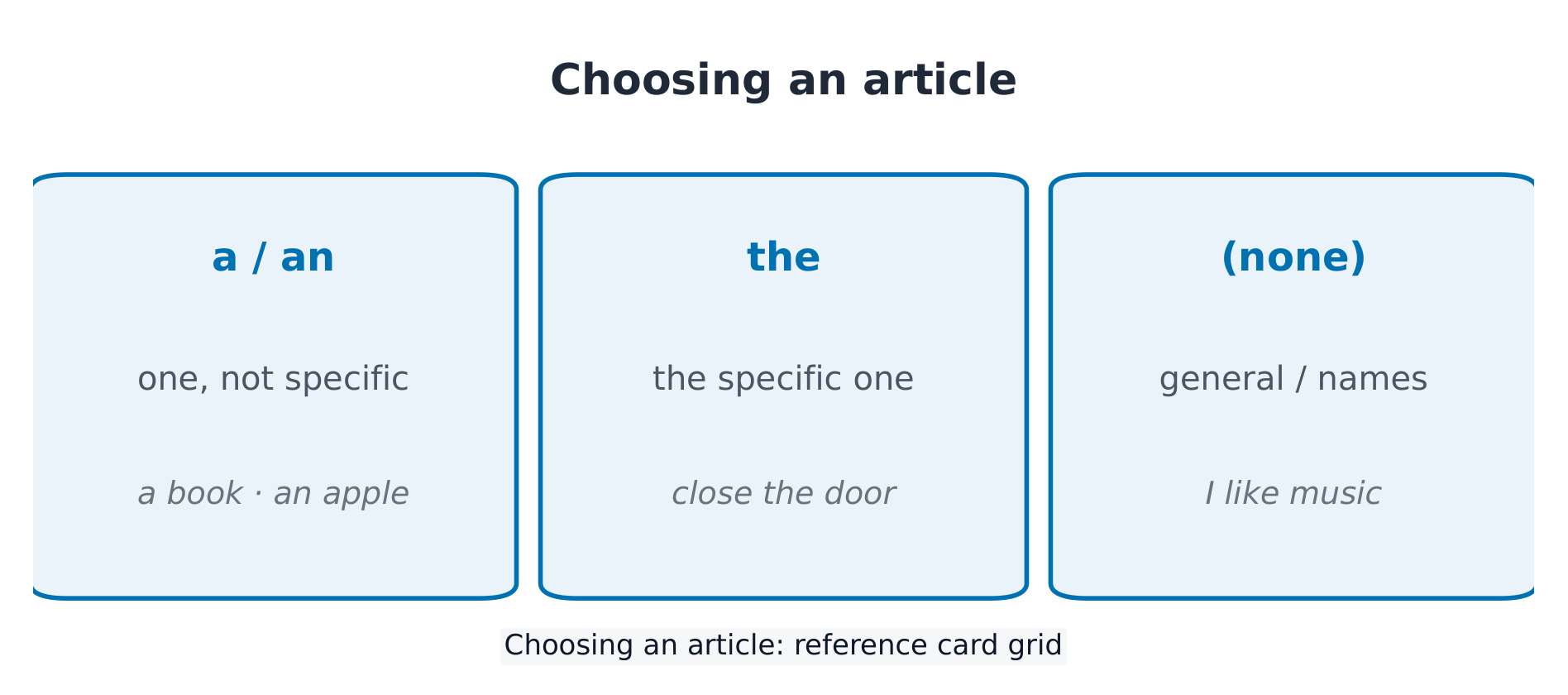
    a / an

    English

    a and an are indefinite articles, used before singular countable nouns to mean "one (non-specific)".

    • a is used before consonant sounds: a book, a car, a university (pronounced /j/ sound).
    • an is used before vowel sounds: an apple, an hour (h is silent).

    我I 有have 一个a 问题question.

    I have a question.

    她She 是is 一名an 工程师engineer.

    She is an engineer.

    Note: Look at the pronunciation, not the letter: an hour (h is silent → an), a university (pronounced /j/ → a).

    Português
    Artigos: a/an · the · zero article

    a e an são artigos indefinidos, usados diante de substantivos singulares contáveis, indicando "um (não especificado)".

    • a vem antes de som consoante: a book, a car, a university (soa /j/).
    • an vem antes de som vogal: an apple, an hour (h não soa).

    我I 有have 一个a 问题question.

    我有一个问题。

    她She 是is 一名an 工程师engineer.

    她是一名工程师。

    Atenção observe a pronúncia, não a letra: an hour (h não soa → an), a university (soa /j/ → a).

    8.2

    the

    English

    the is the definite article, indicating specificity — both speaker and listener know exactly which one.

    请Please 关close (这扇)the 门door.

    Please close (this) door.

    Common uses of the:

    • When mentioned previously or referred to again: I saw a cat. The cat was black. (I saw a cat. That cat was black.)
    • For unique things in the world: the sun, the moon.
    • Before superlatives: the best, the tallest.

    (那个)The 太阳sun 是is 非常very 明亮bright 今天today.

    The sun is very bright today.

    Português

    the é artigo definido, indica especificidade — algo conhecido tanto pelo falante quanto pelo ouvinte.

    请Please 关close (这扇)the 门door.

    请关上(这扇)门。

    Usos comuns de the:

    • Quando já mencionado anteriormente ou citado novamente: I saw a cat. The cat was black.(Vi um gato. O gato era preto.)
    • Coisas únicas no mundo: the sun (sol), the moon (lua).
    • Antes do superlativo: the best, the tallest.

    (那个)The 太阳sun 是is 非常very 明亮bright 今天today.

    今天太阳很亮。

    8.3

    Zero Article (Sem artigo)

    English

    Sometimes no article (zero article) is placed before a noun:

    • Plural / uncountable nouns expressing generalization: I like music. (I like music.) Cats are cute. (Cats are cute.)
    • Proper nouns: names, most countries, cities: China, Tom, Beijing.
    • Some fixed phrases: go to school / bed / work (indicating purpose, without the).

    我I 去go (介词)to 上学school 乘by 自行车bike.

    I go to school by bike.

    水Water 是is 重要important.

    Water is important.

    Note: Do not use the when plural / uncountable nouns express generalization: ~~I like the music~~ (general sense) ✗ → I like music ✓.

    Common Errors

    • ❌ ~~I want to be teacher.~~ → ✓ I want to be a teacher. — Add a / an before professions; direct translation of Chinese "to be a teacher" often omits this.
    • ❌ ~~I went to home.~~ → ✓ I went home. — home is used as an adverb here: go home, get home; do not use to or the before it.
    • ❌ ~~He plays the football.~~ → ✓ He plays football. — No the before sports; but add the for instruments: play the piano / violin.
    • Distinguish: go to school (attend school, purpose) vs go to the school (go to the school building, e.g., parents attending a meeting). Same logic applies to bed / hospital / work.
    Português

    有时名词前不加冠词(零冠词):

    • Substantivos plurais / incontáveis indicando generalização: I like music.(Gosto de música.)Cats are cute.(Gatos são fofos.)*
    • Nomes próprios: nomes de pessoas, maioria dos países e cidades: China, Tom, Beijing.
    • Algumas expressões fixas: go to school / bed / work(indica propósito, sem the).

    我I 去go (介词)to 上学school 乘by 自行车bike.

    我骑自行车上学。

    水Water 是is 重要important.

    水很重要。

    Atenção ao indicar generalização com plurais/incontáveis, não use the: ~~I like the music~~ (generalizado) ✗ → I like music ✓.

    常见错误

    • ❌ ~~I want to be teacher.~~ → ✓ Quero ser um professor. — Profissões exigem a / an; tradução literal de "ser professor" em chinês perde facilmente o artigo.
    • ❌ ~~I went to home.~~ → ✓ Eu fui para casa. — home como advérbio: go home, get home, não leva to nem the.
    • ❌ ~~He plays the football.~~ → ✓ Ele joga futebol. — Esportes não levam the; instrumentos musicais sim: play the piano / violin.
    • Distinção: go to school(ir estudar/frequentar, propósito) vs go to the school(ir ao prédio da escola, p.ex. reunião de pais). Mesma lógica para bed / hospital / work.
  • 9 Countable and uncountable nouns · ⁨Substantivos contáveis e incontáveis⁩
    9.1

    Countable vs Uncountable (Contável vs Incontável)

    English

    English nouns are divided into two categories:

    • Countable nouns: can be counted, have singular and plural forms. a book → two books.
    • Uncountable nouns: cannot be directly counted, have no plural form. water, music, money, information.

    我I 买了bought 三three 苹果apples.

    I bought three apples. (Countable)

    我I 需要need 一些some 水water.

    I need some water. (Uncountable, no ~~waters~~)

    Note

    • Uncountable nouns take a singular verb: The news is good. (The news is good.)
    • To count uncountable nouns, use measure words: a glass of water, a piece of information.
    Português
    Countable vs Uncountable Nouns

    英语名词分两类:

    • Substantivos contáveis (countable): podem ser contados, têm singular e plural. a book → two books.
    • 不可数名词 (uncountable): não pode ser contado diretamente, sem plural. water, music, money, information。

    我I 买了bought 三three 苹果apples.

    我买了三个苹果。(可数)

    我I 需要need 一些some 水water.

    Eu preciso de um pouco de água. (不可数, 没有 ~~waters~~)

    注意

    • 不可数名词用单数动词: The news is good. (消息是好的。)
    • 想数不可数名词, 要借助单位: a glass of water, a piece of information。
    9.2

    some 与 any

    English

    some and any mean "some", used before plurals or uncountable nouns:

    • some: used in affirmative sentences (also used in polite requests / invitations).
    • any: used in negative sentences and interrogative sentences.

    (有)There 有are 一些some 鸡蛋eggs 在in (冠词)the 冰箱里fridge.

    There are some eggs in the fridge.

    (有)There 没有isn't 任何any 牛奶milk.

    There is no milk left.

    (助动词)Do 你you 有have 任何any 问题questions?

    Do you have any questions?

    Note: When offering drinks to others, some is commonly used to sound polite: Would you like some tea?

    Português
    可数名词:水果可以一个一个地数。

    some 和 any 表示"一些", 用在复数或不可数名词前:

    • some: 用于肯定句(也用于客气的请求 / 邀请)。
    • any: 用于否定句和疑问句。

    (有)There 有are 一些some 鸡蛋eggs 在in (冠词)the 冰箱里fridge.

    冰箱里有一些鸡蛋。

    (有)There 没有isn't 任何any 牛奶milk.

    没有牛奶了。

    (助动词)Do 你you 有have 任何any 问题questions?

    你有什么问题吗?

    注意 请别人喝东西时, 常用 some 表示客气: Would you like some tea? (要喝点茶吗?)

    9.3

    much / many / a lot of

    English

    Used to express "a lot":

    • many + countable plural: many books.
    • much + uncountable: much water (mostly used in negative sentences / questions).
    • a lot of + both types (most common in positive sentences).

    (有)There 有are 许多many 人people 这里here.

    There are many people here.

    我们We 没有don't 有have 多少much 时间time.

    We don't have much time left.

    她She 有has 许多a lot of 朋友friends.

    She has a lot of friends.

    Note: In positive sentences, much is rarely used; instead use a lot of: ~~I have much money~~ → I have a lot of money.

    Common Errors

    • ❌ ~~informations / advices / homeworks / furnitures~~ → ✓ information / advice / homework / furniture — These words are uncountable in English (although Chinese can say "several pieces of advice" or "pieces of furniture"). They never take a plural form.
    • ❌ ~~a bread / a paper~~ → ✓ a piece of bread / a piece of paper — Uncountable nouns require measure words to be counted.
    • ❌ ~~How much apples do you want?~~ → ✓ How many apples…? — Use many for countable plurals and much only for uncountable nouns.
    • ❌ ~~There aren't some eggs.~~ → ✓ There aren't any eggs — Replace some with any in negative sentences.
    Português

    表示"很多":

    • many + 可数复数: many books。
    • much + 不可数: much water(多用于否定 / 疑问)。
    • a lot of + 两者都行(肯定句最常用)。

    (有)There 有are 许多many 人people 这里here.

    这里有很多人。

    我们We 没有don't 有have 多少much 时间time.

    我们没多少时间了。

    她She 有has 许多a lot of 朋友friends.

    她有很多朋友。

    注意 肯定句里 much 较少用, 多用 a lot of: ~~I have much money~~ → I have a lot of money。

    常见错误

    • ❌ ~~informations / advices / homeworks / furnitures~~ → ✓ information / advice / homework / furniture — 这些词在英语里不可数(虽然中文能说"几条建议、几件家具"), 永远没有复数。
    • ❌ ~~a bread / a paper~~ → ✓ a piece of bread / a piece of paper — 不可数名词要借单位词来数。
    • ❌ ~~How much apples do you want?~~ → ✓ How many apples…? — 可数复数用 many, 不可数才用 much。
    • ❌ ~~There aren't some eggs.~~ → ✓ There aren't any eggs. — 否定句里 some 换成 any。
  • 10 Modal verbs
    10.1

    can 与 could (能力、请求)

    English

    can expresses ability or possibility; could is the past tense of can, and is also used for more polite requests. All modal verbs are followed by the base form of the verb.

    我I 会can 游泳swim.

    I can swim.

    她She 会could 读read 在at 四岁four.

    She could read at the age of four. (Past ability)

    能Could 你you 帮help 我me 请, please?

    Could you please help me? (Polite request)

    Note

    • After a modal verb, use the base form: ~~can to swim~~ ✗ → can swim ✓.
    • Negative: cannot / can't, could not / couldn't.
    Português
    情态动词:能力/建议/义务

    can 表示能力或可能; could 是 can 的过去式, 也用于更客气的请求。情态动词后面都跟动词原形。

    我I 会can 游泳swim.

    我会游泳。

    她She 会could 读read 在at 四岁four.

    她四岁就会读书了。(过去的能力)

    能Could 你you 帮help 我me 请, please?

    请问你能帮我一下吗?(客气请求)

    注意

    • 情态动词后用原形: ~~can to swim~~ ✗ → can swim ✓。
    • 否定: cannot / can't, could not / couldn't。
    10.2

    should (建议)

    English

    should expresses advice or "should".

    你You 应该should 看see 一位a 医生doctor.

    You should see a doctor.

    我们We 不应该shouldn't 浪费waste 水water.

    We shouldn't waste water.

    Note: should gives advice and is less forceful than must; it is also followed by the base form of the verb.

    Português

    should 表示建议或"应该"。

    你You 应该should 看see 一位a 医生doctor.

    你应该去看医生。

    我们We 不应该shouldn't 浪费waste 水water.

    我们不该浪费水。

    注意 should 给的是建议, 语气比 must 委婉; 后面同样跟动词原形。

    10.3

    must 与 have to (义务)

    English

    Both express "must":

    • must: Often indicates something the speaker considers important, or a rule.
    • have to: Often indicates an external requirement (regulation, objective necessity).

    你You 必须must 系wear (冠词)a 安全带seatbelt.

    You must wear a seatbelt.

    我I 不得不have to 起床get up 早early.

    I have to get up early.

    Note

    • mustn't = "prohibited": You mustn't smoke here. (Smoking is prohibited here.)
    • don't have to = "not necessary": You don't have to come. (You don't need to come.)
    • Note that their meanings are completely different: one means "forbidden," the other means "not necessary."

    Common Errors

    • ❌ ~~You must to wear a helmet.~~ → ✓ You must wear a helmet — All modal verbs (can / could / should / must) are followed directly by the base form and never take to.
    • ❌ ~~She musts study harder.~~ → ✓ She must study harder — Modal verbs do not take a third-person singular -s.
    • ❌ Wanting to say "you don't need to come" but saying ~~You mustn't come.~~ → ✓ You don't have to come — mustn't means "forbidden," while don't have to means "not necessary." Their meanings are exactly opposite.
    • ❌ ~~Yesterday I must work late.~~ → ✓ Yesterday I had to work late — must has no past tense; use had to for past obligations.
    Português

    两者都表示"必须":

    • must: 多表示说话人觉得很重要, 或规则。
    • have to: 多表示外部要求(规定、客观需要)。

    你You 必须must 系wear (冠词)a 安全带seatbelt.

    你必须系安全带。

    我I 不得不have to 起床get up 早early.

    我得早起。

    注意

    • mustn't = "禁止": You mustn't smoke here. (这里禁止吸烟。)
    • don't have to = "不必": You don't have to come. (你不用来。)
    • 注意两者意思完全不同:一个是"禁止",一个是"不必"。

    常见错误

    • ❌ ~~You must to wear a helmet.~~ → ✓ You must wear a helmet. — 所有情态动词(can / could / should / must)后面直接跟原形, 永远不加 to。
    • ❌ ~~She musts study harder.~~ → ✓ She must study harder. — 情态动词没有第三人称 -s。
    • ❌ 想说"你不必来"却说 ~~You mustn't come.~~ → ✓ You don't have to come. — mustn't 是"禁止", don't have to 才是"不必", 意思正好相反。
    • ❌ ~~Yesterday I must work late.~~ → ✓ Yesterday I had to work late. — must 没有过去式, 过去的义务用 had to。
  • 11 Prepositions
    11.1

    时间介词 (at / in / on)

    English

    When indicating time, at / in / on each have specific uses:

    • at + specific time / point: at 7 o'clock, at night, at the weekend.
    • on + specific day / date: on Monday, on May 1st, on my birthday.
    • in + longer period: in the morning, in July, in 2020, in winter.

    (冠词)The 课class 开始starts 在at 九点nine.

    This class starts at nine o'clock.

    我们We 见面met 在on 周五Friday.

    We met on Friday.

    我的My 生日birthday 在is 在in 五月May.

    My birthday is in May.

    Note: The scope increases from small to large: at (point) → on (day) → in (month / year / period).

    Português
    时间介词:at / on / in

    表示时间时, at / in / on 各有分工:

    • at + 具体时刻 / 节点: at 7 o'clock, at night, at the weekend。
    • on + 具体某天 / 日期: on Monday, on May 1st, on my birthday。
    • in + 较长时间段: in the morning, in July, in 2020, in winter。

    (冠词)The 课class 开始starts 在at 九点nine.

    这节课九点开始。

    我们We 见面met 在on 周五Friday.

    我们周五见的面。

    我的My 生日birthday 在is 在in 五月May.

    我的生日在五月。

    注意 范围由小到大: at(点)→ on(天)→ in(月 / 年 / 段)。

    11.2

    地点介词 (at / in / on)

    English

    When indicating location:

    • at + a specific point / place: at the bus stop, at home, at school.
    • in + interior space: in the room, in China, in a box.
    • on + surface / line: on the table, on the wall, on the second floor.

    她She 在is (在)at 家home.

    She is at home.

    (冠词)The 书book 在is 在on (冠词)the 桌子上table.

    The book is on the table.

    (有)There 有are 鱼fish 在in (冠词)the 河里river.

    There are fish in the river.

    Português

    表示地点时:

    • at + 某一点 / 场所: at the bus stop, at home, at school。
    • in + 空间内部: in the room, in China, in a box。
    • on + 表面 / 线上: on the table, on the wall, on the second floor。

    她She 在is (在)at 家home.

    她在家。

    (冠词)The 书book 在is 在on (冠词)the 桌子上table.

    书在桌子上。

    (有)There 有are 鱼fish 在in (冠词)the 河里river.

    河里有鱼。

    11.3

    移动介词 (Prepositions of movement)

    English

    Indicating direction / movement:

    • to: Towards a place. into: Entering inside. out of: Coming out from inside.
    • up (upward) / down (downward) / across (cross over) / through (pass through the interior).

    我I 去go 去to 上班work 乘by 公交车bus.

    I go to work by bus.

    (冠词)The 猫cat 跳jumped 进入into (冠词)the 箱子box.

    The cat jumped into the box.

    Note: to indicates "going somewhere," so do not confuse it with at (being somewhere): go to school (go to school) vs be at school (be at school).

    Common Errors

    • ❌ ~~in Monday~~ → ✓ on Monday; ❌ ~~at July~~ → ✓ in July — Use on for specific days and in for months / years.
    • ❌ ~~in the morning of Monday~~ → ✓ on Monday morning — When referring to the morning / evening of a specific day, the preposition upgrades to on.
    • ❌ ~~I arrived to Beijing.~~ → ✓ I arrived in Beijing. / I arrived at the station — arrive does not take to; use in for large places and at for small locations.
    • ❌ ~~listen music / look the picture / wait him~~ → ✓ listen to music / look at the picture / wait for him — Although these verbs may not take prepositions in Chinese, the corresponding prepositions in English cannot be omitted.
    Português

    表示方向 / 移动:

    • to: 朝向某地。into: 进入里面。out of: 从里面出来。
    • up(向上)/ down(向下)/ across(穿过)/ through(穿越内部)。

    我I 去go 去to 上班work 乘by 公交车bus.

    我坐公交车上班。

    (冠词)The 猫cat 跳jumped 进入into (冠词)the 箱子box.

    猫跳进了箱子里。

    注意 to 表示"去某地", 别和 at(在某地)弄混: go to school(去学校) vs be at school(在学校)。

    常见错误

    • ❌ ~~in Monday~~ → ✓ on Monday; ❌ ~~at July~~ → ✓ in July — 具体某天用 on, 月份 / 年份用 in。
    • ❌ ~~in the morning of Monday~~ → ✓ on Monday morning — 说到具体某天的早上 / 晚上, 介词升级成 on。
    • ❌ ~~I arrived to Beijing.~~ → ✓ I arrived in Beijing. / I arrived at the station. — arrive 不接 to; 大地方用 in, 小地点用 at。
    • ❌ ~~listen music / look the picture / wait him~~ → ✓ listen to music / look at the picture / wait for him — 中文这些动词不带介词, 英语的介词不能丢。
  • 12 Connecting ideas
    12.1

    and / but / or / so / because

    English

    Conjunctions link two ideas together:

    • and (and): Parallel, additive. but (but): Contrast, opposite.
    • or (or): Choice. so (so): Result. because (because): Reason.

    我I (过去)was 累tired 所以, so 我I 去went (介词)to 睡觉bed.

    I was tired, so I went to bed.

    她She 留在stayed 家home 因为because (天气it)it (过去)was 下雨raining.

    She stayed at home because it was raining.

    Note: so introduces a result, while because introduces a reason; do not mix them up: Tired → so go to sleep; Slept → because tired.

    Português
    连接词:连接想法

    连词把两个想法连起来:

    • and(和): 并列、相加。but(但是): 转折、相反。
    • or(或者): 选择。so(所以): 结果。because(因为): 原因。

    我I (过去)was 累tired 所以, so 我I 去went (介词)to 睡觉bed.

    我累了,所以去睡觉了。

    她She 留在stayed 家home 因为because (天气it)it (过去)was 下雨raining.

    她待在家里,因为在下雨。

    注意 so 引出结果, because 引出原因; 别用反了: 累了 → so 去睡; 睡了 → because 累。

    12.2

    零条件句与第一条件句

    English

    Conditional sentences express "if... then...":

    • Zero Conditional (universal facts): If + 一般现在时, 一般现在时.
    • First Conditional (future possibilities): If + 一般现在时, will + 动词原形.

    如果If 你you 加热heat 冰ice (它), it 融化melts.

    If you heat ice, it melts. (Universal fact → Zero Conditional)

    如果If (天气it)it 下雨rains 我们, we 将will 留stay 家home.

    If it rains, we will stay at home. (Future possibility → First Conditional)

    Note: In clauses introduced by if, use the present simple even when referring to the future: ~~If it will rain~~ ✗ → If it rains ✓.

    Português

    条件句讲"如果……就……":

    • 零条件句(普遍事实):If + 一般现在时, 一般现在时。
    • 第一条件句(将来可能):If + 一般现在时, will + 动词原形。

    如果If 你you 加热heat 冰ice (它), it 融化melts.

    如果你加热冰,它就会化。(普遍事实 → 零条件句)

    如果If (天气it)it 下雨rains 我们, we 将will 留stay 家home.

    如果下雨,我们就待在家。(将来可能 → 第一条件句)

    注意 if 引导的句子里用一般现在时, 即使讲将来: ~~If it will rain~~ ✗ → If it rains ✓。

    12.3

    频率副词 (Adverbs of frequency)

    English

    Adverbs of frequency indicate "how often": always (100%) > usually > often > sometimes > rarely > never (0%).

    Position Rules:

    • Place them before the main verb.
    • But place them after the be verb.

    我I 总是always 刷brush 我的my 牙teeth.

    I always brush my teeth. (Before a lexical verb)

    他He (be)is 从不never 迟到late.

    He is never late. (After a be verb)

    Note: Adverbs of frequency go before lexical verbs and after be verbs: I often read; She is often busy.

    Common Errors

    • ❌ ~~Because it was raining, so we stayed home.~~ → ✓ Because it was raining, we stayed home. / It was raining, so we stayed home. — In Chinese, "because... so..." appears as a pair, but in English, you can only keep one of because or so.
    • ❌ ~~Although he is rich, but he is not happy.~~ → ✓ Although he is rich, he is not happy. — Similarly, in the Chinese structure "although... but...", you can only choose one of although or but.
    • ❌ ~~I like apples and I like bananas and I like oranges.~~ → ✓ I like apples, bananas and oranges. — When listing multiple items, separate them with commas and use and only before the final item.
    • ❌ ~~I play sometimes football.~~ → ✓ I sometimes play football. / I play football sometimes. — An adverb cannot be placed between a verb and its object.
    Português

    频率副词表示"多久一次": always(100%) > usually > often > sometimes > rarely > never(0%)。

    位置规则:

    • 放在主要动词前面。
    • 但放在 be 动词后面。

    我I 总是always 刷brush 我的my 牙teeth.

    我总是刷牙。(实义动词前)

    他He (be)is 从不never 迟到late.

    他从不迟到。(be 动词后)

    注意 频率副词在实义动词前、be 动词后: I often read; She is often busy。

    常见错误

    • ❌ ~~Because it was raining, so we stayed home.~~ → ✓ Because it was raining, we stayed home. / It was raining, so we stayed home. — 中文"因为……所以……"成对出现, 英语 because 和 so 只能留一个。
    • ❌ ~~Although he is rich, but he is not happy.~~ → ✓ Although he is rich, he is not happy. — 同理,"虽然……但是……"里 although 和 but 也只能选一个。
    • ❌ ~~I like apples and I like bananas and I like oranges.~~ → ✓ I like apples, bananas and oranges. — 并列多项用逗号隔开, 最后一项前才用 and。
    • ❌ ~~I play sometimes football.~~ → ✓ I sometimes play football. / I play football sometimes. — 副词不能插在动词和宾语中间。

Log in or create account · ⁨Entrar ou criar conta⁩

IGCSE, A-Level & AP