Skip to content · ⁨Pular para o conteúdo⁩
Subjects · ⁨Matérias⁩

English Grammar · A1 · ⁨Gramática Inglesa · Nível A1⁩

  • 1 The verb to be
    1.1

    am / is / are

    English

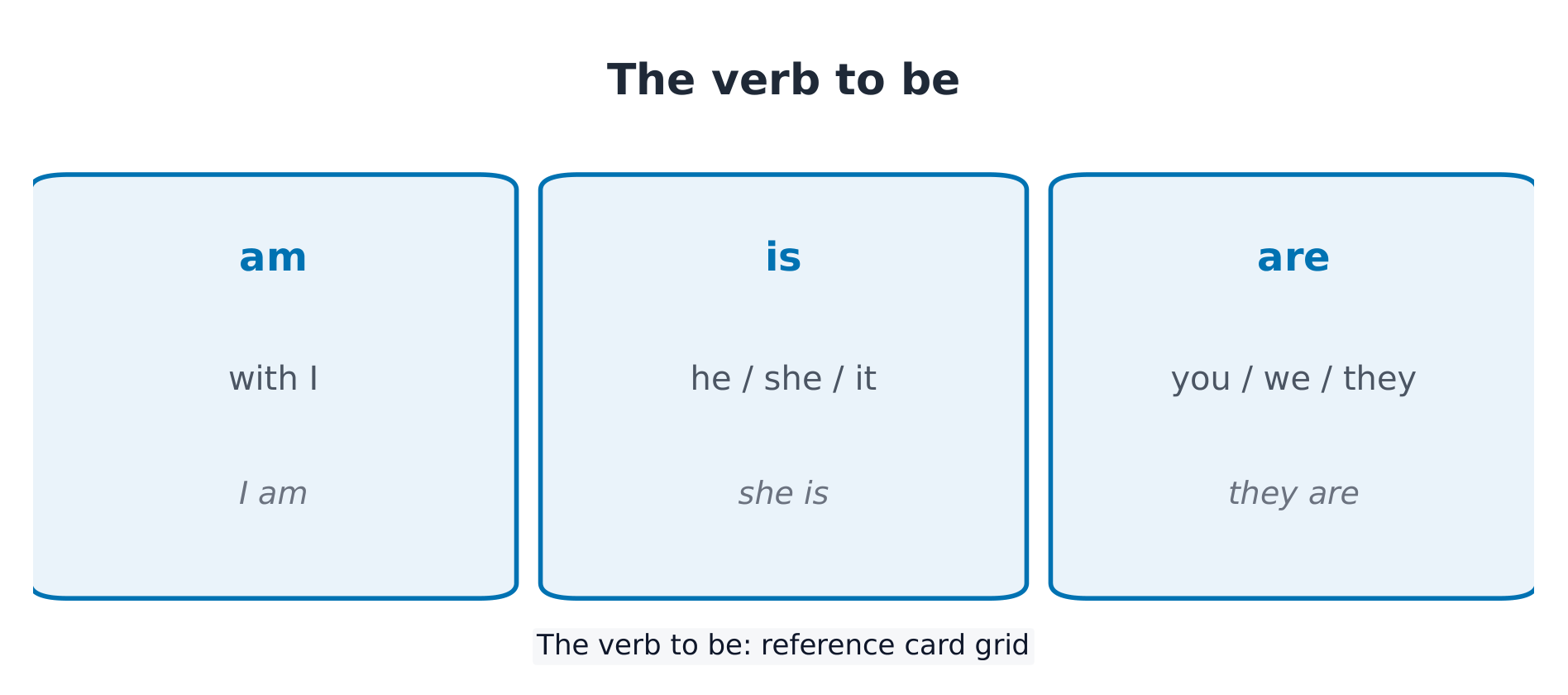
    The verb "to be" means "is / am / are." It changes according to the subject and has three forms:

    • I → am
    • he / she / it → is
    • you / we / they → are

    我I 是am 一名a 学生student.

    I am a student.

    她She 是is 开心happy.

    She is happy.

    他们They (是)are 来自from 中国China.

    They are from China.

    Note: Common spoken contractions: I'm, you're, he's, she's, it's, we're, they're.

    Português
    verbo be: am / is / are variam conforme o sujeito

    O verbo be (o verbo to be) significa "ser / estar". Ele varia conforme o sujeito e tem três formas:

    • I → am
    • he / she / it → is
    • you / we / they → are

    我I 是am 一名a 学生student.

    我是一名学生。

    她She 是is 开心happy.

    她很开心。

    他们They (是)are 来自from 中国China.

    他们来自中国。

    Nota Abreviações comuns na fala: I'm, you're, he's, she's, it's, we're, they're.
    1.2

    否定与疑问

    English

    Negation: Add not after the be verb (often contracted).

    他He 不是is not 一名a 老师teacher.

    He is not a teacher. (= He isn't a teacher.)

    Interrogative: Place the be verb before the subject.

    (是吗)Are 你you 准备好ready?

    Are you ready?

    Short answers: Yes, I am. / No, I'm not.

    Note: Negative contractions: is not → isn't, are not → aren't; but am not is only contracted to I'm not (there is no ~~amn't~~).

    Common Errors

    • ❌ ~~He busy.~~ → ✓ He is busy. — In Chinese, "He is very busy" can exist without a verb, but an English sentence must have a verb. Use be to link when the predicative is an adjective or noun and there are no other verbs in the sentence (He is busy); do not add be if the sentence already contains an ordinary verb (I go to school).
    • ❌ ~~I am go to school.~~ → ✓ I go to school. — Do not use be and ordinary verbs together; "go" alone suffices for "to go."
    • ❌ ~~They is my friends.~~ → ✓ They are my friends. — Plural subjects (you / we / they) take are.
    • ❌ ~~I am agree.~~ → ✓ I agree. — agree is itself a verb; do not add am before it.
    • ❌ ~~Are you ready? — Yes, I'm.~~ → ✓ Yes, I am. — Contractions cannot be used at the end of affirmative short answers (say Yes, I am); however, negative short answers typically end with a negative contraction (No, he isn't / No, I can't; first person is No, I'm not, as there is no amn't).
    Português

    Negativo: adicione not depois do verbo be (geralmente abreviado).

    他He 不是is not 一名a 老师teacher.

    Ele não é professor. (= He isn't a teacher.)

    Interrogativo: mova o verbo be para antes do sujeito.

    (是吗)Are 你you 准备好ready?

    你准备好了吗?

    Respostas curtas: Yes, I am. / No, I'm not.

    Nota Abreviações negativas: is not → isn't, are not → aren't; mas am not só se abrevia como I'm not (não existe ~~amn't~~).

    常见错误

    • ❌ ~~He busy.~~ → ✓ He is busy. — Em chinês "ele está muito ocupado" pode não ter verbo, mas uma frase em inglês deve ter verbo. Use be para ligar quando o predicativo for adjetivo ou substantivo e não houver outro verbo (He is busy); se já houver um verbo comum, não use be (I go to school).
    • ❌ ~~I am go to school.~~ → ✓ I go to school. — be e verbos comuns não podem ser usados juntos; "ir" exige apenas go.
    • ❌ ~~They is my friends.~~ → ✓ They are my friends. — Sujeitos no plural (you / we / they) usam are.
    • ❌ ~~I am agree.~~ → ✓ I agree. — agree (concordar) já é um verbo, não use am antes dele.
    • ❌ ~~Are you ready? — Yes, I'm.~~ → ✓ Yes, I am. — No final de respostas curtas afirmativas não se usa abreviação (diga Yes, I am); mas respostas curtas negativas geralmente terminam com abreviação negativa (No, he isn't / No, I can't; para primeira pessoa é No, I'm not, pois não existe amn't).
  • 2 Subject pronouns
    2.1

    I, you, he, she, it, we, they

    English

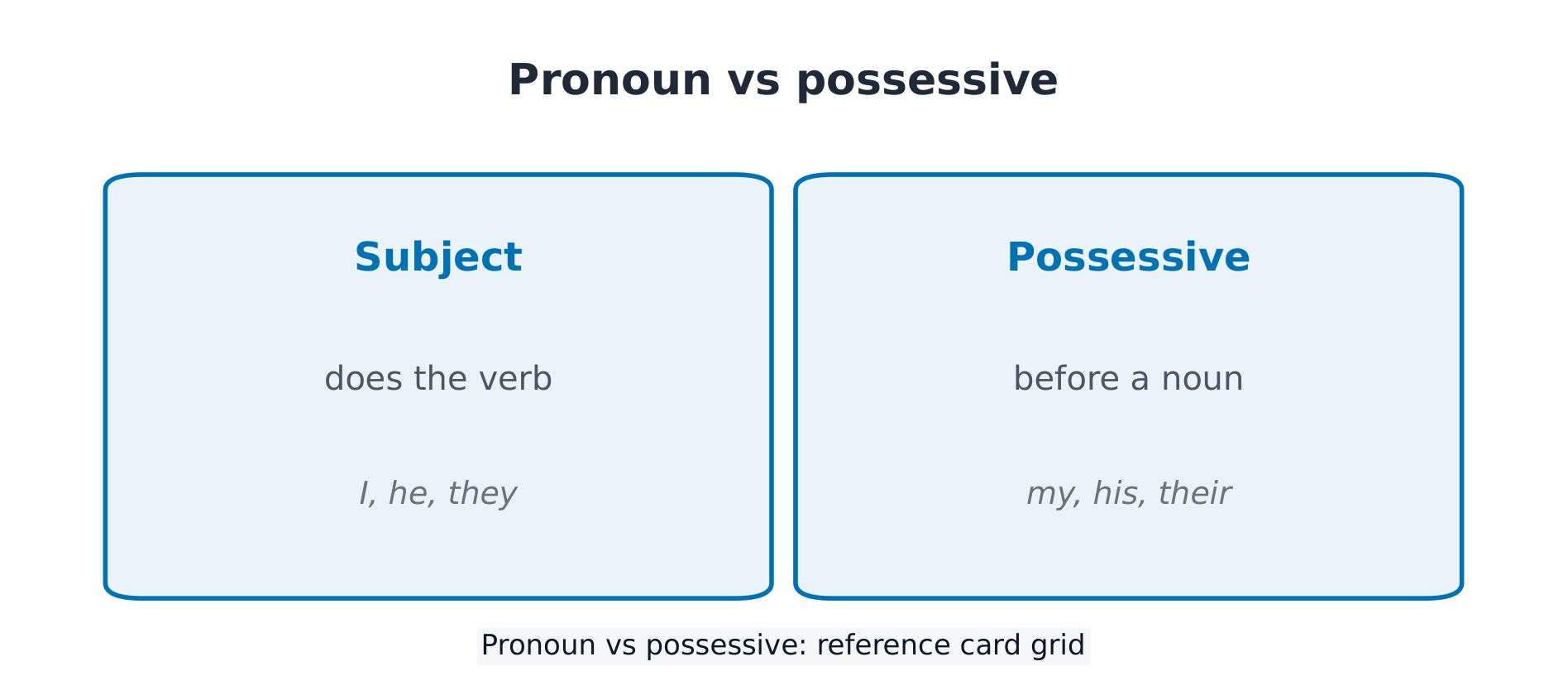
    Subject pronouns replace the subject and are placed before the verb:

    • I(I), you(you), he(he), she(she)
    • it(it), we(we), they(they)

    他He 是is 我的my 哥哥brother.

    He is my brother.

    我们We 喜欢like 音乐music.

    We like music.

    Key Usage Points:

    • I is always capitalized, regardless of its position in the sentence.
    • Things and animals commonly use it: This is my bag. It is new.(This is my bag. It is new.)*
    • Plural people or things both use they: The books are here. They are mine.(The books are here. They are mine.)*

    Note: Subject pronouns are followed by verbs; do not confuse them with object pronouns (me, him, her...) which will be learned later.

    Common Errors

    • ❌ ~~My mother is a doctor. He is very kind.~~ → ✓ She is very kind. — In colloquial Chinese, "he/she" sounds identical, but in English, he and she must be clearly distinguished.
    • ❌ ~~Me am a student.~~ → ✓ I am a student. — Use I for the subject, not me.
    • ❌ ~~My friend he is tall.~~ → ✓ My friend is tall. — The subject needs to be mentioned only once; avoid repeating "noun + pronoun" (the Chinese habit of saying "my friend he..." does not apply in English).
    • ❌ ~~Is raining.~~ → ✓ It is raining. — English sentences must have a subject; weather, time, and dates begin with it.
    Português
    主语代词与物主词

    Os pronomes pessoais do caso reto (subject pronouns) substituem o sujeito e vêm antes do verbo:

    • I(eu), you(você / vocês), he(ele), she(ela)
    • it(ele/ela/isto), we(nós), they(eles/delas/os/as/as/es)

    他He 是is 我的my 哥哥brother.

    他是我哥哥。

    我们We 喜欢like 音乐music.

    我们喜欢音乐。

    用法要点:

    • I 永远大写,不管在句子哪里。
    • Coisas e animais usam it: This is my bag. It is new.(Este é minha bolsa. Ela é nova.)*
    • Pessoas ou coisas no plural usam they: The books are here. They are mine.(Os livros estão aqui. Eles são meus.)*

    Nota Os pronomes retos vêm antes do verbo; não confunda com os pronomes oblíquos que virão depois (me, him, her...).

    常见错误

    • ❌ ~~My mother is a doctor. He is very kind.~~ → ✓ She is very kind. — Na fala chinesa "ele / ela" têm som igual, mas em inglês he / she devem ser distinguidos.
    • ❌ ~~Me am a student.~~ → ✓ I am a student. — Para fazer o papel de sujeito, use I, não me.
    • ❌ ~~My friend he is tall.~~ → ✓ My friend is tall. — O sujeito é dito uma vez; não repita "substantivo + pronome" (o hábito chinês de dizer "meu amigo ele..." não se aplica ao inglês).
    • ❌ ~~Is raining.~~ → ✓ It is raining. — Frases em inglês devem ter sujeito; tempo, hora e data começam com it.
  • 3 Possessive adjectives
    3.1

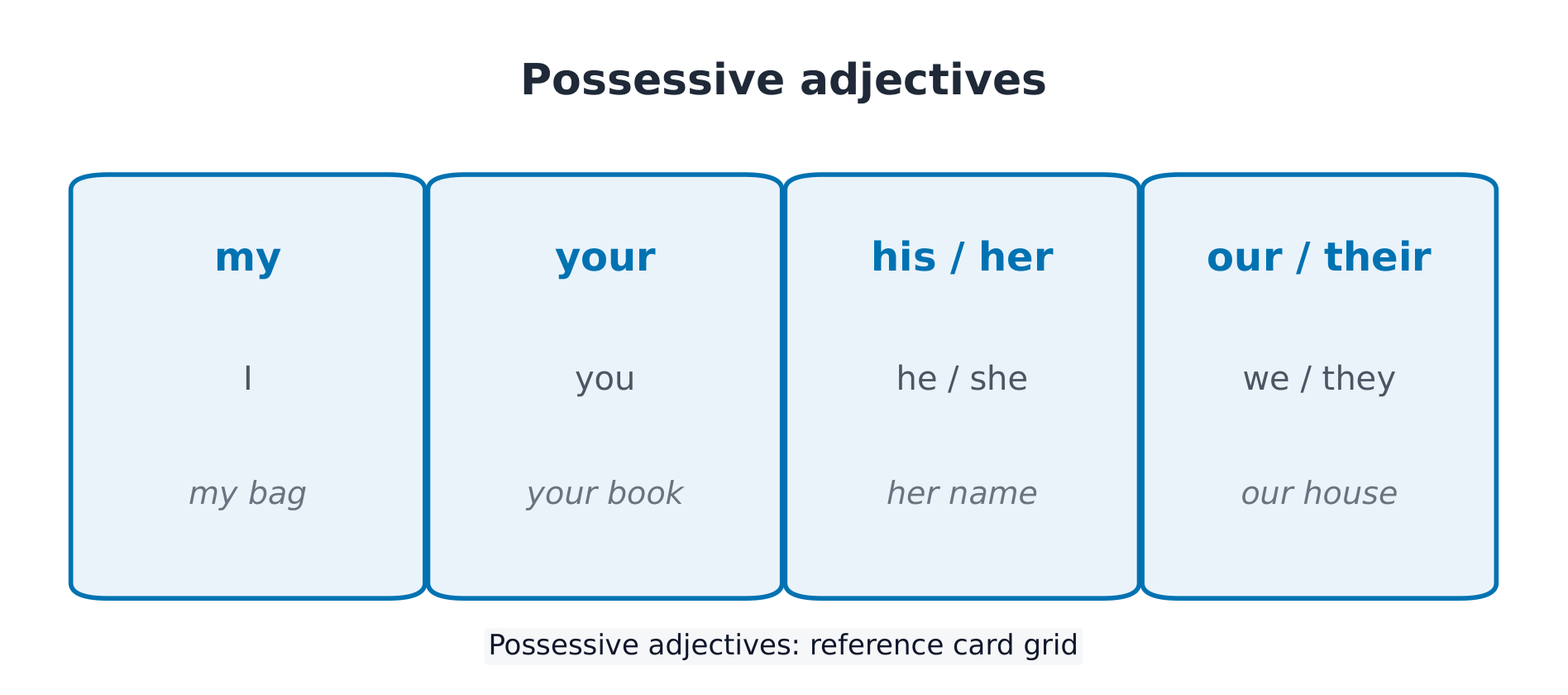
    my, your, his, her, our, their

    English

    Possessive adjectives indicate "whose" and are placed before the noun:

    • I → my(my), you → your(your), he → his(his)
    • she → her(her), it → its(its), we → our(our), they → their(their)

    这This 是is 我的my 包bag.

    This is my bag.

    她的Her 名字name 是is 露西Lucy.

    Her name is Lucy.

    Key Usage Points:

    • Possessive adjectives are always followed by a noun: my book, their house.
    • They do not change with noun number: my book, my books(my remains unchanged).

    Note: Be careful to distinguish its (its, no apostrophe) and it's (= it is). For example: The dog wags its tail.(The dog wags its tail.)*

    Common Errors

    • ❌ ~~This is she book.~~ → ✓ This is her book. — A possessive form must precede a noun: he → his, she → her.
    • ❌ ~~He is me friend.~~ → ✓ He is my friend. — The possessive form of I is my.
    • ❌ ~~The dog wags it's tail.~~ → ✓ …wags its tail. — it's = it is; "its" (possessive) has no apostrophe.
    • ❌ ~~Their is a park near here.~~ → ✓ There is a park near here. — their (their) and there (there/here) sound identical; do not mix them up in writing.
    Português
    adjetivos possessivos: my / your / his / her

    Os adjetivos possessivos (possessive adjectives) indicam "de quem" e vêm antes do substantivo:

    • I → my(meu/milha), you → your(seu/sua/vossa), he → his(dele/dele)
    • she → her(dela/dela), it → its(dele/dela/isto), we → our(nosso/nossa), they → their(deles/delas)

    这This 是is 我的my 包bag.

    这是我的包。

    她的Her 名字name 是is 露西Lucy.

    她的名字叫露西。

    用法要点:

    • Após os adjetivos possessivos sempre vem um substantivo: my book, their house.
    • Eles não mudam conforme singular/plural do substantivo: my book, my books (my permanece invariável).

    Nota Cuidado para distinguir its (dele/dela, sem apóstrofo) e it's (= it is). Exemplo: The dog wags its tail.(O cachorro abaixa sua cauda.)*

    常见错误

    • ❌ ~~This is she book.~~ → ✓ This is her book. — Antes do substantivo, use a forma possessiva: he → his, she → her.
    • ❌ ~~He is me friend.~~ → ✓ He is my friend. — A forma possessiva de I é my.
    • ❌ ~~The dog wags it's tail.~~ → ✓ ...wags its tail. — it's = it is; "dele/dela" é its, sem apóstrofo.
    • ❌ ~~Their is a park near here.~~ → ✓ There is a park near here. — their (deles) e there (há / lá) têm som idêntico; não misture na escrita.
  • 4 this, that, these, those
    4.1

    this com that

    English

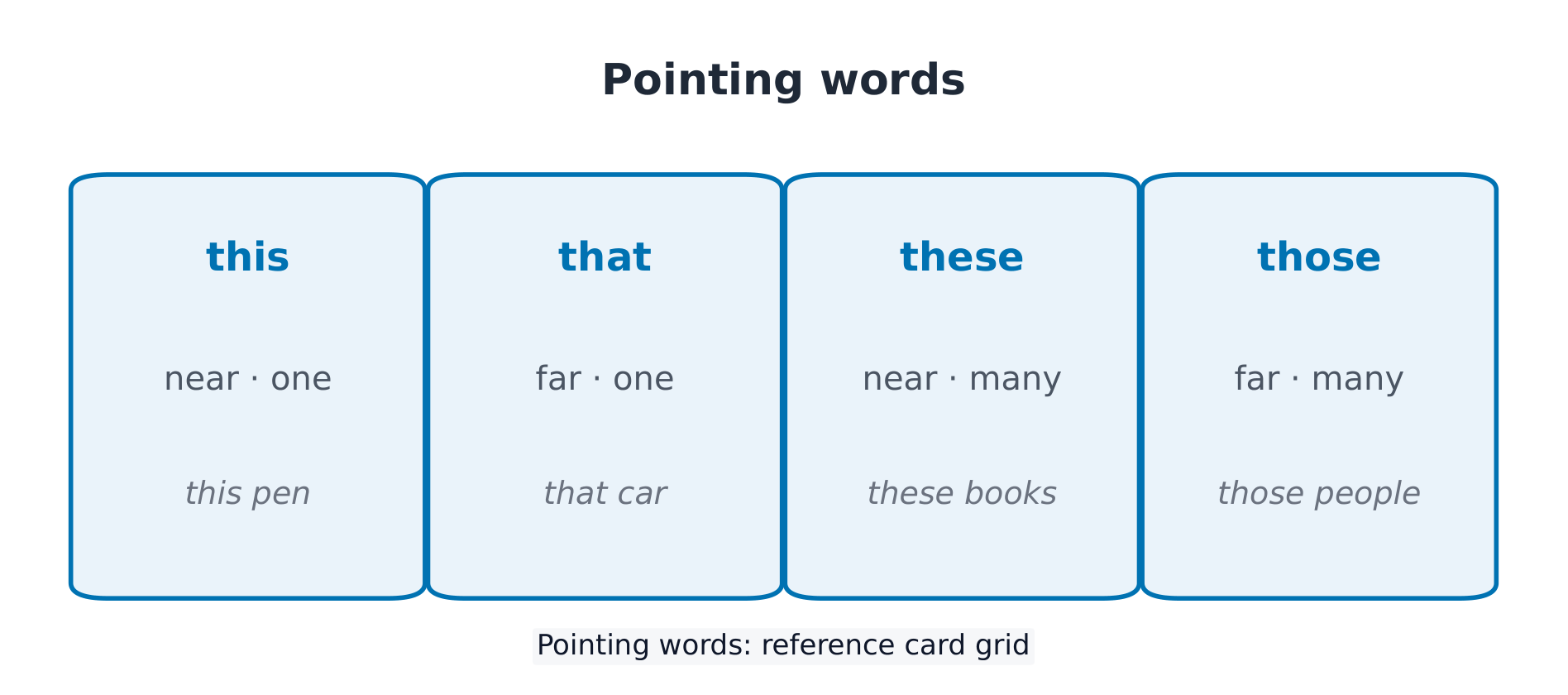
    Demonstratives point out "which one." Use this and that for singular:

    • this(this): Close to the speaker.
    • that(that): Far from the speaker.

    这This 是is 我的my 手机phone.

    This is my phone. (Close)

    那That 是is 你的your 车car.

    That is your car. (Far)

    Português
    próximo/distante × singular/plural: this / that / these / those

    Os demonstrativos (demonstratives) indicam "qual". Para singular, use this e that:

    • this(este): próximo de quem fala.
    • that(aquele): distante de quem fala.

    这This 是is 我的my 手机phone.

    这是我的手机。(近)

    那That 是is 你的your 车car.

    那是你的车。(远)

    4.2

    these com those

    English

    Use these and those for plural:

    • these(these): Close. those(those): Far.

    这些These 是are 我的my 书books.

    These are my books.

    那些Those 是are 她的her 朋友friends.

    Those are her friends.

    Contrastive Memory:

    • Near → this (singular) / these (plural).
    • Far → that (singular) / those (plural).

    Note: These / those are followed by plural nouns: these books, not ~~these book~~.

    Common Errors

    • ❌ ~~these book~~ → ✓ these books — Plural nouns must follow these / those.
    • ❌ ~~This books are mine.~~ → ✓ These books are mine. — If the noun is plural, the demonstrative must also be plural.
    • ❌ When introducing yourself on the phone, say ~~I am Tom.~~ → ✓ This is Tom. — In English, introduce yourself on the phone using this is.
    • Remember pairs: Near this / these are often used with here; far that / those are often used with there.
    Português

    Para plural, use these e those:

    • these(estes): próximos. those(aqueles): distantes.

    这些These 是are 我的my 书books.

    这些是我的书。

    那些Those 是are 她的her 朋友friends.

    那些是她的朋友。

    对照记忆:

    • Próximo → this (singular) / these (plural).
    • Distante → that (singular) / those (plural).

    Nota these / those vêm antes de substantivos no plural: these books, não ~~these book~~.

    常见错误

    • ❌ ~~these book~~ → ✓ these books — after these / those deve vir sempre um substantivo no plural.
    • ❌ ~~This books are mine.~~ → ✓ These books are mine. — Se o substantivo é plural, o demonstrativo também deve ser.
    • ❌ Ao discar pelo telefone, diga ~~I am Tom.~~ → ✓ This is Tom. — Em inglês, ao apresentar-se por telefone, usa-se this is.
    • Lembre-se dos pares: this / these (perto) costumam ir com here; that / those (longe) costumam ir com there.
  • 5 a, an and plurals · ⁨a, an e plurais⁩
    5.1

    a com an

    English

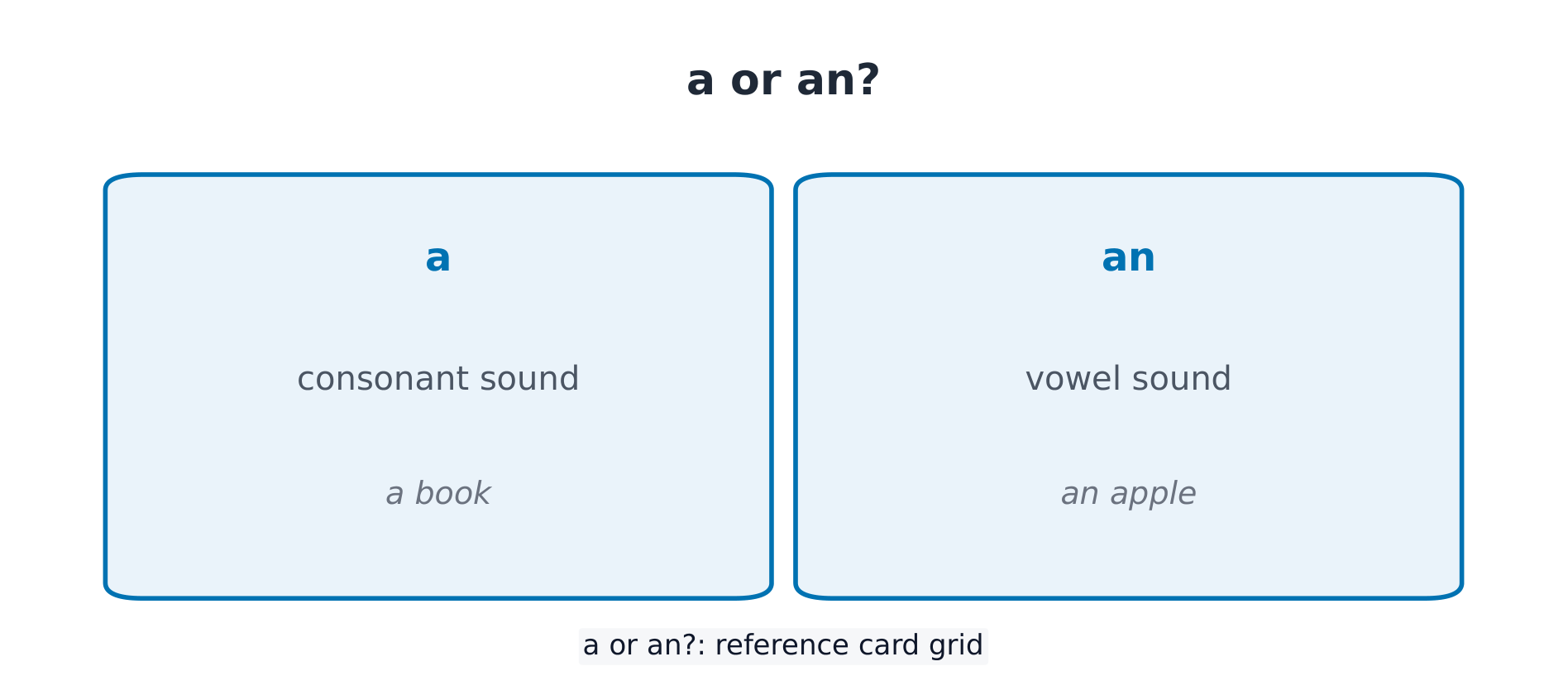
    a and an mean "one" and are used before singular countable nouns. How to choose depends on pronunciation:

    • a + consonant sound: a book, a dog, a cat.
    • an + vowel sound: an apple, an egg, an orange.

    我I 有have 一个a 笔pen.

    I have a pen.

    她She 吃eats 一个an 苹果apple.

    She eats an apple.

    Note: Look at the sound, not the letter: an hour (h is silent), a university (pronounced "yu-").

    Português
    a / an: veja a pronúncia (consoante vs vogal)

    a e an significam "um/uma" e vêm antes de substantivos contáveis no singular. Escolha baseada na pronúncia:

    • a + som de consoante: a book, a dog, a cat.
    • an + som de vogal: an apple, an egg, an orange.

    我I 有have 一个a 笔pen.

    我有一支笔。

    她She 吃eats 一个an 苹果apple.

    她吃一个苹果。

    Nota Observe o som, não a letra: an hour (h muda), a university (soa como "yu-").

    5.2

    名词复数

    English

    To indicate "more than one," use the plural form of the noun, usually adding -s:

    • Generally add -s: book → books, car → cars.
    • Words ending in -s / -sh / -ch / -x add -es: bus → buses, box → boxes.
    • Consonant + y ending: change y to i and add -es: baby → babies, city → cities.

    我I 有have 两two 猫cats.

    I have two cats.

    Irregular plurals (must memorize):

    • man → men, woman → women, child → children.
    • foot → feet, tooth → teeth, person → people.

    Note: Do not use a / an before plural nouns: ~~a books~~ ✗ → books / two books ✓.

    Common Errors

    • ❌ ~~I have dog.~~ → ✓ I have a dog. — In Chinese you can say "I have dogs," but singular countable nouns in English must have a / an (or my, the, etc.) before them.
    • ❌ ~~an university~~ → ✓ a university; ❌ ~~a hour~~ → ✓ an hour — Look at pronunciation, not spelling: university starts with a consonant sound /j/, and h is silent in hour.
    • ❌ ~~two book~~ → ✓ two books — Chinese nouns do not change for plurality, but nouns after numbers in English require -s; this is easily forgotten.
    • ❌ ~~three childs~~ → ✓ three children — Irregular plurals must be memorized separately: men, women, children, feet, teeth, people.
    • ❌ ~~a people~~ → ✓ a person (one person) / people (many people) — people is inherently plural.
    Português

    表示"不止一个"时,名词用复数,通常加 -s:

    • Adicione -s geralmente: book → books, car → cars.
    • Palavras terminadas em -s / -sh / -ch / -x, adicione -es: bus → buses, box → boxes.
    • Consoante + y, y vira i e adiciona -es: baby → babies, city → cities.

    我I 有have 两two 猫cats.

    我有两只猫。

    不规则复数(要背):

    • man → men, woman → women, child → children.
    • foot → feet, tooth → teeth, person → people.

    Nota Não use a / an antes de substantivos no plural: ~~a books~~ ✗ → books / two books ✓.

    常见错误

    • ❌ ~~I have dog.~~ → ✓ I have a dog. — Em chinês pode-se dizer "tenho cachorro", mas em inglês substantivos contáveis singulares exigem a / an (ou my, the, etc.).
    • ❌ ~~an university~~ → ✓ a university; ❌ ~~a hour~~ → ✓ an hour — Olhe a pronúncia, não as letras: university começa com consoante /j/, h de hour muda.
    • ❌ ~~two book~~ → ✓ two books — Substantivos em chinês não têm plural, mas em inglês números seguidos de substantivo exigem -s, erro mais comum.
    • ❌ ~~three childs~~ → ✓ three children — Plurais irregulares devem ser memorizados separadamente: men, women, children, feet, teeth, people.
    • ❌ ~~a people~~ → ✓ a person(uma pessoa) / people(pessoas muitas) — people já é plural.
  • 6 there is and there are · ⁨there is e there are⁩
    6.1

    单数与复数

    English

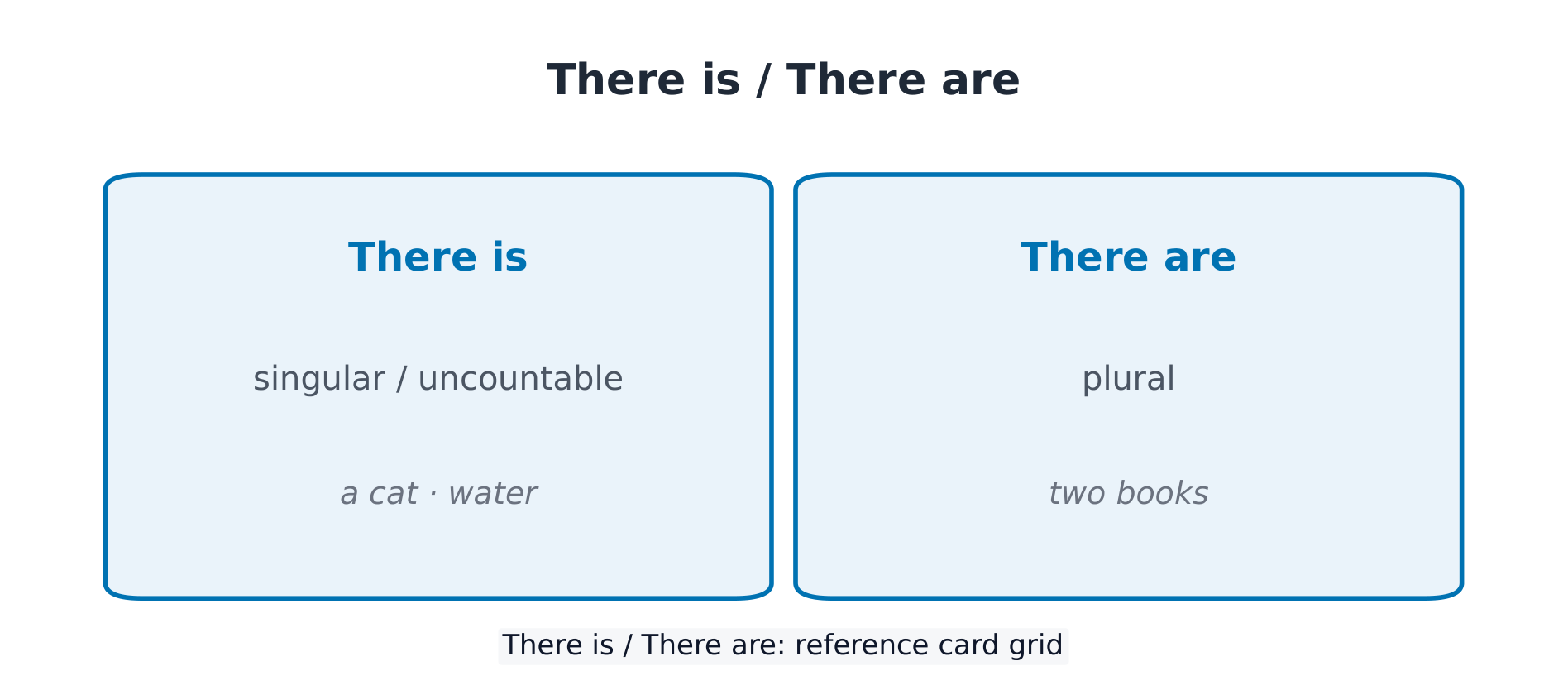
    there is / there are means "there exists" (something exists somewhere).

    • There is + singular / uncountable noun: There is a book.
    • There are + plural noun: There are two books.

    (有)There 有is 一只a 猫cat 在on (冠词)the 沙发上sofa.

    There is a cat on the sofa.

    (有)There 有are 三three 书books 在on (冠词)the 桌上desk.

    There are three books on the table.

    Note: In spoken English, there is is often contracted to there's: There's a problem.

    Português
    There is (singular) / There are (plural)

    there is / there are significam "haver / existir" (algo existe num lugar).

    • There is + singular / incontável: There is a book.
    • There are + plural: There are two books.

    (有)There 有is 一只a 猫cat 在on (冠词)the 沙发上sofa.

    沙发上有一只猫。

    (有)There 有are 三three 书books 在on (冠词)the 桌上desk.

    桌上有三本书。

    Nota Na fala, there is freqüentemente abreviado como there's: There's a problem.

    6.2

    否定与疑问

    English

    Negative: there is not / there are not (contracted as there isn't / there aren't).

    (有)There 没有isn't 任何any 牛奶milk.

    There is no milk left.

    Question: Move is / are to the front of there.

    (有吗)Is (有)there 一家a 银行bank 附近near 这里here?

    Is there a bank nearby?

    Short answer: Yes, there is. / No, there isn't.

    Note: Use any frequently in negative / question sentences: Is there any water? (Is there any water?)

    Common Errors

    • ❌ ~~Here has many people.~~ → ✓ There are many people here. — The "have" in the Chinese "There are many people here" indicates existence; use there is / there are in English, do not translate literally as have.
    • ❌ ~~There have a book on the desk.~~ → ✓ There is a book on the desk. — Use is / are after there; there have does not exist.
    • ❌ ~~There is two cats.~~ → ✓ There are two cats. — If the following noun is plural, use are.
    • ❌ ~~There are a milk.~~ → ✓ There is some milk. — milk is uncountable: use there is + some, do not use a.
    Português

    Negativo: there is not / there are not (abreviado: there isn't / there aren't).

    (有)There 没有isn't 任何any 牛奶milk.

    没有牛奶了。

    Interrogativo: mova is / are para antes de there.

    (有吗)Is (有)there 一家a 银行bank 附近near 这里here?

    这附近有银行吗?

    Respostas curtas: Yes, there is. / No, there isn't.

    Nota Em frases negativas e interrogativas, use any: Is there any water?(Tem água?)

    常见错误

    • ❌ ~~Here has many people.~~ → ✓ There are many people here. — O "ter/haver" em "há muita gente aqui" indica existência; em inglês use there is / there are, não traduza literalmente com have.
    • ❌ ~~There have a book on the desk.~~ → ✓ There is a book on the desk. — After there use is / are; não existe "there have".
    • ❌ ~~There is two cats.~~ → ✓ There are two cats. — Se o substantivo seguinte é plural, use are.
    • ❌ ~~There are a milk.~~ → ✓ There is some milk. — milk é incontável: use there is + some, não a.
  • 7 have got · ⁨ter⁩
    7.1

    have got / has got

    English

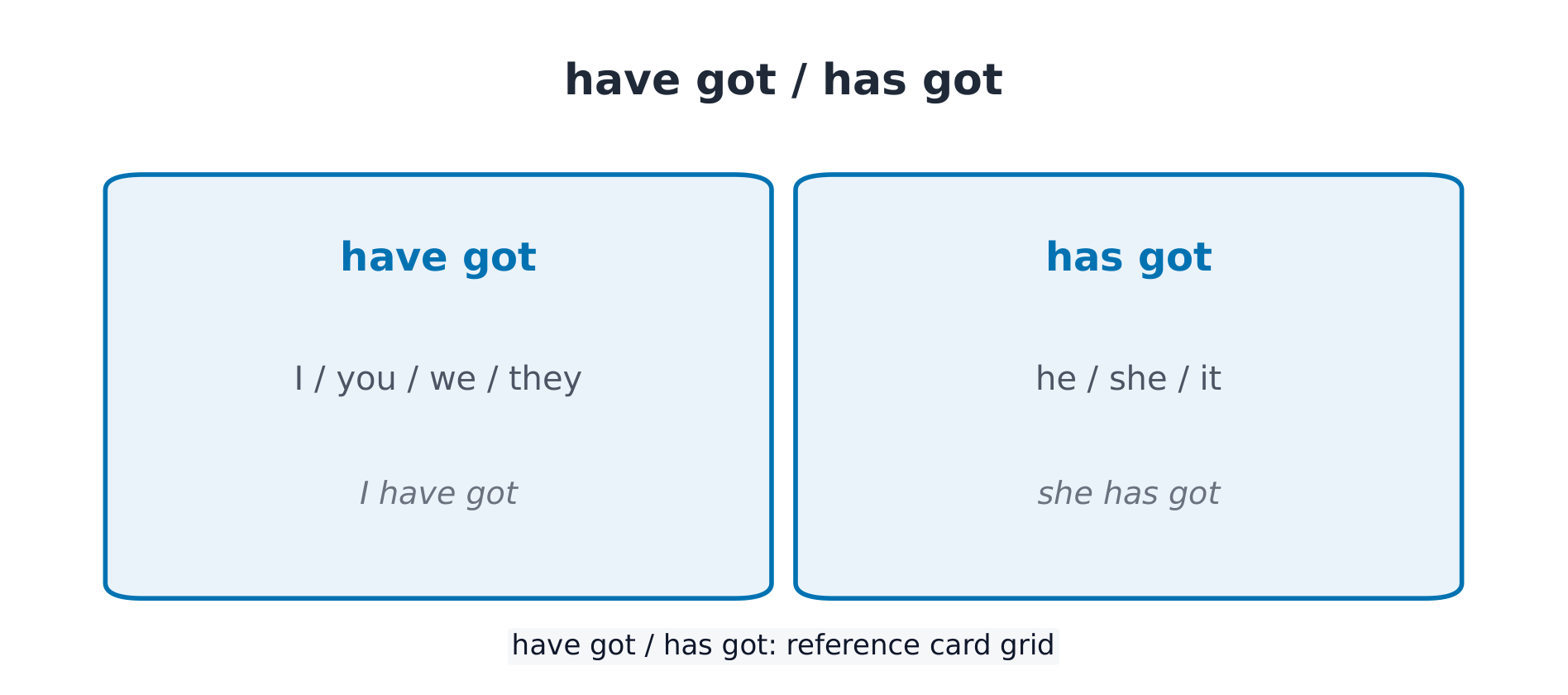
    have got means "to possess" (= have), common in British English.

    • I / you / we / they → have got
    • he / she / it → has got

    我I 有have got 一个a 兄弟brother.

    I have a brother. (= I have a brother.)

    她She 有has got 蓝色blue 眼睛eyes.

    She has blue eyes.

    Note: Often contracted in spoken language: I've got, she's got, they've got. Same meaning as have / has.

    Português
    have got / has got

    have got significa "ter/possuir" (= have), muito comum no inglês britânico.

    • I / you / we / they → have got
    • he / she / it → has got

    我I 有have got 一个a 兄弟brother.

    Tenho um irmão. (= I have a brother.)

    她She 有has got 蓝色blue 眼睛eyes.

    她有一双蓝眼睛。

    Nota Na fala, freqüentemente abreviado: I've got, she's got, they've got. Significado igual a have / has.

    7.2

    否定与疑问

    English

    Negative: haven't got / hasn't got.

    他He 没有hasn't got 一辆a 车car.

    He doesn't have a car.

    Question: Move Have / Has to the front of the subject.

    (有吗)Have 你you 有got 一支a 笔pen?

    Do you have a pen?

    Short answer: Yes, I have. / No, I haven't.

    Note: have got is mostly used for current possession; for past or habits, use regular have / had.

    Common Errors

    • ❌ ~~She have got long hair.~~ → ✓ She has got long hair. — Use has got for he / she / it.
    • ❌ ~~I have got not a car.~~ → ✓ I haven't got a car. — Place not after have / has, then contract.
    • ❌ ~~Do you have got a pen?~~ → ✓ Have you got a pen? / Do you have a pen? — Both question forms are correct, but never mix them.
    • ❌ ~~Yes, I have got.~~ → ✓ Yes, I have. — Short answers end at have / has, without got.
    Português

    Negativo: haven't got / hasn't got.

    他He 没有hasn't got 一辆a 车car.

    他没有车。

    Interrogativo: mova Have / Has para antes do sujeito.

    (有吗)Have 你you 有got 一支a 笔pen?

    你有笔吗?

    Respostas curtas: Yes, I have. / No, I haven't.

    Nota have got usa-se mais para estados momentâneos de "ter"; para falar de passado ou hábitos, use have / had normal.

    常见错误

    • ❌ ~~She have got long hair.~~ → ✓ She has got long hair. — he / she / it usa has got.
    • ❌ ~~I have got not a car.~~ → ✓ I haven't got a car. — not vem depois de have / has, depois abrevie.
    • ❌ ~~Do you have got a pen?~~ → ✓ Have you got a pen? / Do you have a pen? — Ambas as perguntas estão corretas, mas não as misture.
    • ❌ ~~Yes, I have got.~~ → ✓ Yes, I have. — Respostas curtas param em have / has, sem levar got.
  • 8 Present simple
    8.1

    习惯与第三人称 -s

    English

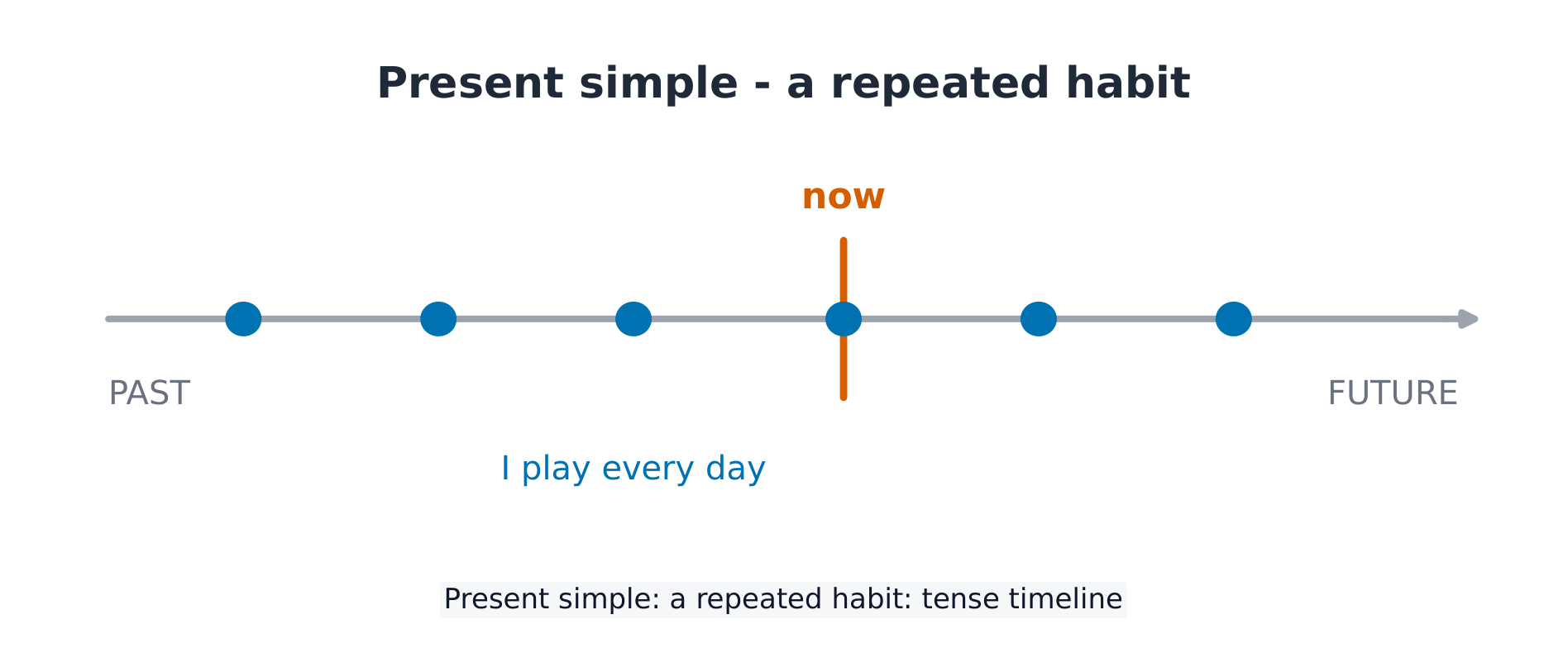
    Present simple (present simple) describes habits and facts. The base form is the infinitive (base verb).

    我I 喜欢like 茶tea.

    I like tea.

    When the subject is he / she / it, add -s to the verb:

    他He 踢plays 足球football.

    He plays football.

    Spelling rules:

    • Generally add -s: like → likes.
    • Words ending in -s / -sh / -ch / -x / -o add -es: go → goes, watch → watches.
    • Consonant + y ending: change y to i and add -es: study → studies.

    Note: Only he / she / it take -s; I / you / we / they use the base form: They like tea.

    Português
    一般现在时:反复的习惯

    Present Simple (present simple) fala sobre hábitos e fatos. A forma básica é o verbo na forma original.

    我I 喜欢like 茶tea.

    我喜欢茶。

    Quando o sujeito é he / she / it, o verbo recebe -s:

    他He 踢plays 足球football.

    他踢足球。

    拼写:

    • Geralmente adicione -s: like → likes.
    • Terminações em -s / -sh / -ch / -x / -o, adicione -es: go → goes, watch → watches.
    • Consoante + y, y vira i e adiciona -es: study → studies.

    Nota Só he / she / it recebem -s; I / you / we / they usam a forma original: They like tea.

    8.2

    否定与疑问

    English

    For negatives and questions, use auxiliary verbs do / does (does for he / she / it).

    Negative: Subject + don't / doesn't + base verb.

    我I 不don't 喜欢like 咖啡coffee.

    I don't like coffee.

    Question: Do / Does + Subject + base verb ?

    (助动词)Does 她she 住live 这里here?

    Does she live here?

    Note: When using do / does, the verb returns to its base form (no -s): ~~Does she lives~~ ✗ → Does she live ✓.

    Common Errors

    • ❌ ~~He go to school by bus.~~ → ✓ He goes to school by bus. — Forgetting to add -s in third person singular is the most frequent error; check your work afterwards.
    • ❌ ~~She doesn't likes coffee.~~ → ✓ She doesn't like coffee. — When using does / doesn't, the verb returns to its base form.
    • ❌ ~~I very like English.~~ → ✓ I like English very much. — "Very much" in Chinese cannot be translated literally; very cannot directly modify a verb.
    • ❌ ~~You like tea?~~ → ✓ Do you like tea? — Questions must start with do / does; rising intonation alone is insufficient.
    Português
    Hábitos diários: I have breakfast every morning.

    Para negações e perguntas, use o auxiliar do / does (he / she / it usa does).

    Negação: Sujeito + don't / doesn't + verbo na forma base.

    我I 不don't 喜欢like 咖啡coffee.

    我不喜欢咖啡。

    Pergunta: Do / Does + sujeito + verbo na forma base ?

    (助动词)Does 她she 住live 这里here?

    她住在这里吗?

    Atenção: ao usar do / does, o verbo volta para a forma base(sem -s):~~Does she lives~~ ✗ → Does she live ✓。

    常见错误

    • ❌ ~~He go to school by bus.~~ → ✓ He goes to school by bus. — Esquecer de adicionar -s na terceira pessoa do singular é o erro mais frequente; revise após escrever.
    • ❌ ~~She doesn't likes coffee.~~ → ✓ She doesn't like coffee. — Ao usar does / doesn't, o verbo volta para a forma base.
    • ❌ ~~I very like English.~~ → ✓ I like English very much. — "Muito" em chinês não deve ser traduzido literalmente; very não pode modificar verbos diretamente.
    • ❌ ~~You like tea?~~ → ✓ Do you like tea? — Perguntas devem começar com do / does, não apenas com entonação ascendente.
  • 9 can
    9.1

    能力与请求

    English

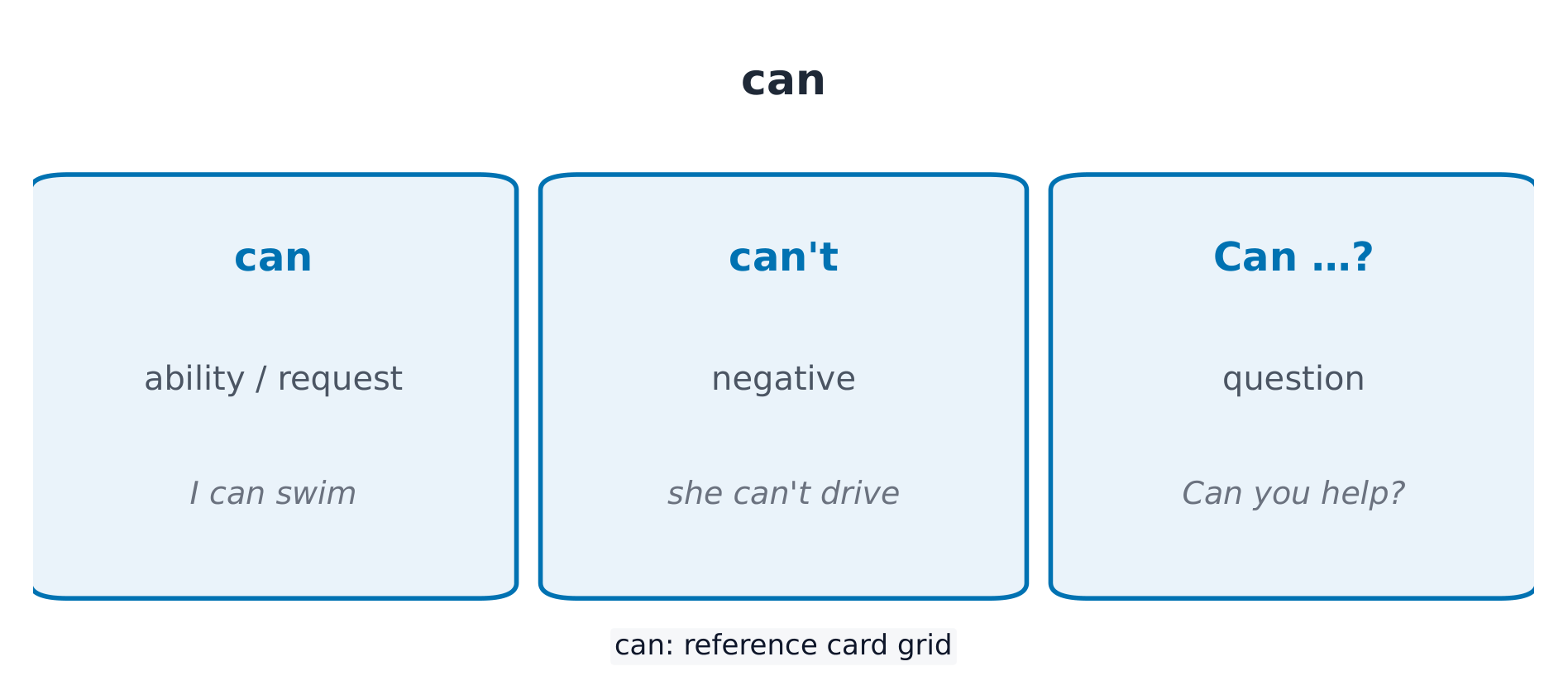
    can expresses ability ("know how to / be able to") or is used for requests. It is followed by the base form of the verb, and remains the same for all persons.

    我I 会can 游泳swim.

    I can swim.

    能Can 你you 帮help 我me?

    Can you help me?

    Note: Use the base form after can: ~~can to swim~~ ✗, ~~can swims~~ ✗ → can swim ✓.

    Português
    can: habilidade, negação, pergunta

    can indica habilidade("saber / poder") ou é usado para pedidos. É seguido por verbo na forma base, igual para todas as pessoas.

    我I 会can 游泳swim.

    我会游泳。

    能Can 你you 帮help 我me?

    你能帮我一下吗?

    Atenção: can é seguido por forma base:~~can to swim~~ ✗、~~can swims~~ ✗ → can swim ✓。

    9.2

    否定与疑问

    English

    Negative: cannot (abbreviation can't) + base form of the verb.

    她She 不会can't 开车drive.

    She cannot drive.

    Question: Place Can before the subject.

    能Can 他he 做饭cook?

    Can he cook?

    Short answer: Yes, I can. / No, I can't.

    Note: can has no -s and does not use do/does: ask directly with Can he…?, not ~~Does he can…?~~

    Common Errors

    • ❌ ~~She cans drive.~~ → ✓ She can drive. — can has no third-person singular -s; it is the same for all persons.
    • ❌ ~~I don't can swim.~~ → ✓ I can't swim. — The negative of can is formed directly with not (can't), without using don't.
    • ❌ ~~He can sings very good.~~ → ✓ He can sing very well. — Use the base form of the verb after can; use the adverb well to modify a verb, not good.
    • ❌ ~~You can help me?~~ → ✓ Can you help me? — When making a request, place can before the subject.
    Português

    Negação: cannot(abreviado can't) + verbo na forma base.

    她She 不会can't 开车drive.

    她不会开车。

    Pergunta: coloque Can antes do sujeito.

    能Can 他he 做饭cook?

    他会做饭吗?

    Respostas curtas:Yes, I can. / No, I can't.

    Atenção: can não tem -s, nem usa do / does: pergunte diretamente Can he…?, não ~~Does he can…?~~

    常见错误

    • ❌ ~~She cans drive.~~ → ✓ She can drive. — can não tem terceira pessoa -s, mesmo formato para todos os sujeitos.
    • ❌ ~~I don't can swim.~~ → ✓ I can't swim. — A negação de can é direta com not(can't), sem don't.
    • ❌ ~~He can sings very good.~~ → ✓ He can sing very well. — Após can use verbo na forma base; para modificar verbos use o advérbio well, não good。
    • ❌ ~~You can help me?~~ → ✓ Can you help me? — Ao pedir ajuda, mova can antes do sujeito。
  • 10 Imperatives
    10.1

    命令与指示

    English

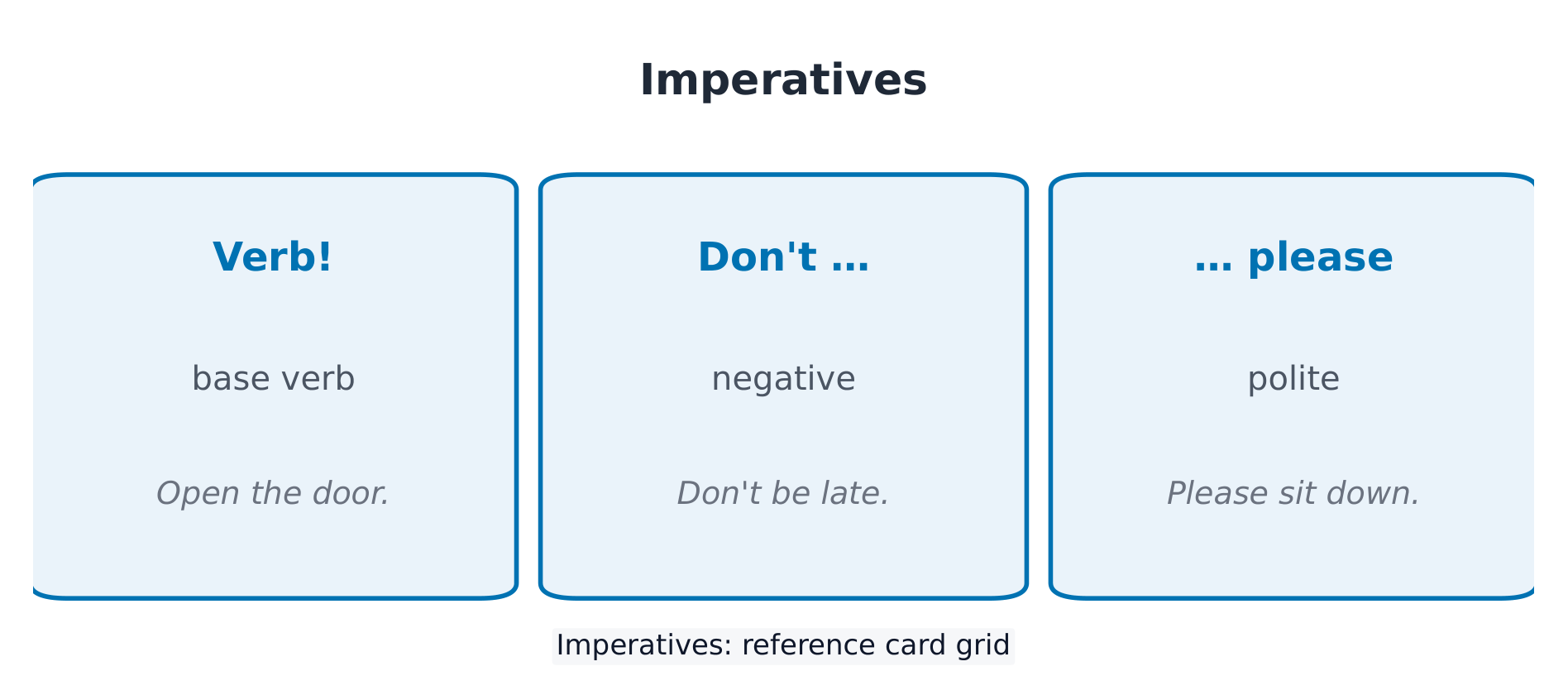
    Imperatives are used to give commands, provide instructions, or make requests. Start directly with the base form of the verb, without a subject.

    打开Open (冠词)the 门door 请, please.

    Please open the door.

    坐Sit 下down.

    Sit down.

    Negative: Add Don't at the beginning.

    不要Don't (是)be 迟到late.

    Don't be late.

    Key Usage Points:

    • Add please to be more polite: Please come in.
    • Also used for directions and instructions: Turn left. Mix the eggs.

    Note: Do not write a subject in imperatives: ~~You open the door~~ (for a command) → Open the door.

    Common Errors

    • ❌ ~~Please open door.~~ → ✓ Please open the door. — Articles must still be included in imperatives.
    • ❌ ~~Don't to touch it.~~ → ✓ Don't touch it. — Follow don't directly with the base form of the verb; do not add to.
    • ❌ ~~No talk in class!~~ → ✓ Don't talk in class! / No talking! — To prohibit an action, use don't + base form; after no, use -ing or a noun.
    • ❌ ~~You sit down!~~ → ✓ Sit down, please. — Adding you to a command sounds angry; add please for politeness, or change to Can you…?
    Português
    祈使句:命令、否定、请求

    Imperativos são usados para dar ordens, dar instruções ou fazer pedidos. Comece diretamente com verbo na forma base, sem sujeito。

    打开Open (冠词)the 门door 请, please.

    请把门打开。

    坐Sit 下down.

    坐下。

    Negação: adicione Don't antes。

    不要Don't (是)be 迟到late.

    别迟到。

    用法要点:

    • Adicionar please torna mais educado:Please come in.(Entre, por favor。)
    • Também usado para rotas e instruções:Turn left.(Virar à esquerda。)Mix the eggs.(Bater os ovos。)

    Atenção: imperativos não usam sujeito:~~You open the door~~(ao dar ordem)→ Open the door。

    常见错误

    • ❌ ~~Please open door.~~ → ✓ Please open the door. — Artigos também não podem ser omitidos em imperativos。
    • ❌ ~~Don't to touch it.~~ → ✓ Don't touch it. — Após don't, vá direto para o verbo na forma base, sem to。
    • ❌ ~~No talk in class!~~ → ✓ Don't talk in class! / No talking! — Para proibir algo, use don't + forma base; após no use -ing ou substantivo。
    • ❌ ~~You sit down!~~ → ✓ Sit down, please. — Ordenar com you soa bruto; para ser educado, adicione please ou mude para Can you…?
  • 11 Question words
    11.1

    what, where, who

    English

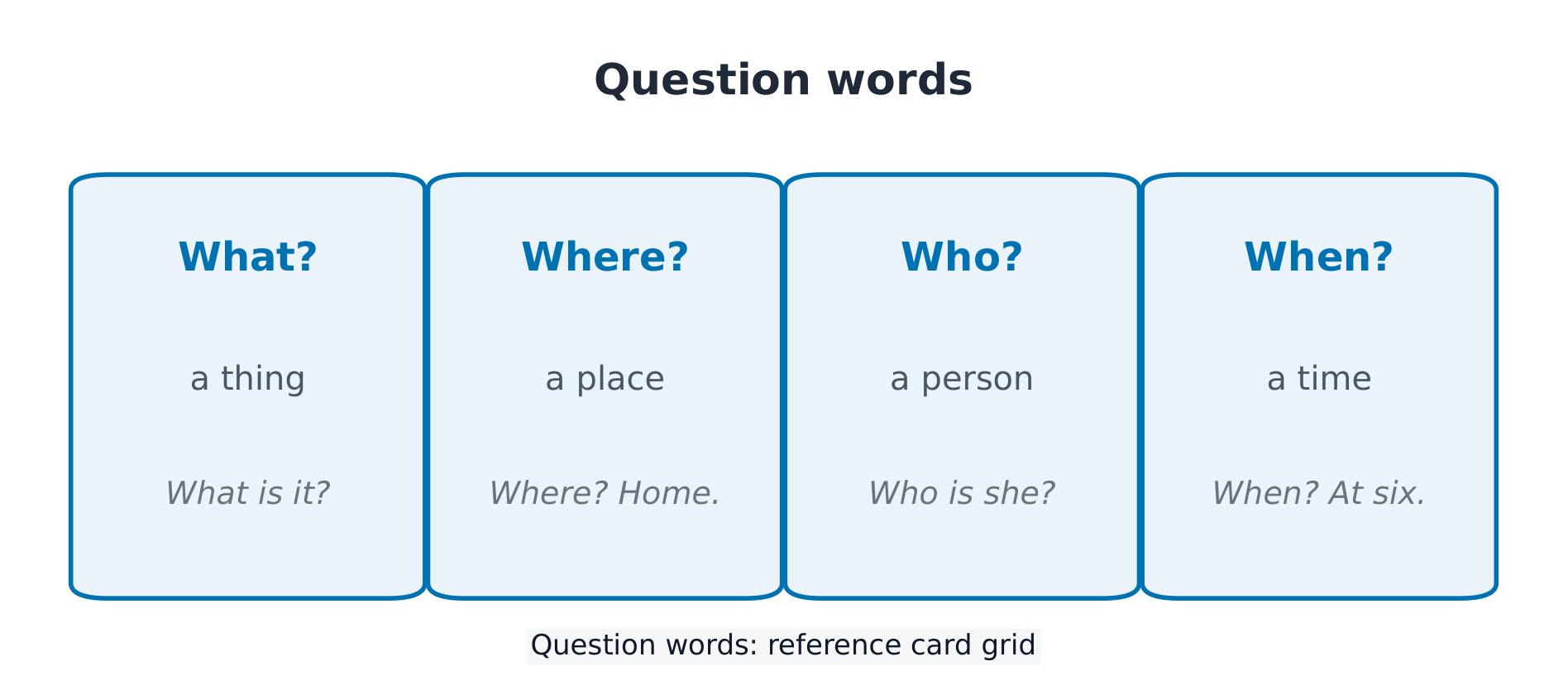
    Question words are placed at the beginning of a question to ask for specific information.

    • what (what), where (where), who (who)

    什么What 是is 你的your 名字name?

    What's your name?

    哪里Where (助动词)do 你you 住live?

    Where do you live?

    谁Who 是is 那个that 男人man?

    Who is that man?

    Note: A be verb or auxiliary do/does often follows the question word: Where do you work?

    Português
    疑问词:问事物/地点/人/时间

    Palavras interrogativas (question words) vêm no início da pergunta para questionar informações específicas。

    • what(o que), where(onde), who(quem)

    什么What 是is 你的your 名字name?

    你叫什么名字?

    哪里Where (助动词)do 你you 住live?

    你住在哪里?

    谁Who 是is 那个that 男人man?

    那个男人是谁?

    Atenção: palavras interrogativas geralmente são seguidas por verbo be ou auxiliar do / does:Where do you work?

    11.2

    when, why, how

    English
    • when (when), why (why), how (how / in what way)

    什么时候When 是is (冠词)the 派对party?

    When is the party?

    为什么Why (是)are 你you 难过sad?

    Why are you sad?

    怎么How (助动词)do 你you 拼写spell 它it?

    How do you spell this?

    Note: how can also combine with adjectives to ask about degree: How old are you? How much is it?

    Common Errors

    • ❌ ~~Where you live?~~ → ✓ Where do you live? — After the question word, you still need do/does or be; you cannot follow directly with the subject.
    • ❌ ~~What means this word?~~ → ✓ What does this word mean? — mean is an ordinary verb: question word + does + subject + base form.
    • ❌ ~~Why you are late?~~ → ✓ Why are you late? — When there is a be verb in the sentence, move be before the subject.
    • ❌ ~~How to spell it?~~ → ✓ How do you spell it? — A literal translation of "How to spell?" loses the subject and auxiliary verb; these must be added.
    Português
    • when(quando), why(por que), how(como / de que maneira)

    什么时候When 是is (冠词)the 派对party?

    派对什么时候?

    为什么Why (是)are 你you 难过sad?

    你为什么难过?

    怎么How (助动词)do 你you 拼写spell 它it?

    这个怎么拼?

    Atenção: how também pode combinar com adjetivos para perguntar grau:How old are you?(Quantos anos você tem?)How much is it?(Quanto custa?)

    常见错误

    • ❌ ~~Where you live?~~ → ✓ Where do you live? — Após palavra interrogativa ainda é necessário do / does ou be, não pode ir direto para o sujeito。
    • ❌ ~~What means this word?~~ → ✓ What does this word mean? — mean é um verbo comum: palavra interrogativa + does + sujeito + forma base。
    • ❌ ~~Why you are late?~~ → ✓ Why are you late? — Se houver verbo be na frase, mova-o antes do sujeito。
    • ❌ ~~How to spell it?~~ → ✓ How do you spell it? — Traduzir literalmente "Como se escreve?" perde sujeito e auxiliar; é preciso completar。
  • 12 Prepositions of place · ⁨Preposições de lugar⁩
    12.1

    in, on, under

    English

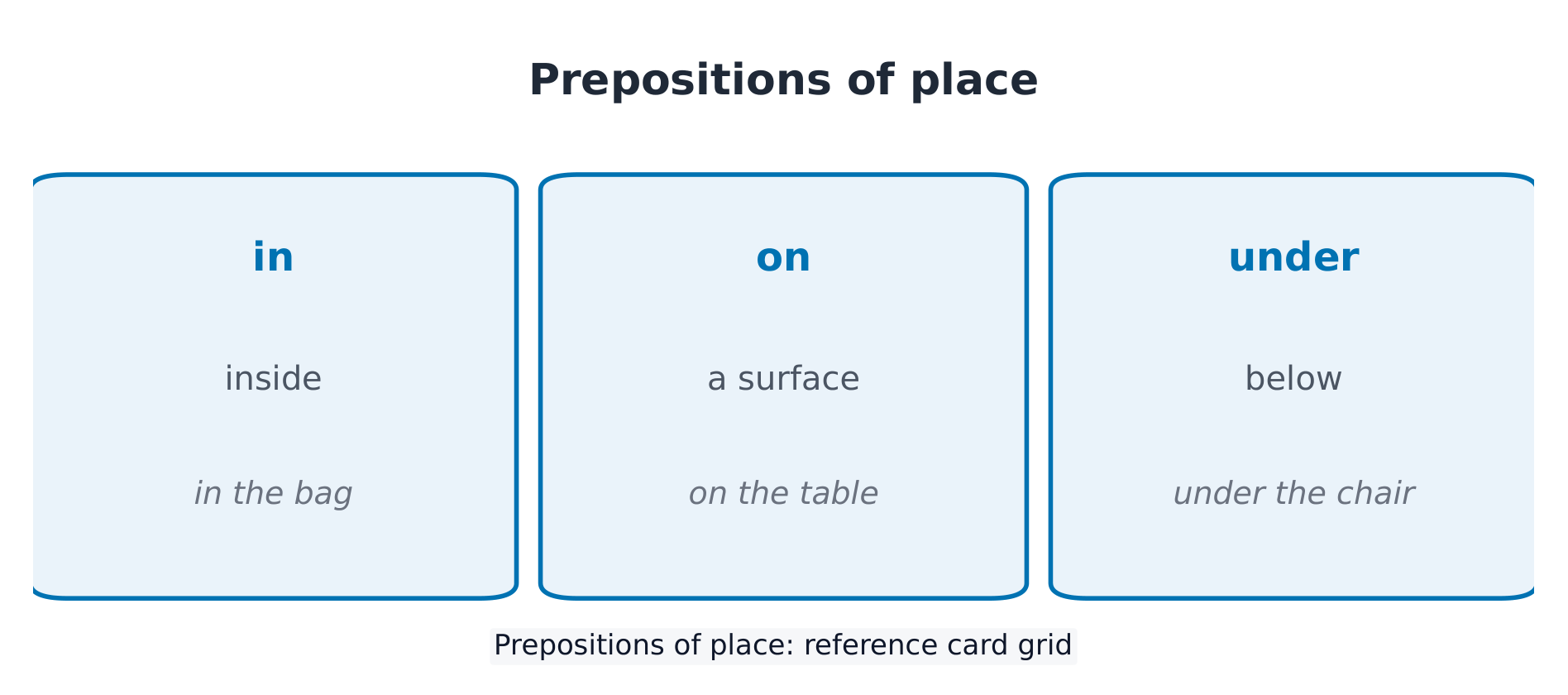
    Prepositions of place indicate where something is located.

    • in (inside...), on (on top of... / surface), under (below...)

    (冠词)The 钥匙keys 在are 在...里in (冠词)the 包里bag.

    The key is in the bag.

    (冠词)The 书book 在is 在...上on (冠词)the 桌上table.

    The book is on the table.

    (冠词)The 猫cat 在is 在...下under (冠词)the 椅子下chair.

    The cat is under the chair.

    Português
    preposições de lugar: in / on / under

    Preposições de lugar indicam onde algo está。

    • in(dentro de), on(sobre / em cima), under(embaixo de)

    (冠词)The 钥匙keys 在are 在...里in (冠词)the 包里bag.

    钥匙在包里。

    (冠词)The 书book 在is 在...上on (冠词)the 桌上table.

    书在桌上。

    (冠词)The 猫cat 在is 在...下under (冠词)the 椅子下chair.

    猫在椅子下面。

    12.2

    next to, between, behind

    English
    • next to (beside...), between (between...), behind (behind...), in front of (in front of...)

    (冠词)The 商店shop 在is 旁边next to (冠词)the 银行bank.

    The shop is next to the bank.

    她She 坐sits 之间between 汤姆Tom 和and 萨姆Sam.

    She sits between Tom and Sam.

    Note: between means "between two," and is usually followed by A and B: between the door and the window.

    Common Errors

    • ❌ ~~The picture is in the wall.~~ → ✓ The picture is on the wall. — Hanging "on" the wall involves surface contact, so use on.
    • ❌ ~~I read it on the book.~~ → ✓ ...in the book. — Content "inside" a book uses in; people in photos also use in the photo.
    • ❌ ~~The shop is next the bank.~~ → ✓ next to the bank — next to is two words; to cannot be omitted.
    • ❌ ~~between the door with the window~~ → ✓ between the door and the window — between takes the fixed collocation A and B.
    Português
    • next to(ao lado de), between(entre), behind(atrás de), in front of(na frente de)

    (冠词)The 商店shop 在is 旁边next to (冠词)the 银行bank.

    商店在银行旁边。

    她She 坐sits 之间between 汤姆Tom 和and 萨姆Sam.

    她坐在汤姆和萨姆之间。

    Atenção: between significa "entre dois", geralmente seguido por A and B:between the door and the window。

    常见错误

    • ❌ ~~The picture is in the wall.~~ → ✓ The picture is on the wall. — quadros pendurados na parede têm contato superficial, use on。
    • ❌ ~~I read it on the book.~~ → ✓ …in the book. — Conteúdo dentro de livros usa in; pessoas em fotos também usam in the photo。
    • ❌ ~~The shop is next the bank.~~ → ✓ next to the bank — next to são duas palavras, to não pode ser omitido。
    • ❌ ~~between the door with the window~~ → ✓ between the door and the window — between tem coligação fixa A and B。

Log in or create account · ⁨Entrar ou criar conta⁩

IGCSE, A-Level & AP