Parallel and perpendicular lines
Introduced| English | Meaning |
|---|---|
| parallel/ˈpærəlel/ | Describing lines in the same plane that never meet, however far extended. |
| perpendicular/ˌpɜːpənˈdɪkjʊlə/ | Meeting at a right angle of 90 degrees. |
| negative reciprocal/ˈneɡətɪv rɪˈsɪprəkl/ | For a non-zero number m, the number −1/m; their product is −1. |
| perpendicular bisector/ˌpɜːpənˈdɪkjʊlə baɪˈsektə/ | A line that crosses a line segment at its midpoint and at a right angle. |
Railway tracks and city grids
- Railway tracks run parallel 平行 — the same gradient, never meeting, stretching to the horizon.
- Streets in a planned city like New York or Barcelona cross at right angles, forming a grid.
- Both ideas — parallel and perpendicular 垂直 — come down to one thing: the gradient.
Parallel lines (Core and Extended)
- Parallel lines never meet, no matter how far you extend them.
- Distinct nonvertical lines are parallel when they have the same gradient. Vertical lines are parallel too, but have no defined gradient.
- $y = 4x - 1$ and $y = 4x + 7$ are parallel (both have $m = 4$).
Find a parallel line. The line parallel to $y = 4x - 1$ through $(1, -3)$: same gradient $4$, so $-3 = 4(1) + c \Rightarrow c = -7$. The equation is $y = 4x - 7$.

For the non-vertical lines shown, parallel gradients are equal and perpendicular gradients multiply to $-1$.
Parallel & perpendicular
y = ax + b
Parallel lines share a gradient; perpendicular gradients multiply to −1.
A line is parallel to y = 4x − 1 and passes through (1, −3). In y = 4x + c, what is c?
Difficulty 2/5 · 140 coins + a small bonus on first completion today
Parallel → same gradient 4. −3 = 4(1) + c, so c = −7.
Which line is parallel to y = −2x + 5?
Difficulty 1/5 · 100 coins + a small bonus on first completion today
Parallel lines have the same gradient. y = −2x − 3 has gradient −2, the same as y = −2x + 5.
Core and Extended: find the line parallel to y=−3x+4 through (−2,1). Show that your new line is distinct from the original and check the point.
Equal gradients with equal intercepts would describe the same line.
Perpendicular lines (Extended)
- Two lines are perpendicular if they meet at a right angle ($90°$).
- When both gradients are finite, their product is $-1$:
- In words: flip the fraction and change the sign (the negative reciprocal 负倒数).
- Gradient $\dfrac{3}{2}$ → perpendicular gradient $-\dfrac{2}{3}$.
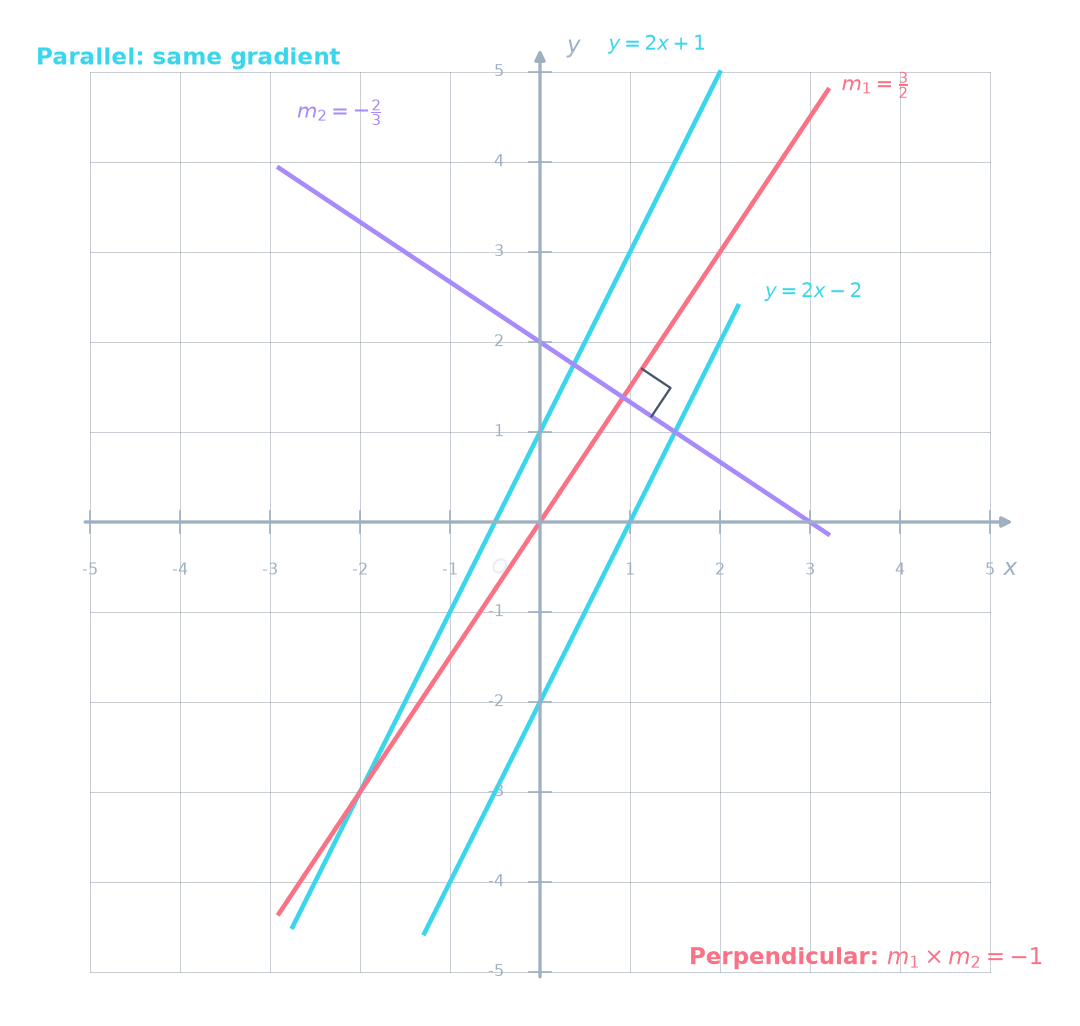
These perpendicular lines have finite gradients with product $-1$.
A line has gradient 3/2. The gradient of a line perpendicular to it is:
Difficulty 1/5 · 100 coins + a small bonus on first completion today
Flip and change sign: perpendicular gradient = −1 ÷ (3/2) = −2/3.
Extended, with both gradients finite: Two perpendicular lines have gradients that multiply to −1.
Difficulty 1/5 · 100 coins + a small bonus on first completion today
m₁ × m₂ = −1 is the defining property of perpendicular gradients. Horizontal/vertical perpendicular pairs are handled directly because the vertical gradient is undefined.
Extended, with both gradients finite: If two lines are perpendicular, then m₁ × m₂ = ______.
Difficulty 1/5 · 100 coins + a small bonus on first completion today
The product of perpendicular gradients is always −1. Horizontal/vertical perpendicular pairs are handled directly because the vertical gradient is undefined.
Worked example — perpendicular line
- Find the line perpendicular to $y = 2x + 3$ through $(4, 1)$.
- Original gradient $m_1 = 2$, so perpendicular gradient $m_2 = -\dfrac{1}{2}$.
- Substitute: $1 = -\dfrac{1}{2}(4) + c \Rightarrow 1 = -2 + c \Rightarrow c = 3$.
- The perpendicular line is $y = -\dfrac{1}{2}x + 3$.
Don't forget both steps. The perpendicular gradient is flip AND change sign. Gradient $3$ → perpendicular $-\dfrac{1}{3}$ (not $\dfrac{1}{3}$, which would just be the reciprocal).
A line has gradient 5. What is the gradient of a line perpendicular to it?
Difficulty 2/5 · 140 coins + a small bonus on first completion today
Perpendicular gradient = −1/5 = −0.2.
Perpendicular bisector 垂直平分线 (Extended)
- The perpendicular bisector of a segment cuts it in half at a right angle.
- Method (three steps):
- 1. Find the midpoint of the segment.
- 2. Find the perpendicular gradient ($-\dfrac{1}{m}$).
- 3. Use the perpendicular gradient and the midpoint to write the equation.
Match each gradient pair (m₁, m₂) to the relationship between the lines.
Difficulty 2/5 · 140 coins + a small bonus on first completion today
2/3 × (−3/2) = −1 → perpendicular. 4 = 4 → parallel. 1 × (−1) = −1 → perpendicular. 5 × (−5) = −25 ≠ −1 and 5 ≠ −5 → neither.
Put the steps for finding the perpendicular bisector of (0, 0) and (6, 2) in order.
Difficulty 3/5 · 200 coins + a small bonus on first completion today
First find the midpoint, then the segment gradient, then flip-and-sign for the perpendicular gradient, then substitute into y = mx + c.
Complete a perpendicular bisector (Extended)
- For $A(-2,6)$ and $B(4,2)$, the midpoint is $(1,4)$ and the segment gradient is $(2-6)/(4-(-2))=-2/3$. The perpendicular gradient is $3/2$.
- Substitute the midpoint, not an endpoint: $4=\tfrac32(1)+c$, so $c=5/2$ and the bisector is $y=\tfrac32x+\tfrac52$. Check the midpoint satisfies it and the gradients multiply to $-1$.
Axis exceptions. The bisector of a horizontal segment is vertical; the bisector of a vertical segment is horizontal. For $(-2,3)$ and $(6,3)$, the midpoint is $(2,3)$ and the bisector is $x=2$. There is no reciprocal of zero to calculate.
Extended: A=(−4,1) and B=(2,5). Find the perpendicular bisector of AB in y=mx+c form. Verify both its midpoint condition and its perpendicular-gradient condition.
Using an endpoint instead of the midpoint gives a different perpendicular line.
Extended: find the perpendicular bisector of (a) P(−3,2), Q(5,2) and (b) R(4,−5), S(4,1). Explain why the negative-reciprocal formula is not the right calculation for both cases.
The midpoint condition and right-angle condition still apply when a gradient is undefined.
Extended: P=(−3,2) and Q=(1,8). A second segment RS is perpendicular to PQ and passes through the midpoint of PQ. The lengths satisfy PQ:RS=2:3. Find the exact length RS and the equation of its line in y=mx+c form. Show each method.
A combined problem requires the length, midpoint, ratio and perpendicular-line methods to work together. Avoid rounding an exact surd before applying the ratio.
You've got it
- Core and Extended: distinct non-vertical parallel lines have equal gradients; vertical lines are parallel too
- Extended: perpendicular finite gradients multiply to $-1$ ($m_2 = -\dfrac{1}{m_1}$, "flip and change sign")
- perpendicular bisector = perpendicular gradient through the midpoint
- parallel to $y = 4x - 1$ through $(1, -3)$ → $y = 4x - 7$
Find a perpendicular gradient independently (Extended)
- A line has gradient 2.
- Find the gradient of a perpendicular line.
A line has gradient 2. What is the gradient of a line perpendicular to it?
The negative reciprocal of 2 is negative one half.
Extended: a line has gradient 2. What is its perpendicular gradient?
Difficulty 1/5 · 100 coins + a small bonus on first completion today
Perpendicular gradients multiply to negative 1. Other options — 2 (the original gradient); Negative 0.2 (the lesson perpendicular gradient).