Lines, angles, triangles and quadrilaterals
Introduced| English | Meaning |
|---|---|
| parallel/ˈpærəlel/ | Describing lines in the same plane that never meet, however far extended. |
| perpendicular/ˌpɜːpənˈdɪkjʊlə/ | Meeting at a right angle of 90 degrees. |
| acute/əˈkjuːt/ | acute |
| obtuse/ɒbˈtjuːs/ | obtuse |
| reflex/ˈriːfleks/ | reflex |
| vertex/ˈvɜːteks/ | A corner or meeting point of edges, a turning point of a parabola, or a node in a graph, depending on the context. |
| equilateral/ˌiːkwɪˈlætərəl/ | Describing a shape with all sides equal; an equilateral triangle also has three 60° angles. |
| isosceles/aɪˈsɒsəliːz/ | isosceles |
| scalene/ˈskeɪliːn/ | scalene |
| quadrilateral/ˌkwɒdrɪˈlætərəl/ | A four-sided polygon. |
| parallelogram/ˌpærəˈleləɡræm/ | A quadrilateral with both pairs of opposite sides parallel. |
| rhombus/ˈrɒmbəs/ | rhombus |
| trapezium/trəˈpiːzɪəm/ | A quadrilateral with a pair of parallel sides, using the British convention. |
The shapes around you
- Look at any room: the door is a rectangle, a table might be circular, roof trusses are triangles.
- Geometry is the mathematics of shape — and it starts with naming the basics precisely.
Shape and angle lab
Classify angle facts by the diagram feature that creates them.
Lines and angles
- Two lines are parallel 平行 if they never meet; perpendicular 垂直 if they meet at exactly $90^{\circ}$.
- Angles are named by size:
| Name | Size |
|---|---|
| acute 锐角 | less than $90^{\circ}$ |
| right | exactly $90^{\circ}$ |
| obtuse 钝角 | between $90^{\circ}$ and $180^{\circ}$ |
| reflex 优角 | between $180^{\circ}$ and $360^{\circ}$ |
- Name an angle with three letters: angle $ABC$ is the angle at vertex 顶点 $B$.
Reflex angles are easy to misread. If an angle is $250^{\circ}$, that's reflex — not $110^{\circ}$. Always check: the smaller angle and the reflex add to $360^{\circ}$.

Angles by size: acute (under 90°), right (90°, shown by a square), obtuse (90°–180°) and reflex (180°–360°)

The Taj Mahal has a clear line of symmetry down its centre
An angle of 40° is called:
Difficulty 1/5 · 100 coins + a small bonus on first completion today
Less than 90° is acute.
An angle of 250° is an obtuse angle.
Difficulty 1/5 · 100 coins + a small bonus on first completion today
250° is between 180° and 360°, so it is a reflex angle, not obtuse.
Triangles
- A triangle has three sides; its angles always add up to $180^{\circ}$.
- Equilateral 等边: all sides equal, all angles $60^{\circ}$.
- Isosceles 等腰: two equal sides, two equal angles.
- Scalene 不等边: all sides and angles different.
Angles $x$, $2x$, and $90^{\circ}$: $\;x + 2x + 90 = 180 \Rightarrow 3x = 90 \Rightarrow x = 30^{\circ}$.

The angle at the centre ($80^\circ$) is twice the angle at the circumference ($40^\circ$) on the same arc
A triangle has angles x, 2x and 90°. Find x (in degrees).
Difficulty 2/5 · 140 coins + a small bonus on first completion today
x + 2x + 90 = 180, so 3x = 90 and x = 30°.
An isosceles triangle has ______ equal sides.
Difficulty 1/5 · 100 coins + a small bonus on first completion today
An isosceles triangle has exactly two equal sides (and two equal angles).
Quadrilaterals 四边形
- A quadrilateral has four sides; its angles always add up to $360^{\circ}$.
- Key types: square (4 equal sides, 4 right angles), rectangle (4 right angles), parallelogram 平行四边形 (opposite sides parallel), rhombus 菱形 (4 equal sides), kite (2 pairs of adjacent equal sides), trapezium 梯形 (exactly 1 pair of parallel sides).
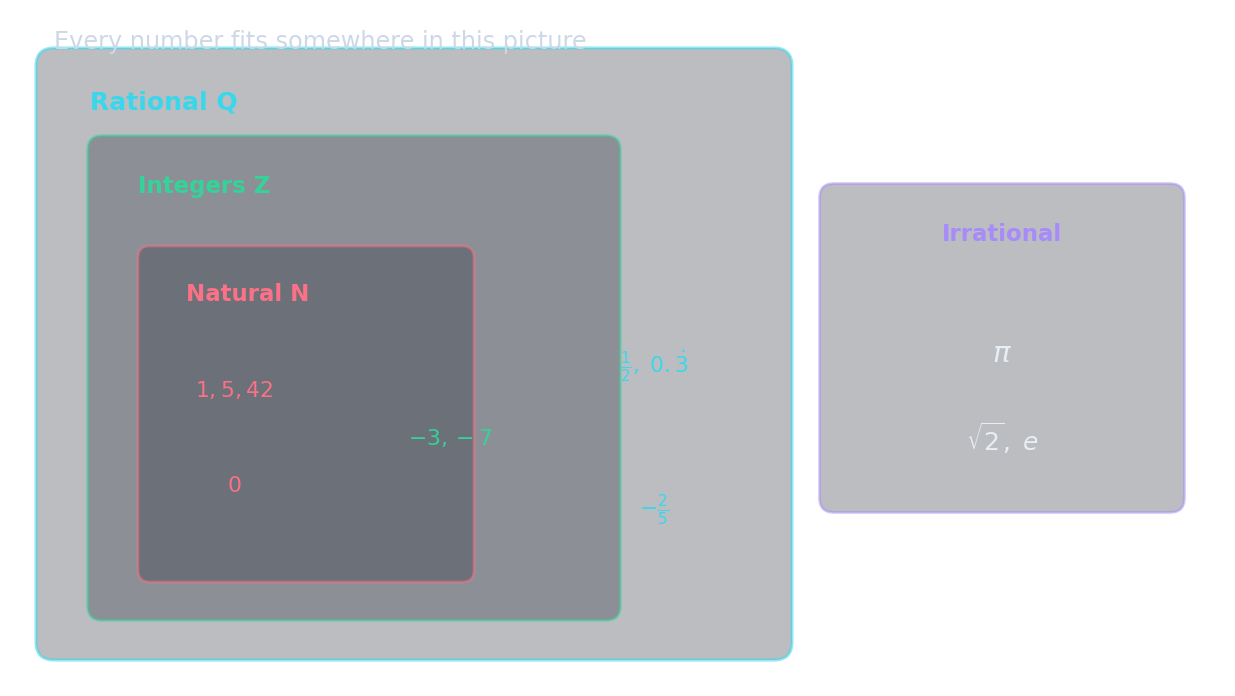
Like number families, shapes nest inside each other: every square is a rectangle, but not every rectangle is a square.
The four angles of a quadrilateral add up to how many degrees?
Difficulty 2/5 · 140 coins + a small bonus on first completion today
A quadrilateral can be split into two triangles: 2 × 180 = 360°.
Match each quadrilateral to its property.
Difficulty 2/5 · 140 coins + a small bonus on first completion today
A square has 4 equal sides and 4 right angles; a trapezium has one parallel pair; a kite has two adjacent equal pairs.
Why triangles are special
- Triangles are the only polygon that is always rigid — you can't change the shape without bending a side.
- That's why bridges, roof trusses, and crane booms are built from triangles.

Two theorems for both levels: the angle in a semicircle is $90^\circ$, and a tangent meets a radius at $90^\circ$
You've got it
- acute $<90^{\circ}$, right $=90^{\circ}$, obtuse $90$–$180^{\circ}$, reflex $180$–$360^{\circ}$
- triangle angles $= 180^{\circ}$; quadrilateral angles $= 360^{\circ}$
- name an angle by three letters — the middle letter is the vertex