Alcohols
Introduced| English | Meaning |
|---|---|
| alcohols/ˈælkəhɒlz/ | An organic compound with a hydroxyl group bonded to a saturated carbon atom. |
| hydroxyl/haɪˈdrɒksɪl/ | The functional group consisting of an oxygen atom bonded to a hydrogen atom, written OH. |
| ethanol/ˈeθənɒl/ | A two-carbon alcohol with molecular formula C2H5OH. |
| fermentation/fɜːmənˈteɪʃn/ | The breakdown of sugars without oxygen, often by microorganisms, to release energy and form products such as ethanol or lactic acid. |
| carboxylic acids/ˌkɑːbəkˈsɪlɪk ˈæsɪdz/ | An organic compound containing the COOH functional group. |
From drinks to fuel
- The alcohol in drinks, the fuel in some cars, the solvent in hand gel — all are alcohols 醇.
- They are a homologous series with the –OH functional group.
The functional group of the alcohols is:
Difficulty 1/5 · 100 coins + a small bonus on first completion today
Alcohols contain the hydroxyl –OH group.
The hydroxyl functional group is written as –______.
Difficulty 1/5 · 100 coins + a small bonus on first completion today
Alcohols contain –OH.
The alcohol family
- Alcohols contain the hydroxyl 羟基 (–OH) functional group.
- Examples: methanol (CH₃OH), ethanol 乙醇 (C₂H₅OH).
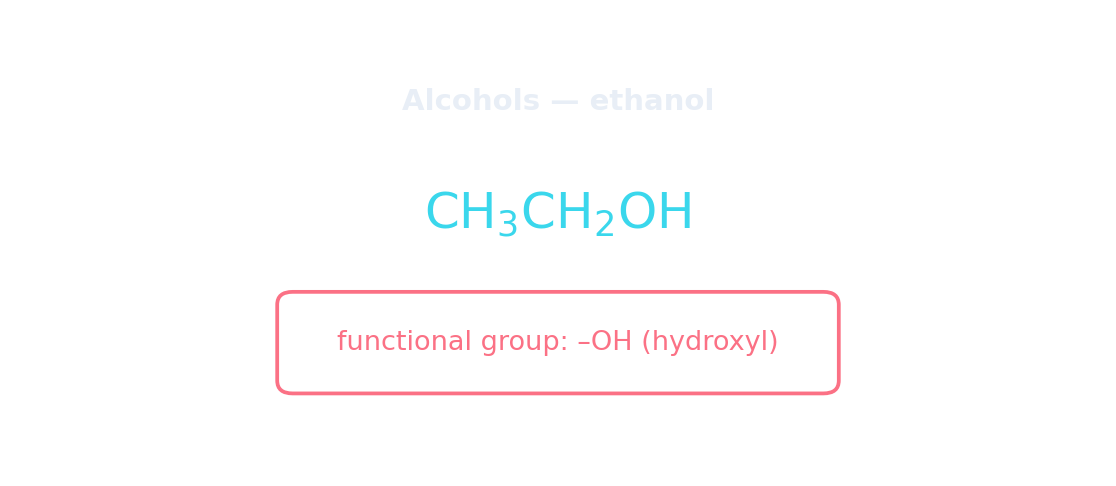
Alcohols share the –OH (hydroxyl) functional group, as in ethanol
Making ethanol by fermentation
Step through fermentation. Yeast turns sugar into ethanol with no air — the same alcohol can then be oxidised to vinegar.
Ethanol can be made by the fermentation of sugars using:
Difficulty 1/5 · 100 coins + a small bonus on first completion today
Yeast ferments sugars to ethanol.
Which are uses of ethanol? (Select all that apply.)
Difficulty 2/5 · 140 coins + a small bonus on first completion today
Ethanol is a fuel, solvent and the alcohol in drinks.
Making and using ethanol
- Ethanol can be made by fermentation 发酵 of sugars by yeast, or from ethene.
- It is used as a fuel, a solvent, and in alcoholic drinks.
Ethanol can be oxidised to:
Difficulty 1/5 · 100 coins + a small bonus on first completion today
Ethanol → ethanoic acid (as in vinegar).
Reactions of alcohols
- Alcohols burn in oxygen (combustion), releasing energy.
- They can be oxidised to carboxylic acids 羧酸 (e.g. ethanol → ethanoic acid, as in vinegar).
Worked example. Leave wine open to the air and the ethanol slowly oxidises to ethanoic acid — which is why old wine tastes of vinegar. Alcohols oxidise to carboxylic acids.
You've got it
- alcohols have the –OH functional group (e.g. ethanol, methanol)
- ethanol is made by fermentation and used as fuel, solvent and in drinks
- alcohols burn and can be oxidised to carboxylic acids