Carboxylic acids
Introduced| English | Meaning |
|---|---|
| carboxylic acid/ˌkɑːbəkˈsɪlɪk ˈæsɪd/ | An organic compound containing the COOH functional group. |
| ethanoic acid/ˌeθəˈnəʊɪk ˈæsɪd/ | The two-carbon carboxylic acid CH3COOH, also called acetic acid. |
| weak acids/wiːk ˈæsɪdz/ | An acid that only partially ionises in aqueous solution. |
| esters/ˈestəz/ | An organic compound containing a carbonyl group bonded to an oxygen atom that is bonded to another carbon group. |
The sour family
- The sharp taste of vinegar comes from a carboxylic acid 羧酸.
- They are a homologous series with the –COOH functional group.
The functional group of carboxylic acids is:
Difficulty 1/5 · 100 coins + a small bonus on first completion today
Carboxylic acids contain –COOH.
The carboxylic acid found in vinegar is:
Difficulty 1/5 · 100 coins + a small bonus on first completion today
Ethanoic acid (CH₃COOH) is in vinegar.
The carboxylic acid functional group is written –______.
Difficulty 1/5 · 100 coins + a small bonus on first completion today
It is the carboxyl group.
The carboxylic acid family
- Carboxylic acids contain the –COOH functional group.
- Example: ethanoic acid 乙酸 (CH₃COOH), the acid in vinegar.
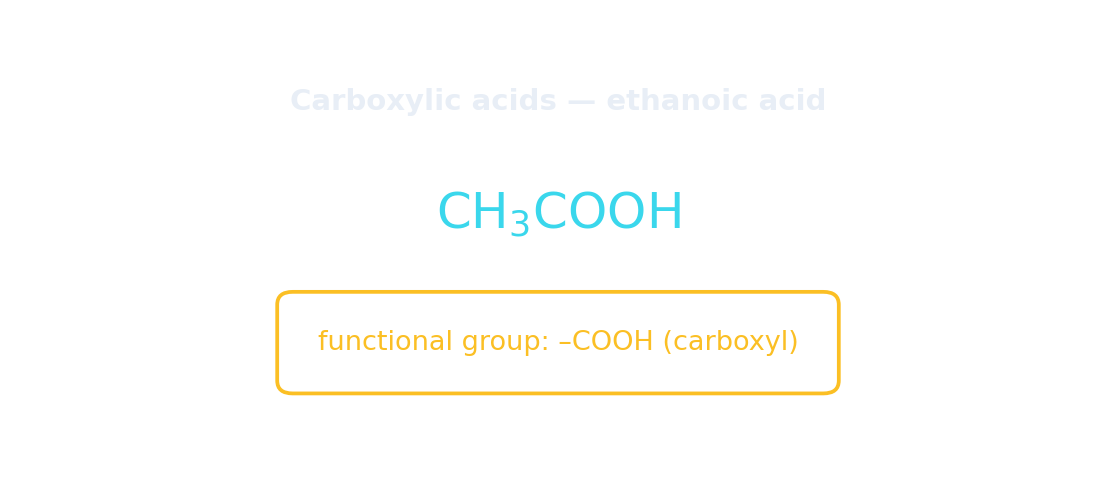
Carboxylic acids share the –COOH (carboxyl) functional group, as in ethanoic acid
A weak acid's pH
Carboxylic acids are weak acids — they only partly ionise, so they sit just below pH 7. Slide the scale to see where they fall.
Carboxylic acids are described as weak acids because they:
Difficulty 1/5 · 100 coins + a small bonus on first completion today
Weak means partly ionised, not dilute.
Match each carboxylic-acid fact.
Difficulty 2/5 · 140 coins + a small bonus on first completion today
Carboxylic acids contain –COOH, are weak acids, and fizz with carbonates.
Weak acids 弱酸
- Carboxylic acids are weak acids: they only partly ionise in water.
- They still show typical acid reactions, just less vigorously than strong acids.

A carboxylic acid and an alcohol react to make an ester and water
A carboxylic acid reacts with an alcohol to form a sweet-smelling:
Difficulty 1/5 · 100 coins + a small bonus on first completion today
Acid + alcohol → ester.
Reactions
- They react with metals (→ salt + hydrogen) and carbonates (→ salt + water + CO₂).
- They react with alcohols to form sweet-smelling esters 酯.
Carboxylic acids are weak acids. Unlike hydrochloric acid (strong, fully ionised), they only partly ionise — so they react more gently. "Weak" describes ionisation, not concentration.
You've got it
- carboxylic acids have the –COOH group (e.g. ethanoic acid in vinegar)
- they are weak acids (only partly ionise) but show typical acid reactions
- they react with metals, carbonates, and with alcohols to form esters
Write from a carbonate that fizzes
- Ethanoic acid is added to solid sodium carbonate.
- The acid has the group COOH.
What is observed, and which gas causes it?
Acids react with carbonates to release carbon dioxide.
What happens when ethanoic acid meets sodium carbonate?
Difficulty 1/5 · 100 coins + a small bonus on first completion today
The carbonate test releases carbon dioxide.