Equity and redistribution
Introduced| English | Meaning |
|---|---|
| equity/ˈekwɪti/ | Fairness in the distribution of resources, opportunities or outcomes, taking relevant differences in circumstances into account. |
| equality/iːˈkwɒlɪti/ | People having the same income, or the same chances. |
| horizontal equity/ˌhɒrɪˈzɒntl ˈekwɪti/ | horizontal equity |
| vertical equity/ˈvɜːtɪkl ˈekwɪti/ | vertical equity |
| Lorenz curve/ˈlɒrənts kɜːv/ | A graph comparing the cumulative share of income or wealth with the cumulative share of the population, ordered from poorest to richest. |
| Gini coefficient/ˈdʒiːni ˌkəʊɪˈfɪʃənt/ | A numerical measure of inequality in a distribution, with zero representing complete equality. |
| progressive taxes/prəˈɡresɪv ˈtæksɪz/ | Taxes for which the average tax rate rises as the taxable base, usually income, increases. |
Fair shares?
- Should everyone get the same, or what they earn, or enough to live on? "Fairness" in economics splits into two ideas.
- Governments redistribute to narrow the gap — but every transfer has a cost.
Inequality policy route
Follow how policy can change disposable income and opportunity.
Equity in economics means:
Difficulty 1/5 · 100 coins + a small bonus on first completion today
Equity = fairness; equality = the same for everyone. They are not identical.
Taxing those who can afford to pay more is an example of ______ equity.
Difficulty 1/5 · 100 coins + a small bonus on first completion today
Vertical equity: the better-off contribute more.
Equity 公平 vs equality 平等
- Equality = everyone gets the same. Equity = what is fair (which may not be equal).
- Horizontal equity 横向公平: treat those in the same situation alike. Vertical equity 纵向公平: those who can pay more, do (progressive tax).

Equality gives everyone the same share; equity gives a fair share, which may not be equal
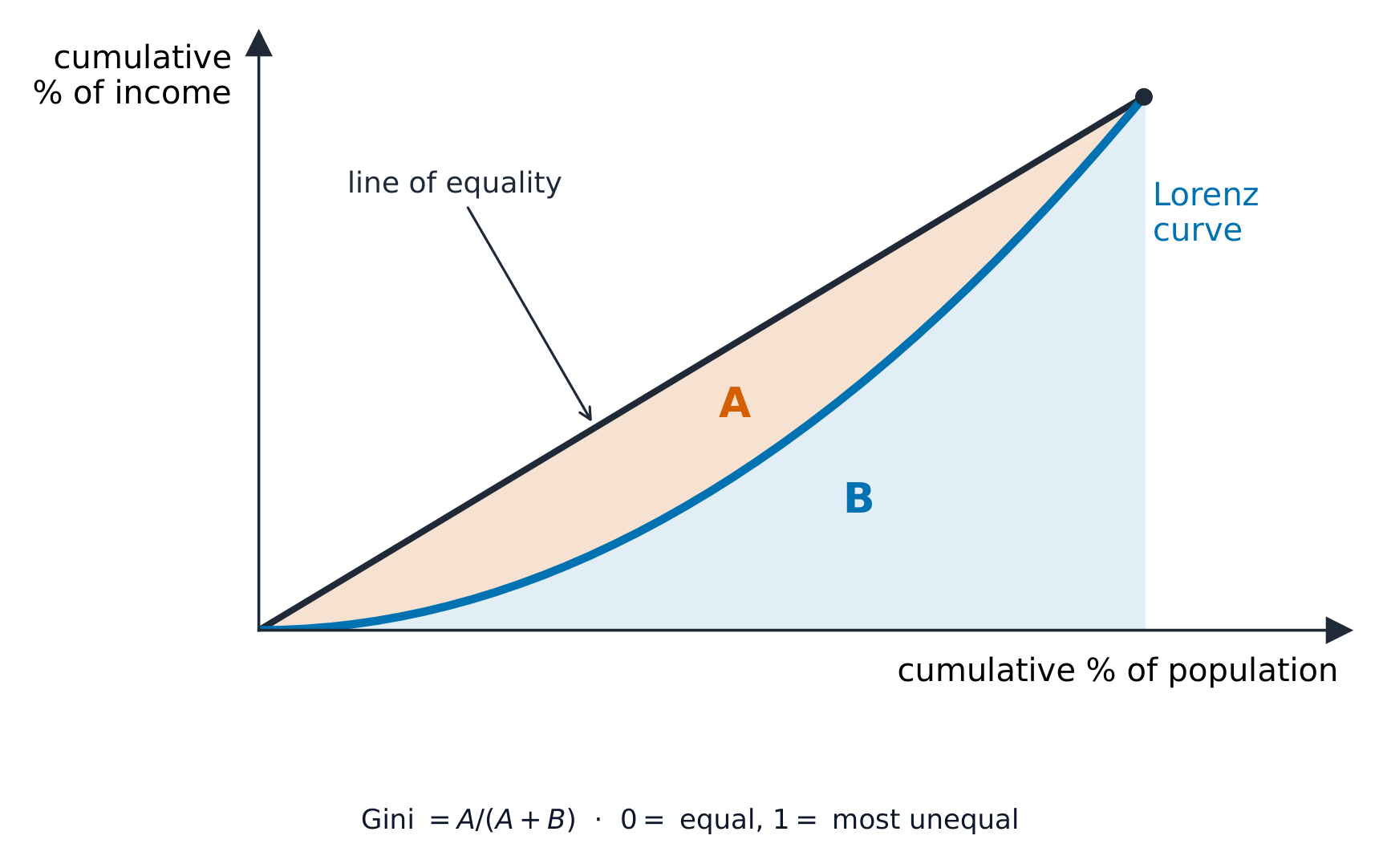
The Lorenz curve 洛伦兹曲线 and Gini coefficient 基尼系数 measure inequality
A Gini coefficient closer to 1 indicates:
Difficulty 1/5 · 100 coins + a small bonus on first completion today
Gini runs 0 (equal) to 1 (one person has everything).
Measuring the gap
- The Lorenz curve and Gini coefficient measure how unequally income is shared (0 = equal, 1 = one person has all).
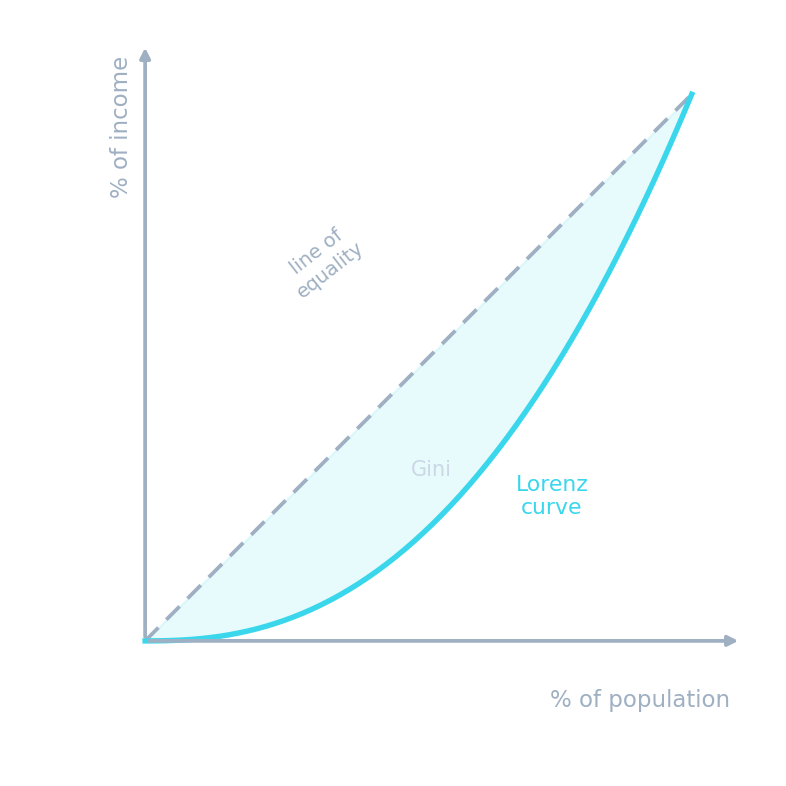
The more the Lorenz curve bows below the line of equality, the higher the Gini — and the more unequal the distribution.
Bend the Lorenz curve
Drag each economy's top-20% income share. The curve that hugs the line of equality has the lower Gini — and the quintile chips show what that society looks like in numbers.
Heavy redistribution can reduce incentives to work — the equity-efficiency trade-off.
Difficulty 1/5 · 100 coins + a small bonus on first completion today
High taxes/benefits can blunt incentives, trading some efficiency for greater equity.
Match each redistribution tool to how it works.
Difficulty 2/5 · 140 coins + a small bonus on first completion today
Taxes, transfers and human-capital spending narrow the income gap.
Redistribution and its cost
- Tools: progressive taxes 累进税, benefits/transfers, and spending on health and education.
- The catch: heavy redistribution can blunt incentives to work and invest — the equity-efficiency trade-off.
Equity is not equality. Aiming for perfect equality can be inefficient and is rarely the goal; most policy targets a fairer distribution while preserving incentives.

A minimum wage above equilibrium causes unemployment
You've got it
- equality = the same for all; equity = fair (horizontal + vertical)
- inequality is measured by the Lorenz curve and Gini (0 equal → 1 unequal)
- redistribute with progressive tax + transfers + spending, mindful of the equity-efficiency trade-off
Write from a disposable income of 50
- A low earner has market income of 20.
- A benefit of 30 is paid, funded by tax on a higher earner.
What is the low earner's disposable income after the benefit?
Disposable income is market income plus benefits minus tax.
What is disposable income after the benefit?
Difficulty 1/5 · 100 coins + a small bonus on first completion today
20 plus a benefit of 30 is 50.