Factors of production
Introduced| English | Meaning |
|---|---|
| factors of production/ˈfæktəz ɒv prəˈdʌkʃn/ | The inputs used to produce goods and services: land, labour, capital and enterprise. |
| land/lænd/ | Natural resources used in production, including the ground, water, minerals and other resources supplied by nature. |
| labour/ˈleɪbə/ | Human physical and mental effort used in production. |
| capital/ˈkæpɪtl/ | Produced assets used to make other goods and services. |
| enterprise/ˈentəpraɪz/ | The ability and willingness to organise production, innovate and bear business risk. |
| entrepreneur/ˌɒntrɪprəˈnjʊə/ | A person who organises a business, takes risks and seeks opportunities to create value. |
| human capital/ˈhjuːmən ˈkæpɪtl/ | The knowledge, skills, experience and health that contribute to people's productive ability. |
Everything is made from four things
- A loaf of bread needs wheat fields, a baker, an oven, and someone who took the risk of opening the bakery.
- Economists group every resource into just four factors of production 生产要素 — and each earns its own reward.
Factors of production lab
Sort real resources by the factor of production they represent.
The four factors
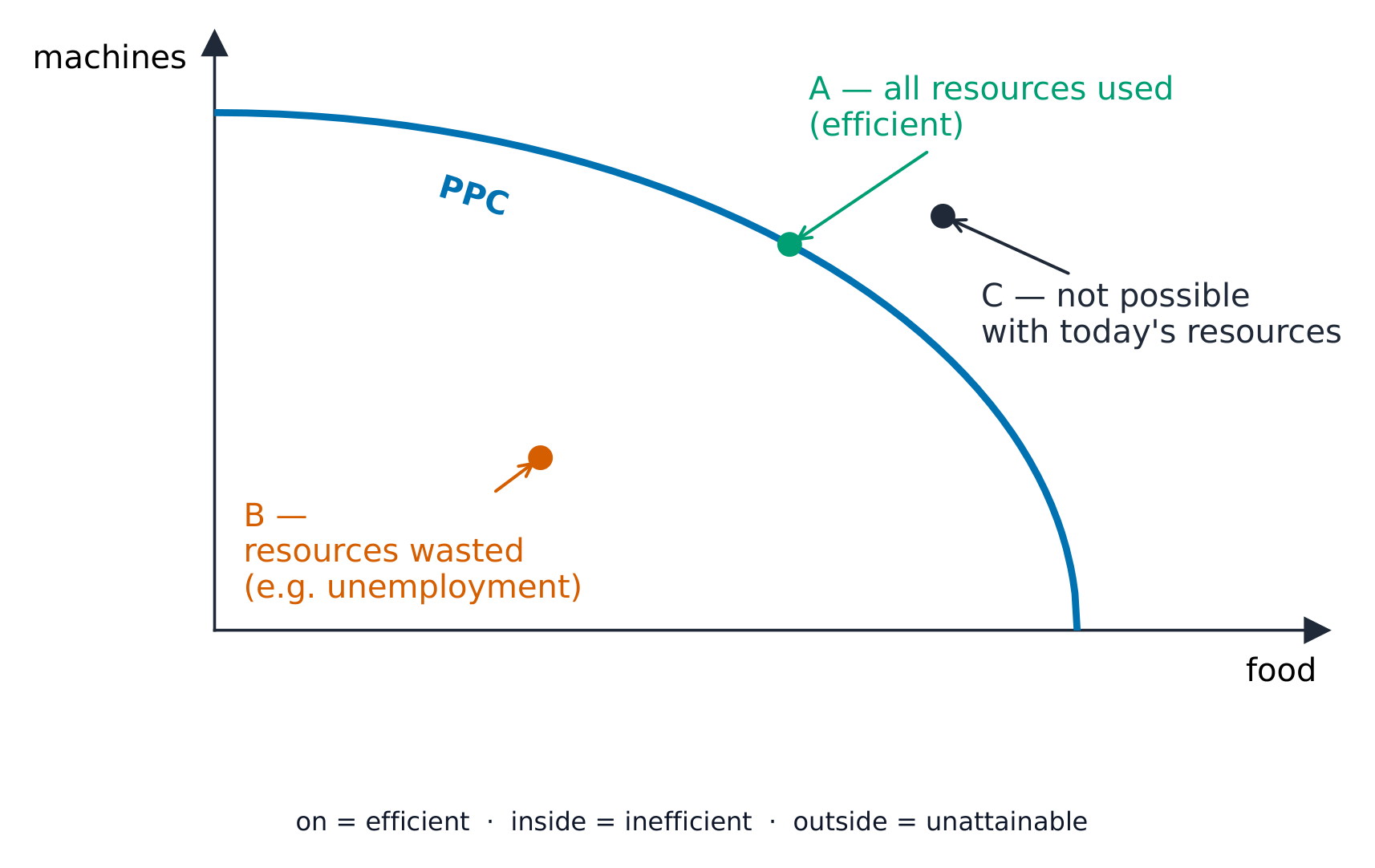
Points on, inside and outside the production possibility curve
Match each factor of production to the reward it earns.
Difficulty 2/5 · 140 coins + a small bonus on first completion today
Land earns rent, labour earns wages, capital earns interest, enterprise earns profit.
In economics, "capital" means:
Difficulty 1/5 · 100 coins + a small bonus on first completion today
Capital is man-made aids to production — not money (money just buys capital).
A factory machine is an example of which factor of production?
Difficulty 1/5 · 100 coins + a small bonus on first completion today
A machine is a man-made aid to production — capital.
The reward earned by the factor "land" is called ______.
Difficulty 1/5 · 100 coins + a small bonus on first completion today
Land earns rent.
Enterprise is special
- The entrepreneur 企业家 combines land, labour and capital, takes the risk, and keeps the profit (or bears the loss).
- Without enterprise the other three factors sit idle — nobody brings them together.
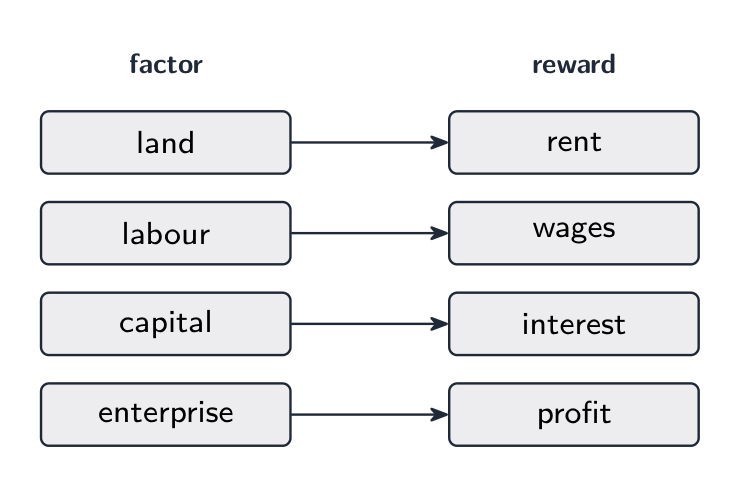
The four factors of production and the reward each earns
The entrepreneur combines the other factors, takes the risk, and earns the profit.
Difficulty 1/5 · 100 coins + a small bonus on first completion today
Enterprise organises land, labour and capital and bears the risk for a profit (or loss).
Quality matters, not just quantity
- More or better factors raise an economy's capacity:
- Human capital 人力资本 (education, skills) makes labour more productive.
- Investment in capital goods boosts future output.
"Capital" means tools, not money. In economics, capital is the man-made aids to production — machines, factories, computers — not cash. Money just buys the capital.
Education and skills that make labour more productive are called human ______.
Difficulty 1/5 · 100 coins + a small bonus on first completion today
Human capital is the skills/education embodied in workers.
You've got it
- four factors: land (rent), labour (wages), capital (interest), enterprise (profit)
- the entrepreneur combines the others, takes the risk, earns the profit
- capital = man-made aids (tools/machines), not money; human capital = skills