Resource allocation in economic systems
Introduced| English | Meaning |
|---|---|
| economic system/ˌiːkəˈnɒmɪk ˈsɪstəm/ | The institutions and rules through which a society organises production, allocation and distribution. |
| market economy/ˈmɑːkɪt ɪˈkɒnəmi/ | An economy in which prices and resource allocation are largely determined by buyers and sellers through markets. |
| price mechanism/praɪs ˈmekənɪzəm/ | The way prices signal scarcity and influence the allocation of resources through demand and supply. |
| command/kəˈmænd/ | command |
| mixed economy/mɪkst ɪˈkɒnəmi/ | An economy combining market allocation and private ownership with government intervention and public provision. |
| signalling/ˈsɪɡnəlɪŋ/ | Prices communicating information about scarcity and changing demand or supply to buyers and sellers. |
| rationing/ˈræʃənɪŋ/ | Allocating a limited supply among competing users, by prices, quotas or another rule. |
| externalities/ekˈstɜːnælɪtiz/ | Costs or benefits of an activity that affect third parties and are not reflected fully in its market price. |
Who decides what gets made?
- In a Soviet factory, a planning committee set the targets. In a farmers' market, prices do. Most countries sit somewhere between.
- How an economy answers what, how, for whom defines its economic system 经济体制.
Three systems
- Market economy 市场经济: the price mechanism 价格机制 decides — private firms, consumer demand, no central plan.
- Command 计划经济 (planned) economy: the state decides what to produce and allocates resources.
- Mixed economy 混合经济: a blend — markets plus government intervention (the real world).

An open-pit copper mine: land includes the natural resources (minerals, oil, water) that firms extract
Allocating scarce resources
An economy can't have more of everything: making more of one good means giving up some of another — the frontier's slope is that opportunity cost.
In a market economy, resources are allocated mainly by:
Difficulty 1/5 · 100 coins + a small bonus on first completion today
Markets use prices (the invisible hand); command economies use central planning.
Match each system to who decides.
Difficulty 2/5 · 140 coins + a small bonus on first completion today
Market = prices; command = state; mixed = a blend (the real world).
The price mechanism
- In a market, price does three jobs at once — Adam Smith's "invisible hand":
- Signalling 信号传递 (a high price signals scarcity), incentive (high price rewards more supply), rationing 配给 (price allocates to those willing to pay).

Price does three jobs at once: signalling scarcity, giving an incentive to supply, and rationing the good
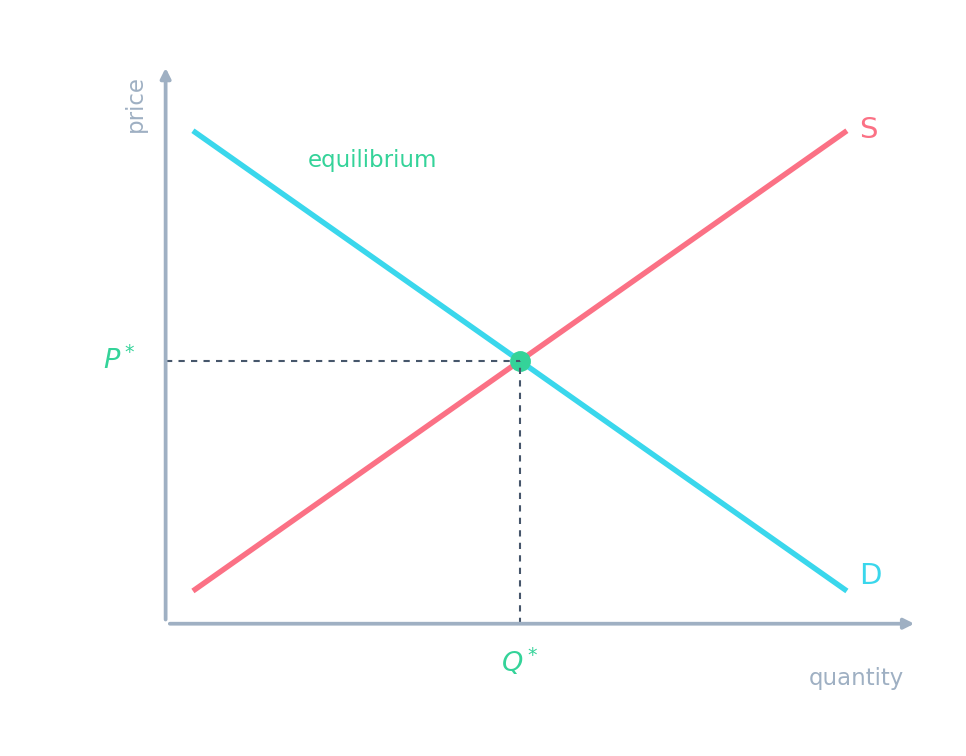
The price mechanism clears a market where supply meets demand — no planner required.
Shortage self-corrects. If price is below equilibrium, demand exceeds supply (a shortage); price rises, choking demand and drawing out supply until the market clears.
A high price that encourages firms to supply more is the price acting as a(n):
Difficulty 1/5 · 100 coins + a small bonus on first completion today
The three jobs of price are signalling, incentive and rationing; rewarding supply is the incentive function.
If the price is below equilibrium, there is a shortage and price tends to rise.
Difficulty 1/5 · 100 coins + a small bonus on first completion today
Below equilibrium, demand exceeds supply → shortage → upward pressure on price until it clears.
The three functions of the price mechanism are signalling, incentive and ______.
Difficulty 1/5 · 100 coins + a small bonus on first completion today
Rationing allocates limited goods to those willing and able to pay.
Strengths and weaknesses
- Markets: efficient, responsive — but ignore externalities 外部性, under-provide public goods, and can worsen inequality.
- Command: can provide for all and curb inequality — but lacks incentives, and planners lack the information prices carry.

Economic systems form a spectrum from a free market to full government planning
You've got it
- market (price mechanism), command (state plans), mixed (both)
- price does three jobs: signalling, incentive, rationing
- markets are efficient but miss externalities/public goods; command lacks incentives + information