Training and the workforce
Introduced| English | Meaning |
|---|---|
| productivity/ˌprɒdəkˈtɪvɪti/ | Output produced per unit of input over a given period. |
| induction/ɪnˈdʌkʃn/ | Training that introduces a new employee to the organisation, workplace and requirements of the job. |
| on-the-job/ɒnðə dʒɒb/ | Describing training carried out while performing work in the workplace. |
| off-the-job/ɒf ðə dʒɒb/ | Describing training undertaken separately from normal work duties. |
| motivation/ˌməʊtɪˈveɪʃn/ | The reasons or influences that encourage a person to act or make an effort. |
| labour productivity/ˈleɪbə ˌprɒdəkˈtɪvɪti/ | Output produced per worker or per unit of labour input over a specified period. |
| labour turnover/ˈleɪbə ˈtɜːnəʊvə/ | The rate at which employees leave an organisation, commonly measured against its average workforce over a period. |
| investment/ɪnˈvestmənt/ | Spending on assets intended to provide future returns or increase productive capacity. |
Turning recruits into performers
- Hiring someone is only the beginning — a new employee rarely performs at their best on day one.
- Training turns potential into productivity 生产率, and keeps skills sharp as the business changes.
Human resources decision lab
Classify HR actions by the job they do inside the workforce.
Training that introduces a new employee to the job and workplace is:
Difficulty 1/5 · 100 coins + a small bonus on first completion today
Induction settles a new starter into the role and organisation.
Learning a job while doing it, guided by a colleague, is:
Difficulty 1/5 · 100 coins + a small bonus on first completion today
On-the-job training happens at the workplace during work.
Types of training
- Induction 入职培训: introduces a new employee to the job, people and procedures.
- On-the-job 在岗培训: learning while working, guided by a colleague.
- Off-the-job 脱岗培训: training away from the workplace (courses, college).
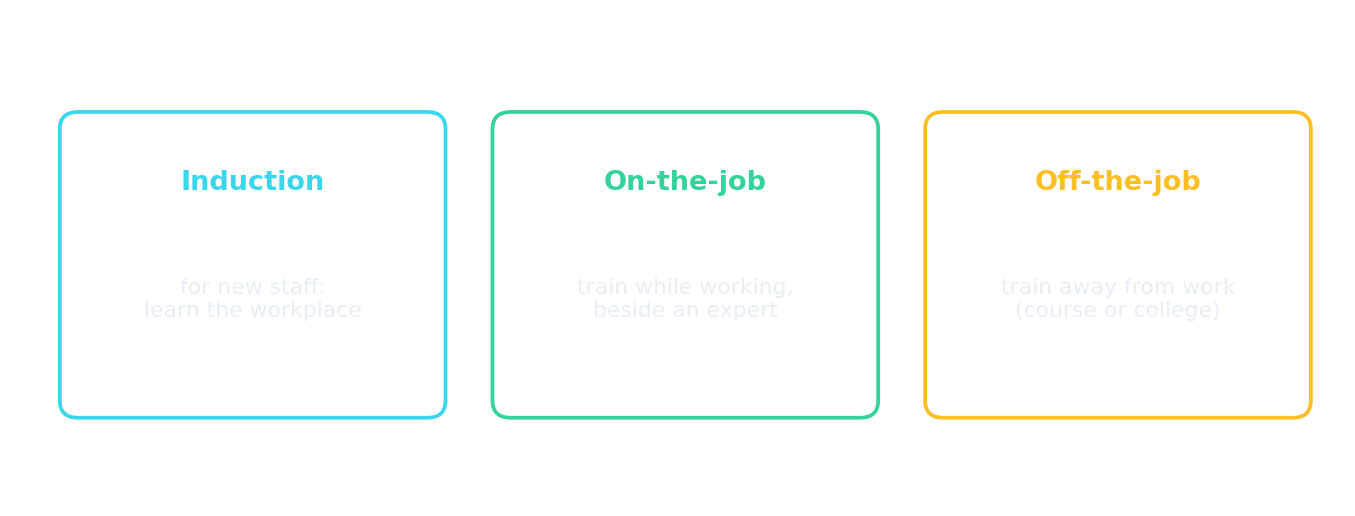
Three kinds of training: induction, on-the-job and off-the-job
Because it raises future productivity, training is best seen as an ______, not just a cost.
Difficulty 1/5 · 100 coins + a small bonus on first completion today
Training pays back through productivity and retention.
Weighing up training
- Benefits: higher productivity, better quality, more motivation 激励, easier change.
- Costs: money, time away from work, and the risk a trained worker leaves.

Three kinds of training: induction, on-the-job and off-the-job
12 workers produce 360 units a day. What is labour productivity (units per worker)?
Difficulty 2/5 · 140 coins + a small bonus on first completion today
360 / 12 = 30 units per worker.
A high labour turnover can be a warning sign of problems in a business.
Difficulty 1/5 · 100 coins + a small bonus on first completion today
High turnover suggests poor pay, motivation or management.
Measuring workforce performance
- Labour productivity 劳动生产率 = output ÷ number of workers.
- Labour turnover 员工流失率 = staff leaving ÷ total staff. High turnover signals problems.
Training is an investment 投资, not just a cost. It costs money now but raises productivity and retention later. Firms that cut all training to save money often pay more in low quality and high turnover.
You've got it
- training types: induction, on-the-job, off-the-job
- it raises productivity and motivation but costs time and money
- track the workforce with labour productivity and labour turnover