Motivation theories
Introduced| English | Meaning |
|---|---|
| motivation/ˌməʊtɪˈveɪʃn/ | The reasons or influences that encourage a person to act or make an effort. |
| scientific management/saɪənˈtɪfɪk ˈmænɪdʒmənt/ | Taylor's approach to improving work efficiency through systematic analysis of tasks, standardised methods and performance incentives. |
| piece rates/piːs reɪts/ | piece rates |
| hygiene factors/ˈhaɪdʒiːn ˈfæktəz/ | In Herzberg's theory, aspects of the work environment whose inadequacy can cause dissatisfaction, such as pay or working conditions. |
| motivators/ˈməʊtɪveɪtəz/ | In Herzberg's theory, features of the work itself associated with satisfaction, such as achievement, recognition and responsibility. |
| hierarchy/ˈhaɪərɑːki/ | An arrangement of people, categories or elements in ranked levels. |
| self-actualisation/self ˌæktʃuːəlaɪˈzeɪʃn/ | The pursuit or fulfilment of one's potential, often described as a high-level need in Maslow's theory. |
| recognition/ˌrekəɡˈnɪʃn/ | Acknowledgment or appreciation of someone's contribution, effort or achievement. |
| human relations/ˈhjuːmən rɪˈleɪʃnz/ | An approach to management emphasising social relationships, communication and employee needs at work. |
What makes people work hard?
- Two workers, same job, same pay — one is energised, the other watches the clock. Why?
- Generations of theorists have tried to explain motivation 激励, and their ideas still shape management today.
F.W. Taylor argued that workers are mainly motivated by:
Difficulty 1/5 · 100 coins + a small bonus on first completion today
Taylor's scientific management stressed pay and piece rates.
Taylor: money motivates
- F.W. Taylor (scientific management 科学管理) argued workers are mainly motivated by money.
- Break work into simple tasks, measure it, and pay piece rates 计件工资 — more output, more pay.

Herzberg: hygiene factors 保健因素 stop unhappiness; motivators 激励因素 give real motivation
Maslow's hierarchy of needs
Maslow said people are motivated by needs in order — satisfy the lower ones first, then they aim higher.
In Maslow's hierarchy, which need is satisfied first?
Difficulty 1/5 · 100 coins + a small bonus on first completion today
Lower (physiological) needs must be met before higher ones motivate.
Maslow arranged human needs in a ______, with the most basic at the bottom.
Difficulty 1/5 · 100 coins + a small bonus on first completion today
Each level must be met before the next motivates.
Maslow: a hierarchy 层级 of needs
- Maslow said people are motivated by a hierarchy of needs, lowest first.
- Once a level is met, the next becomes the motivator — up to self-actualisation 自我实现.
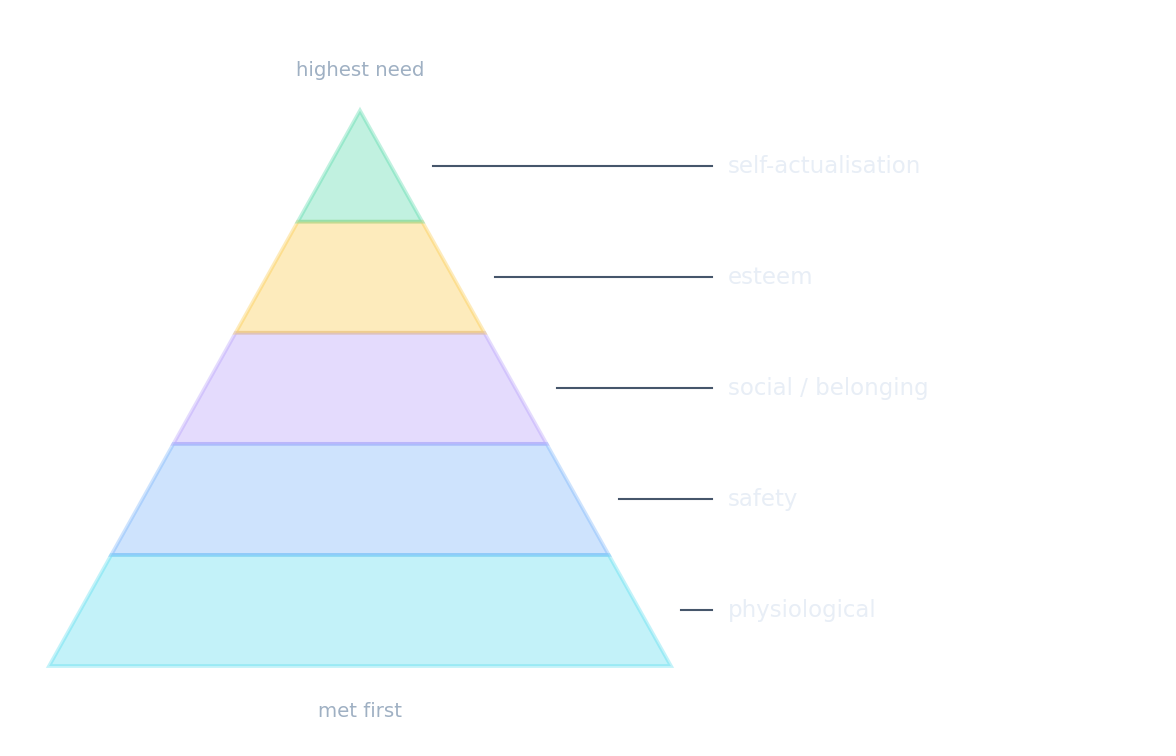
People satisfy lower needs first; only then do higher needs motivate.
In Herzberg's theory, pay and working conditions are:
Difficulty 1/5 · 100 coins + a small bonus on first completion today
Hygiene factors stop dissatisfaction; motivators create satisfaction.
Mayo's human relations school argued that social needs and teamwork affect motivation.
Difficulty 1/5 · 100 coins + a small bonus on first completion today
Mayo found attention and social factors raised performance.
Herzberg and Mayo
- Herzberg: hygiene factors (pay, conditions) prevent dissatisfaction; motivators (achievement, recognition 认可) create real satisfaction.
- Mayo: the human relations 人际关系 school — teamwork, attention and social needs matter, not just money.
Money is necessary but not sufficient. Taylor over-stressed pay; Herzberg showed pay only stops people being unhappy — genuine motivation comes from the work itself, recognition and responsibility.
You've got it
- Taylor: money + piece rates motivate
- Maslow: a hierarchy of needs, lowest first, up to self-actualisation
- Herzberg: hygiene factors stop dissatisfaction, motivators create satisfaction; Mayo: social needs matter