| English | 의미 |
|---|---|
| intercept/ˌɪntəˈsept/ | 절편 |
| line of best fit/laɪn ɒv best fɪt/ | 최적拟合線 (최적 적합선) |
Reading a line like a barcode
- Every straight line has a unique "signature" — its equation.
- If you can read the equation, you can tell the gradient, the intercept 截距, and where the line crosses every axis — without drawing it.
- The signature is just three letters: $y = mx + c$.
The form $y = mx + c$
- $m$ is the gradient (how steep the line is).
- $c$ is the $y$-intercept (where the line crosses the $y$-axis — the point $(0, c)$).
- Together, they completely describe a straight line.
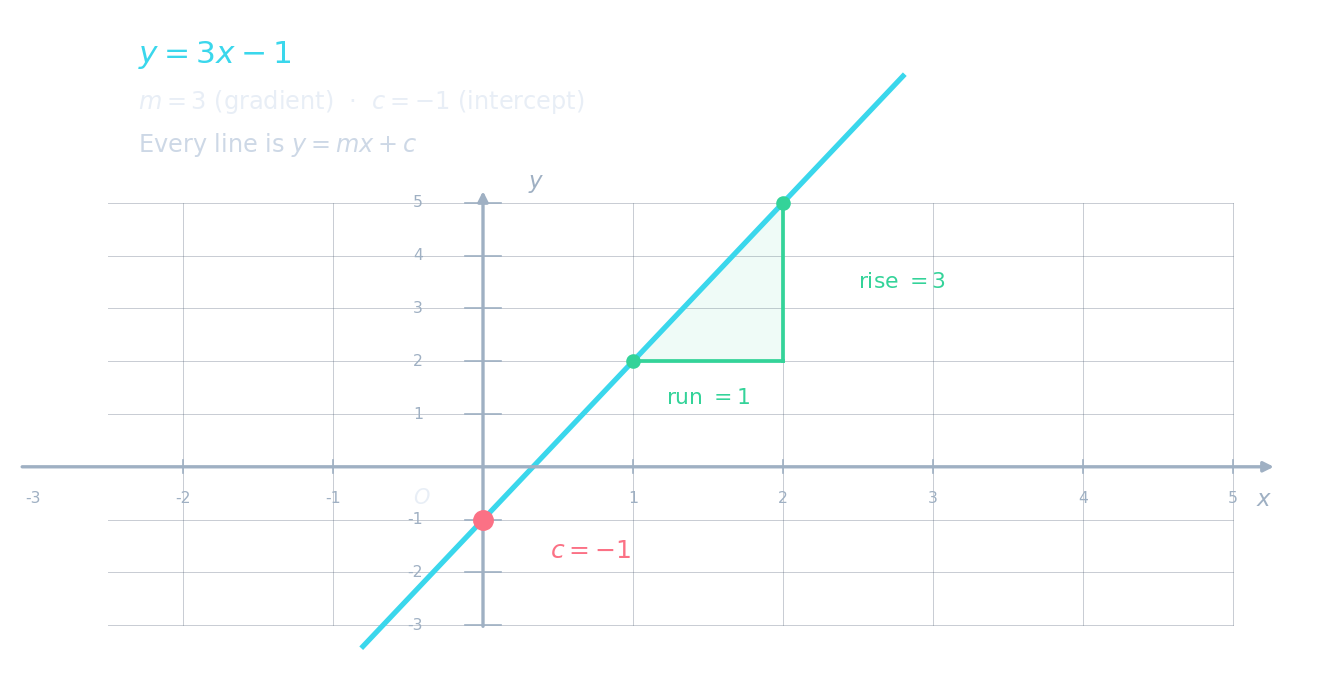
In $y = 3x - 1$: the gradient $m = 3$ and the intercept $c = -1$. The figure shows both.
직선
y = ax + b
모든 직선은 기울기 a와 y절편 b를 가집니다.
y = mx + c에서 문자 m는 다음을 나타냅니다:
난이도 1/5 · 100 코인 + 오늘 첫 완료 시 소액 보너스
m는 기울기(경사도)이며, c는 y절편입니다.
Reading $m$ and $c$ from an equation
- When the equation is already in $y = mx + c$ form, just read off the values:
- $y = 5x + 2$ → $m = 5$, $c = 2$.
- $y = -\dfrac{1}{2}x + 4$ → $m = -\dfrac{1}{2}$, $c = 4$.
- $y = 3x$ → $m = 3$, $c = 0$ (the line passes through the origin).
Not in $y =$ form? You must rearrange first. $5x + 4y = 8$ looks tricky, but: $4y = -5x + 8$, so $y = -\dfrac{5}{4}x + 2$ — gradient $-\dfrac{5}{4}$, intercept $2$.

For $y=mx+c$ the line crosses the $y$-axis at $c$, and the gradient $m$ is the rise divided by the run
Finding the equation from a point and gradient
- Know the gradient $m$ and one point? Substitute into $y = mx + c$ and solve for $c$.
- Example: gradient $3$ through $(1, 2)$:
- $2 = 3(1) + c \Rightarrow c = 2 - 3 = -1$.
- The equation is $y = 3x - 1$.
From two points. Through $(2, 5)$ and $(4, 11)$: first find $m = \dfrac{11-5}{4-2} = \dfrac{6}{2} = 3$. Then $5 = 3(2) + c \Rightarrow c = -1$. Equation: $y = 3x - 1$.
기울기가 3이고 (1, 2)를 지나는 직선이 있습니다. y = 3x + c에서 c값은 무엇입니까?
난이도 2/5 · 140 코인 + 오늘 첫 완료 시 소액 보너스
2 = 3(1) + c이므로, c = 2 − 3 = −1입니다. 따라서 직선의 방정식은 y = 3x − 1입니다.
한 직선의 기울기가 2이고 점 (3, 1)을 지납니다. 이 직선의 방정식은?
난이도 1/5 · 100 코인 + 오늘 첫 완료 시 소액 보너스
1 = 2(3) + c → c = 1 − 6 = −5. 따라서 y = 2x − 5입니다.
직선 y = 2x + 3에 수직이며 점 (4, 1)을 지나는 직선이 있습니다. y = mx + c에서 c는 얼마입니까?
난이도 2/5 · 140 코인 + 오늘 첫 완료 시 소액 보너스
수직의 기울기는 −1/2입니다. 따라서 1 = −(1/2)(4) + c → 1 = −2 + c → c = 3입니다.
Rearranging to $y = mx + c$
- Exams love giving equations like $ax + by = c$ and asking for the gradient.
- Step 1: isolate $y$ — move $ax$ to the other side, then divide by $b$.
- Step 2: read off $m$ and the intercept.
- Example: $2x + 3y = 12 \Rightarrow 3y = -2x + 12 \Rightarrow y = -\dfrac{2}{3}x + 4$.
- Gradient $= -\dfrac{2}{3}$; $y$-intercept $= 4$.
5x + 4y = 8을 y = mx + c 형태로 변형하십시오. c(y절편)값은 무엇입니까?
난이도 2/5 · 140 코인 + 오늘 첫 완료 시 소액 보너스
4y = −5x + 8이므로 y = −(5/4)x + 2; 절편은 2입니다.
2x + 3y = 12를 y = mx + c 형태로 변형할 때, 기울기 m은 얼마입니까?
난이도 2/5 · 140 코인 + 오늘 첫 완료 시 소액 보너스
3y = −2x + 12이므로 y = −(2/3)x + 4입니다. 기울기는 −2/3 ≈ −0.667입니다.
3x − y = 7을 y = mx + c 형태로 변형할 때, y절편은 얼마입니까?
난이도 2/5 · 140 코인 + 오늘 첫 완료 시 소액 보너스
−y = −3x + 7이므로 y = 3x − 7입니다. y절편은 −7입니다.
The line of best fit 最佳拟合线
- In science experiments, data points rarely fall on a perfect line.
- Scientists draw a line of best fit through the scatter — and its equation $y = mx + c$ summarises the whole experiment in one sentence.
- The gradient tells you the rate (e.g. how fast temperature rises per minute); the intercept tells you the starting value.
각 방정식을 그에 맞는 성질과 연결하세요.
난이도 2/5 · 140 코인 + 오늘 첫 완료 시 소액 보너스
y = 4x + 1: m = 4. y = −x + 3: c = 3. y = 2x: c = 0이므로 점 (0,0)을 지납니다. y = 5x − 1의 기울기는 5로, y = 5x + 7과 같으므로 두 직선은 평행합니다.
You've got it
- $y = mx + c$ — $m$ is the gradient, $c$ is the $y$-intercept
- rearrange $ax + by = c$ into $y = mx + c$ before reading off $m$ and $c$
- gradient $3$ through $(1, 2)$ → $c = -1$ → equation $y = 3x - 1$
- from two points: find $m$ first, then substitute one point to find $c$