Skip to content
Subjects

HSK 4 Grammar

  • 1 Adjectives
    • 1.1 Indicating the whole with "quan"
    • 1.2 Negative adjectives with "-si le"

    Adjectives →

  • 2 Adverbs
    • 2.1 Approximations with "chabuduo"
    • 2.2 Assessing situations with "kanlai"
    • 2.3 Coincidence with "zhenghao"
    • 2.4 Declaring the only option with "zhihao"
    • 2.5 Emphasizing negation with "you"
    • 2.6 Emphatic adverb "ke"
    • 2.7 Expressing "all along" with "yuanlai"
    • 2.8 Expressing "almost" using "chadian"
    • 2.9 Expressing "always" with "conglai"
    • 2.10 Expressing "as a result" with "jieguo"
    • 2.11 Expressing "enough" with "gou"
    • 2.12 Expressing "even" with "shenzhi"
    • 2.13 Expressing "had better" with "haishi"
    • 2.14 Expressing "had better" with "zuihao"
    • 2.15 Expressing "have to" with "budebu"
    • 2.16 Expressing "in the end" with "daodi"
    • 2.17 Expressing "in the end" with "jiujing"
    • 2.18 Expressing "just" with "gang"
    • 2.19 Expressing "one by one" with "yi"
    • 2.20 Expressing "originally" with "benlai"
    • 2.21 Expressing "small quantity" with "jiu"
    • 2.22 Expressing "to make certain" with "qianwan"
    • 2.23 Expressing concern with "kongpa"
    • 2.24 Expressing the unexpected with "jingran"
    • 2.25 Rhetorical questions with "nandao"
    • 2.26 Sequencing with "xian" and "zai"
    • 2.27 Using "ye" and "dou" together

    Adverbs →

  • 3 Adverbs with Adjectives
    • 3.1 Expressing "quite" with "ting"

    Adverbs with Adjectives →

  • 4 Auxiliary Words
    • 4.1 Ending a non-exhaustive list with "shenme de"
    • 4.2 Non-exhaustive lists with "dengdeng"

    Auxiliary Words →

  • 5 Conjunctions
    • 5.1 A softer "but" with "buguo"
    • 5.2 Expressing "and then" with "yushi"
    • 5.3 Expressing "in addition" with "haiyou"
    • 5.4 Expressing "in addition" with "lingwai"
    • 5.5 Expressing "in addition" with "zaishuo"
    • 5.6 Two words for "but"
    • 5.7 Using "er" to explain contrasting ideas
    • 5.8 Using "lai" to connect two verb phrases

    Conjunctions →

  • 6 Nouns
    • 6.1 Expressing "within (it/them)" with "qizhong"

    Nouns →

  • 7 Numbers
    • 7.1 Expressing fractions with "fenzhi"

    Numbers →

  • 8 Particles
    • 8.1 Advanced yes-no questions with "ma"
    • 8.2 Reviewing options with "ba"
    • 8.3 Using "de" (modal particle)

    Particles →

  • 9 Prepositions
    • 9.1 Expressing "along with…" with "suizhe"
    • 9.2 Idiomatic phrases with "zai"

    Prepositions →

  • 10 Sentence Patterns
    • 10.1 Emphasizing a negation with "bing"

    Sentence Patterns →

  • 11 Sentence patterns

    by means of以yǐ A for / (wéi) to be为wèi B (take A as B)

    Form: by means of以yǐ A for / (wéi) to be为wèi B (written) · by means of以yǐ……to rely mainly on为主wéi zhǔ / used in the construction…为例wèi lì / for / (wéi) to be为wèicenter中心zhōng xīn / for / (wéi) to be为wèigoal目标mù biāo

    • 南方人nán fāng rénby means of以yǐcooked rice米饭mǐ fànto rely mainly on为主wéi zhǔto feed (a person or animal)食shí。 Nánfāng rén yǐ mǐfàn wéi zhǔshí. – People in the south take rice as their staple food.
    • by means of以yǐBeijing北京běi jīngused in the construction…为例wèi lì,underground railway地铁dì tiěline / route线路xiàn lùalready已经yǐ jīngto exceed超过chāo guò二十条èr shí tiáo。 Yǐ Běijīng wéi lì, dìtiě xiànlù yǐjīng chāoguò èrshí tiáo. – Take Beijing as an example: it already has more than twenty metro lines.
    • we / us我们wǒ men(modifier / structural particle)的de课以kè yǐcolloquial speech口语kǒu yǔto rely mainly on为主wéi zhǔ。 Wǒmen de kè yǐ kǒuyǔ wéi zhǔ. – Our classes focus mainly on speaking.
    • this这个zhè gecity城市chéng shìby means of以yǐtourism industry旅游业lǚ yóu yèfor / (wéi) to be为wèicenter中心zhōng xīnto develop; development发展fā zhǎneconomy经济jīng jì。 Zhège chéngshì yǐ lǚyóuyè wéi zhōngxīn fāzhǎn jīngjì. – This city develops its economy around tourism.
    • we / us我们wǒ menby means of以yǐto pass a university…考上kǎo shànguniversity大学dà xuéfor / (wéi) to be为wèigoal目标mù biāo。 Wǒmen yǐ kǎoshàng dàxué wéi mùbiāo. – Our goal is to get into university.
    • 这次zhè cìactivity; to exercise活动huó dòngby means of以yǐeco-friendly / environmental protection环保huán bǎofor / (wéi) to be为wèitheme主题zhǔ tí。 Zhè cì huódòng yǐ huánbǎo wéi zhǔtí. – The theme of this event is environmental protection.

    How it works. by means of以yǐ A for / (wéi) to be为wèi B means "take A as B, treat A as B". by means of以yǐ introduces A; for / (wéi) to be为wèi links it to the role B (staple food主食zhǔ shí, example例lì, center中心zhōng xīn, goal目标mù biāo, theme主题zhǔ tí). It is written style: you meet it in reports, school notices, news and essays, and it lets one compact clause say what everyday speech needs a whole sentence for.

    In this pattern for / (wéi) to be为wèi is read wéi ("as, to be"), not wèi ("for"). The most useful forms are fixed, so learn them as chunks.

    Fixed form Meaning Spoken equivalent
    by means of以yǐ……to rely mainly on为主wéi zhǔ mainly …, … above all main主要zhǔ yàoto be / is是shì……
    by means of以yǐ……used in the construction…为例wèi lì take … as an example for example比如bǐ rú……
    by means of以yǐ……for / (wéi) to be为wèicenter中心zhōng xīn with … at the centre to revolve around围绕wéi rào……
    by means of以yǐ……for / (wéi) to be为wèigoal目标mù biāo with … as the goal goal目标mù biāoto be / is是shì……
    by means of以yǐ……为荣wèi róng be proud of … for / (wéi) to be为wèi……to feel感到gǎn dàoproud; pride骄傲jiāo ào

    这家zhè jiā店以diàn yǐSichuan or Szechuan cuisine川菜chuān càito rely mainly on为主wéi zhǔ (written) = 这家zhè jiāshop店diànmain主要zhǔ yàoto do; to make做zuòSichuan or Szechuan cuisine川菜chuān cài (spoken).

    Watch out

    • Keep both halves: wrong: by means of以yǐcooked rice米饭mǐ fànstaple food主食zhǔ shí → by means of以yǐcooked rice米饭mǐ fànto rely mainly on为主wéi zhǔto feed (a person or animal)食shí.
    • Read for / (wéi) to be为wèi as wéi here. for / (wéi) to be为wèithe people人民rén mínservice / to serve服务fú wù (wèi, "serve the people") is a different for / (wéi) to be为wèi.
    • In casual speech it sounds stiff: say we / us我们wǒ menmain主要zhǔ yàoto practice练liàncolloquial speech口语kǒu yǔ, not we / us我们wǒ menby means of以yǐcolloquial speech口语kǒu yǔto rely mainly on为主wéi zhǔ when chatting with a friend.

    In a passage

    we / us我们wǒ menschool学校xué xiào(modifier / structural particle)的desummer vacation time暑期shǔ qīcourse课程kè chéngby means of以yǐpractice (putting into practice)实践shí jiànto rely mainly on为主wéi zhǔ。by means of以yǐ科学课kē xué kèused in the construction…为例wèi lì,student学生xué shēngevery week每周měi zhōuwant / will / need要yàoto do; to make做zuòtwice两次liǎng cìexperiment实验shí yàn,还要hái yàoto write写xiě实验报告shí yàn bào gào。course课程kè chéngby means of以yǐto train; to develop培养péi yǎngstudent学生xué shēng(modifier / structural particle)的deto start; to hit (someone)动手dòng shǒuability能力néng lìfor / (wéi) to be为wèigoal目标mù biāo,so / therefore所以suǒ yǐteacher老师lǎo shī讲得少jiǎng dé shǎo,student学生xué shēngto do; to make做zuò(degree marker)得demany; much多duō。

    Read and notice. Find three different by means of以yǐ……for / (wéi) to be为wèi…… phrases. Say each one again in spoken Chinese.
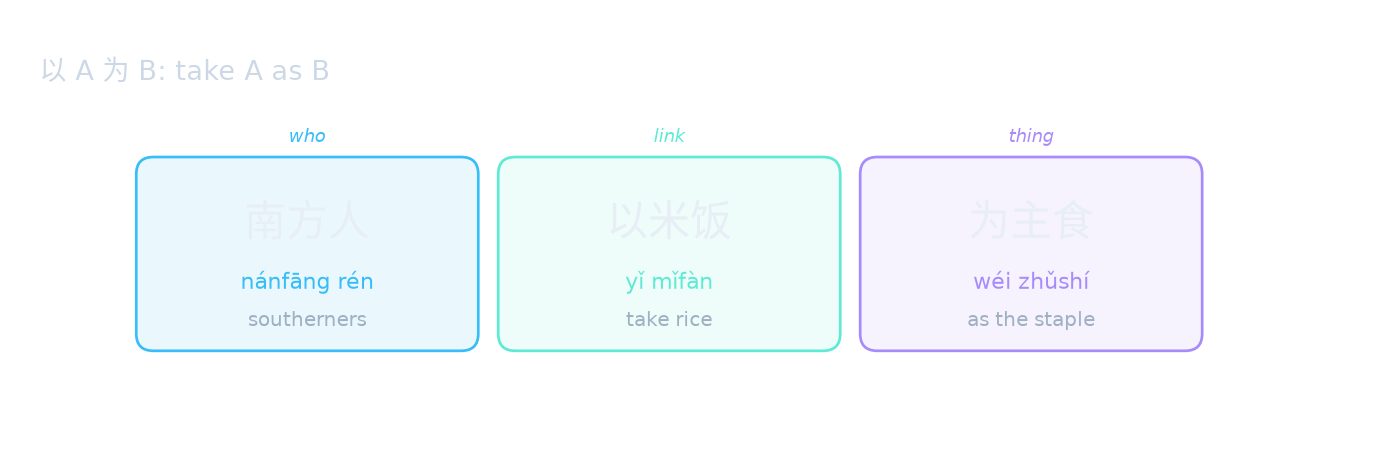
    以 A 为 B: take A as B

    Practice without the models

    Cover the teaching sections before you answer. The answers follow.

    1. Complete (written): “Take Shanghai as an example.” …………Shanghai municipality…上海shàng hǎiused in the construction…为例wèi lì。

    2. How is for / (wéi) to be为wèi read in by means of以yǐcooked rice米饭mǐ fànto rely mainly on为主wéi zhǔ?

    • A. wéi
    • B. wěi
    • C. wēi
    • D. wèi

    3. Build: “Our classes focus mainly on speaking.”

    Put in order: by means of以yǐcolloquial speech口语kǒu yǔ / to rely mainly on为主wéi zhǔ。 / we / us我们wǒ men(modifier / structural particle)的delesson课kè

    4. True or false? 这家zhè jiāshop店diànmain主要zhǔ yàoto do; to make做zuòSichuan or Szechuan cuisine川菜chuān cài is a spoken way to say 这家zhè jiā店以diàn yǐSichuan or Szechuan cuisine川菜chuān càito rely mainly on为主wéi zhǔ. If false, correct it.

    5. You are describing food in different parts of China for a class presentation. Use by means of以yǐ A for / (wéi) to be为wèi B. Write your answer in Chinese, then say it aloud.

    Answers and explanations

    1. by means of以yǐ

    by means of以yǐ A used in the construction…为例wèi lì = take A as an example.

    2. A. wéi

    In by means of以yǐ A for / (wéi) to be为wèi B (“take A as B”), for / (wéi) to be为wèi is read wéi: by means of以yǐcooked rice米饭mǐ fànto rely mainly on为主wéi zhǔ “mainly rice”. Read wèi, it means “for”, as in why?为什么wèi shén me.

    3. we / us我们wǒ men(modifier / structural particle)的de课以kè yǐcolloquial speech口语kǒu yǔto rely mainly on为主wéi zhǔ。

    Topic + by means of以yǐ A to rely mainly on为主wéi zhǔ.

    4. True.

    main主要zhǔ yào is the everyday equivalent of by means of以yǐ…to rely mainly on为主wéi zhǔ.

    5. Model answer: 南方人nán fāng rénby means of以yǐcooked rice米饭mǐ fànto rely mainly on为主wéi zhǔto feed (a person or animal)食shí。

    Check your answer:

    • In this pattern for / (wéi) to be为wèi is read wéi ("as, to be"), not wèi ("for").
    • It is written style; in speech say main主要zhǔ yàoto be / is是shì… or for example比如bǐ rú….
  • 12 Verbs
    • 12.1 Causative verbs
    • 12.2 Expressing "it depends" with "kan"
    • 12.3 Expressing "it seems" with "haoxiang"
    • 12.4 Expressing "lies in" with "zaiyu"
    • 12.5 Expressing "mistakenly think that" with "yiwei"
    • 12.6 Expressing "through" with "tongguo"
    • 12.7 Expressing "to come from" with "laizi"
    • 12.8 Using "lai" as a dummy verb

    Verbs →

  • 13 Auxiliary verbs
    • 13.1 Expressing "don't need to" with "buyong"
    • 13.2 Expressing "must" with "dei"

    Auxiliary verbs →

  • 14 Verb phrases
    • 14.1 Combining verbs with "bing"
    • 14.2 Doing something less with "shao"
    • 14.3 Doing something more with "duo"
    • 14.4 Emphasizing the doer of an action with "you"
    • 14.5 Expressing "moreover" with "bingqie"
    • 14.6 Expressing "never" with "conglai"
    • 14.7 Expressing "to be worth" doing with "zhide"
    • 14.8 Expressing "until" with "dao"
    • 14.9 Indicating negative impact with "haide"
    • 14.10 Separable verb
    • 14.11 Using "zhe" when "verbing away"

    Verb phrases →

  • 15 "But" Statements
    • 15.1 Expressing "although" with "jinguan"
    • 15.2 Expressing contrariness with "dao"
    • 15.3 The "however" adverb "que"

    "But" Statements →

  • 16 "Even If" Statements
    • 16.1 Expressing "even if…" with "jishi"

    "Even If" Statements →

  • 17 "If" Statements
    • 17.1 Expressing "if… then…" with "yaoshi"

    "If" Statements →

  • 18 "No Matter" Statements
    • 18.1 Expressing "no matter" with "buguan"
    • 18.2 Expressing "no matter" with "wulun"

    "No Matter" Statements →

  • 19 Cause/Effect Statements
    • 19.1 Expressing "due to…" with "youyu"
    • 19.2 Expressing "since" with "jiran"
    • 19.3 Expressing "therefore" with "yinci"

    Cause/Effect Statements →

  • 20 Complements
    • 20.1 Advanced uses of direction complement "-qilai"
    • 20.2 Direction complement
    • 20.3 Direction complement "-qilai"
    • 20.4 Potential complement

    Complements →

  • 21 Conditional Statements
    • 21.1 Expressing "as long as" with "zhiyao"
    • 21.2 Expressing "unless" with "chufei"

    Conditional Statements →

  • 22 Noun Phrases
    • 22.1 Expressing "all" with "suoyou"
    • 22.2 Expressing "one of" with "zhiyi"
    • 22.3 Expressing "the other" with "lingwai"

    Noun Phrases →

  • 23 Sentence Patterns
    • 23.1 Advanced uses of "lian"
    • 23.2 Explaining purpose with "wei... er..."
    • 23.3 Expressing "any" with "renhe"
    • 23.4 Expressing "both… and…" with "ji...you"
    • 23.5 Expressing location with "zai... shang / xia / li"

    Sentence Patterns →

  • 24 Basic/Simple Sentence Patterns
    • 24.1 Expressing "even" with "lian" and "dou"
    • 24.2 Expressing "every" with question words
    • 24.3 Expressing "multiples" with "bei"
    • 24.4 Expressing "not at all" with "yidianr ye bu"
    • 24.5 Expressing not knowing how to do something using "hao"
    • 24.6 Phrases using "laishuo"

    Basic/Simple Sentence Patterns →

  • 25 Complex Sentence Patterns
    • 25.1 Conceding a point with "shi"
    • 25.2 Events in quick succession with "yi... jiu..."
    • 25.3 Expressing various aspects with "yi fangmian"

    Complex Sentence Patterns →

  • 26 Not only… but also…
    • 26.1 Many types of "not only... but also..."

    Not only… but also… →

  • 27 Comparing similar adverbs
    • 27.1 Comparing "benlai" and "yuanlai"
    • 27.2 Comparing "changchang" and "wangwang"
    • 27.3 Comparing "gang" and "gangcai"

    Comparing similar adverbs →

  • 28 Comparing similar prepositions
    • 28.1 Comparing "guanyu" and "duiyu"
    • 28.2 Comparing "li" and "cong"

    Comparing similar prepositions →

  • 29 Comparing similar separate functions
    • 29.1 Comparing "fan'er" and “xiangfan"
    • 29.2 Comparing "kending" "queding" and “yiding"
    • 29.3 Comparing "shihe" and "heshi"

    Comparing similar separate functions →

  • 30 Comparing similar time words
    • 30.1 Comparing "yihou" and "de shihou"

    Comparing similar time words →

Log in or create account

IGCSE, A-Level & AP