
Scope and prerequisites
IB Language ab initio first assessment 2020; Spanish focus. This supplementary reference covers only the outcomes listed below. Your school's text choices, the full guide's procedures and any required live or recorded performance are handled separately.
- Describe a routine and ask for practical information
- Write a short message with an appropriate greeting, details and closing
Prerequisites: Present tense; clock times; greeting and closing.
Explain and choose the method
Present-tense verbs describe routines: estudio, vivo, tengo. A las 在……点 ocho gives a clock time.
A simple message should state why you write, the arrangement and any action needed from the reader.
A purposeful message 实用信息 gives the reader usable arrangements. Include why, day, time, place, needed items and a question or request. “A las cuatro” gives a clock time; “el jueves” gives a day. Two complete original 70–150-word models are in the writing companion. The short phrase alone is not an exam-length response.
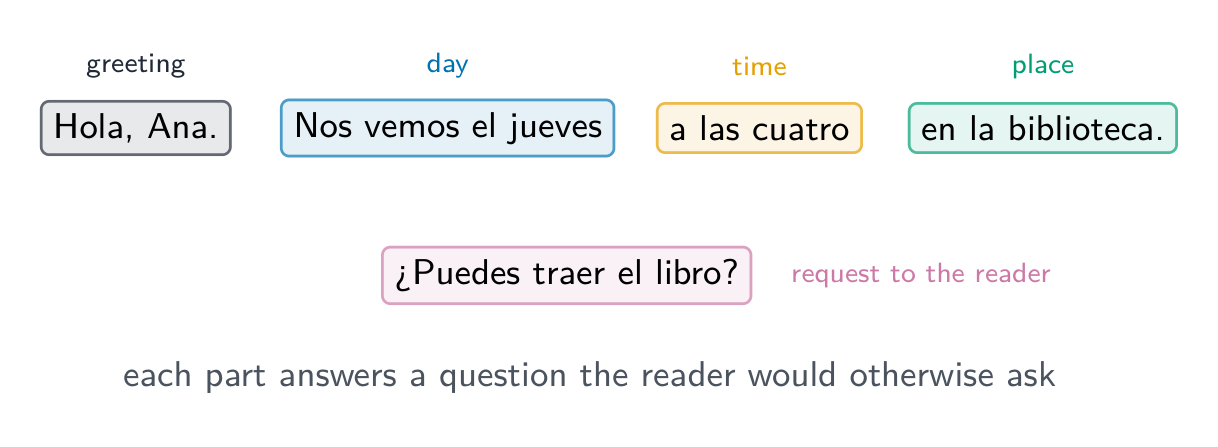
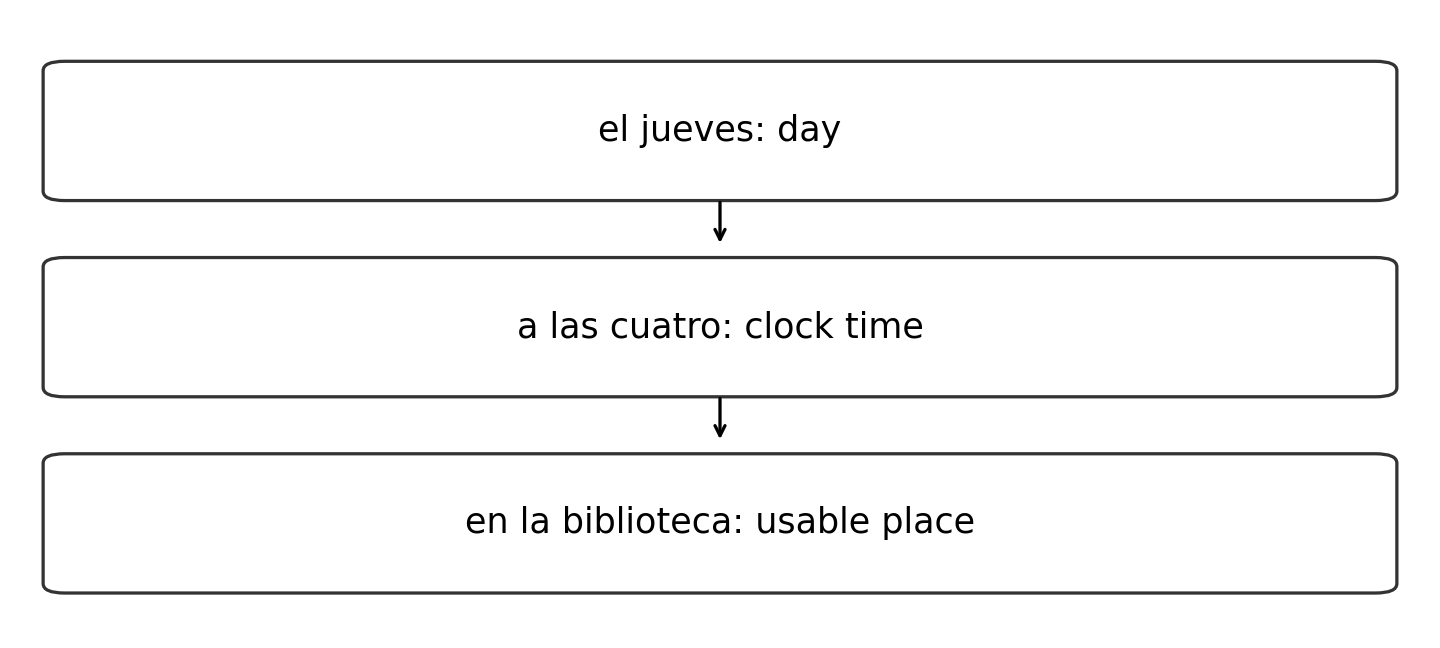
Worked example. Hola, Ana. Nos vemos el jueves a las cuatro en la biblioteca 图书馆. ¿Puedes traer el libro? gives day, time, place and a request. For the current exam, expand the relevant task content within the 70–150-word range instead of repeating the greeting.
Practice material
Task A. Write a message to Ana inviting her to a study meeting. Describe your usual routine, give day/time/place, say what to bring, and ask her to confirm. Write 70–150 Spanish words.
Task B. Write a short blog entry for classmates about a small neighbourhood market visit. Describe what you see, when you go, one preference with a reason, and one practical plan to reduce waste. Write 70–150 Spanish words. These are original practice tasks, not official prompts.
Practice with reasoning
Practice 1
Plan task A, then write the whole message. Check greeting, routine, arrangement, request and closing.
Reasoning. The companion gives a complete original model with all five content cues and a checked word count 字数. Alternatives can use different plausible arrangements if they remain consistent and answer every cue in 70–150 words.
Hola, Ana:
¿Cómo estás? Normalmente tengo clase por la mañana y estudio en casa por la tarde. El jueves quiero estudiar contigo porque tenemos un ejercicio de español. Nos vemos a las cuatro en la biblioteca. La biblioteca está al lado de la escuela y es un lugar tranquilo. Puedes traer tu libro y un lápiz, por favor. Yo llevo mi cuaderno y una lista de preguntas. Después podemos hablar de nuestra rutina y practicar las horas. ¿Puedes venir? Escribe un mensaje para confirmar. Si el jueves no puedes, podemos vernos el viernes a la misma hora.
Hasta pronto, Elena
Classroom model: 100 words. Greeting and closing; usual routine; study purpose; Thursday four o'clock library; book/pencil request; own materials; confirmation; consistent Friday alternative.
Practice 2
Write task B. Underline the visible description, preference and reason, and practical waste plan.
Reasoning. The companion model describes people, fruit and a table; gives Saturday morning; prefers apples because they are easy to carry; and proposes a bag from home and a list to buy only needed food. Other accurate, coherent beginner responses are acceptable.
El sábado voy al mercado de mi barrio por la mañana. En el mercado hay una mesa con fruta y tres personas. Me gusta visitar este lugar porque puedo hablar con los vendedores y comprar comida para mi familia. Prefiero las manzanas porque son fáciles de llevar. Normalmente llevo una bolsa de casa para usar menos plástico. También preparo una lista antes de salir. Así compro solo la comida que necesitamos. La próxima semana quiero ir con mi amiga Ana. Después de comprar, podemos caminar hasta la biblioteca. Es una rutina sencilla, pero para mí es agradable y útil.
Classroom model: 99 words. Saturday morning; market description; preference and reason; bag/list waste plan; coherent next-week arrangement. Original personal scenario; no national cultural claim.
Practice 3
Repair “Nos vemos jueves cuatro biblioteca” into a usable arrangement and add a polite request for a book.
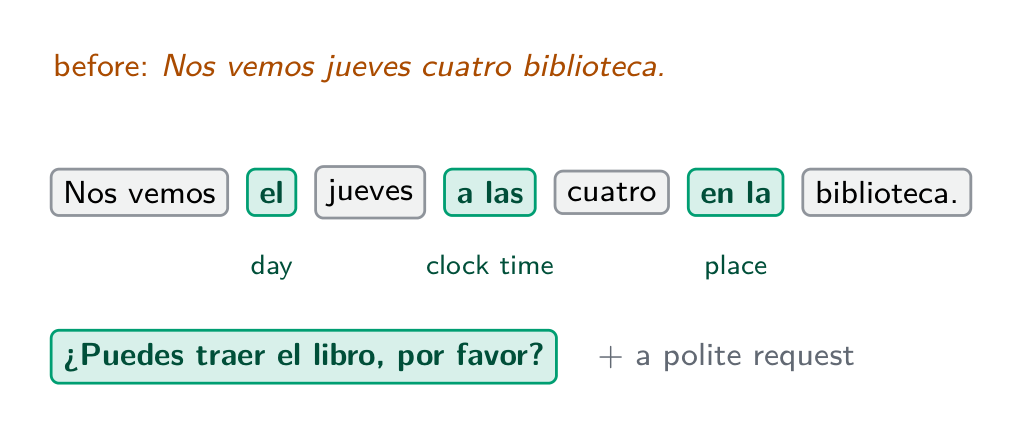
Reasoning. “Nos vemos el jueves a las cuatro en la biblioteca. ¿Puedes traer el libro, por favor?” It supplies day, clock-time phrase, location 位置 preposition and a clear request. Do not assume a reader can reconstruct every missing relationship.
Limits and next use
The short model is a teaching sentence, not a complete exam-length response. No listening recording is provided here; teacher-supplied Spanish audio and live interaction remain necessary.
These are original practice tasks written for this course, not official exam questions.
Vocabulary card meanings
purposeful message: A practical text written to get something done, such as an invitation. biblioteca: The Spanish noun for a place where books are lent. a las: The Spanish pair placed before a plural clock hour. The singular hour uses a different form.