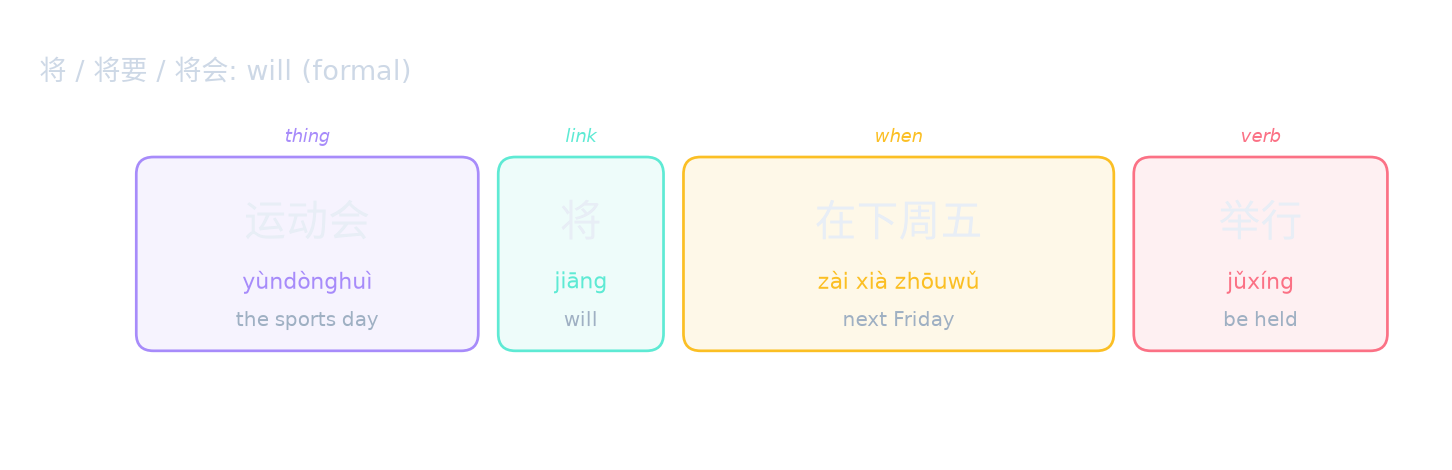
will / (formal 把)将, will将要 and auxiliary verb introducing…将会 are the formal future: "will, is going to". You will meet them in news, notices and speeches: meeting会议will / (formal 把)将at / in在tomorrow明天to hold (an event)举行. In conversation, use can / will会 or want / will / need要 instead.
Auxiliary verbs
HSK 5 · Topic 11
 3:29
HSK 5 Grammar 11: Auxiliary verbs
A notice on the clinic board says: 社区诊所将于下周一搬到新址。 The clinic will move next Monday. Friends talking about the same move would say: 下周一要搬家。 The future is the…
English explanations + Mandarin examples · captions follow the spoken text
11.1
将 / 将要 / 将会 (formal future)
Form: subject + will / (formal 把)将 / will将要 / auxiliary verb introducing…将会 + (time) + verb phrase
- meeting会议will / (formal 把)将at / in在tomorrow明天to hold (an event)举行。 Huìyì jiāng zài míngtiān jǔxíng. – The meeting will be held tomorrow.
- school学校auxiliary verb introducing…将会to announce公布result; as a result结果。 Xuéxiào jiāng huì gōngbù jiéguǒ. – The school will announce the results.
- new新library图书馆will将要to open (to the public)开放。 Xīn túshūguǎn jiāngyào kāifàng. – The new library is about to open.
- 本次(railway) train列车will / (formal 把)将in / at / (formal) to于十点三十分to arrive到达Beijing北京。 Běn cì lièchē jiāng yú shí diǎn sānshí fēn dàodá Běijīng. – This train will arrive in Beijing at 10:30.
- tomorrow明天whole city全市will / (formal 把)将to have / there is有heavy rain大雨。 Míngtiān quán shì jiāng yǒu dà yǔ. – There will be heavy rain across the city tomorrow.
- 这项new新rule; to stipulate规定will / (formal 把)将from从next month下个月to start开始to implement实行。 Zhè xiàng xīn guīdìng jiāng cóng xià ge yuè kāishǐ shíxíng. – This new rule will take effect from next month.
How it works. will / (formal 把)将 jiāng is the formal "will" of notices, news, announcements and speeches. It goes after the subject and before the time phrase or verb, and often meets the formal in / at / (formal) to于 ("at, on"): will / (formal 把)将in / at / (formal) to于Friday周五to hold (an event)举行. will将要 suggests something coming soon ("is about to"); auxiliary verb introducing…将会 stresses that it is expected to happen. All three describe a plan or forecast, so the event has not happened yet.
In conversation the same idea is want / will / need要 or can / will会: we / us我们tomorrow明天want / will / need要to hold a meeting开会, tomorrow明天can / will会to rain下雨. Using will / (formal 把)将 with friends sounds like reading the news. You also meet a different will / (formal 把)将 in writing, where it means (把: marks the object)把 and an object follows it: please; to invite请将门to close (a door)关上 = please; to invite请to stand as a goalkeeper把门to close (a door)关上.
| meeting会议will / (formal 把)将at / in在tomorrow明天to hold (an event)举行。 | please; to invite请将门to close (a door)关上。 | meeting会议already已经to hold (an event)举行(completed / change)了。 |
|---|---|---|
| future "will" (a verb or time follows) | = (把: marks the object)把 (an object follows) | already held |
| formal notice | formal instruction | a report of the past |
Watch out
- An announcement is a plan, not a report: system系统will / (formal 把)将in / at / (formal) to于Friday周五to update更新 means the update has not happened yet.
- will / (formal 把)将 goes after the subject: wrong: will / (formal 把)将meeting会议at / in在tomorrow明天to hold (an event)举行 → meeting会议will / (formal 把)将at / in在tomorrow明天to hold (an event)举行.
- Do not add (completed / change)了 to a will / (formal 把)将 sentence about the future: wrong: competition比赛will / (formal 把)将to start开始(completed / change)了 → competition比赛will / (formal 把)将to start开始 (or spoken competition比赛want / will / need要to start开始(completed / change)了).
In a passage
everybody各位classmate同学please; to invite请to take note of注意:本学期(modifier / structural particle)的sports competition运动会will / (formal 把)将in / at / (formal) to于October十月十五日to hold (an event)举行,competition比赛will / (formal 把)将from从morning (before noon)上午八点to start开始。各班will将要at / in在九月底前交application form报名表。if如果to rain下雨,sports competition运动会auxiliary verb introducing…将会to change改to / arrive / (result: get)到down / next; to fall (rain), get off下one week一周。具体安排will / (formal 把)将at / in在school学校website网站up / on / last; to get on, attend上to announce公布。
Read and notice. List four things the notice says will happen. Then say one of them as you would tell a friend, with want / will / need要 or can / will会.
Vocabulary
Train
| 汉字 | Pinyin | English |
|---|---|---|
| 公布 | gōng bù | to announce |
| 开放 | kāi fàng | to open (to the public) |
| 到达 | dào dá | to arrive |
| 实行 | shí xíng | to implement |
| 系统 | xì tǒng | system |
11.2
Practice
Cover the teaching pages before you answer. The answers are at the end.
1. The meeting will be held tomorrow. meeting会议 ………… at / in在tomorrow明天to hold (an event)举行。
2. Which is the everyday way to say we / us我们will / (formal 把)将to hold a meeting开会?
- A. we / us我们(passive: by)被to hold a meeting开会。
- B. we / us我们to hold a meeting开会will / (formal 把)将。
- C. we / us我们want / will / need要to hold a meeting开会。
- D. we / us我们(把: marks the object)把to hold a meeting开会。
3. In which sentence does will / (formal 把)将 mean (把: marks the object)把?
- A. 新馆will将要to open (to the public)开放。
- B. meeting会议will / (formal 把)将to hold (an event)举行。
- C. school学校will / (formal 把)将to announce公布result; as a result结果。
- D. please; to invite请将门to close (a door)关上。
4. True or false? meeting会议will / (formal 把)将at / in在tomorrow明天to hold (an event)举行 means the meeting has already been held. If false, correct it.
5. Say in formal style: "The new library will open next month."
6. The school will announce the results.
Put in order: to announce公布 / school学校 / result; as a result结果。 / auxiliary verb introducing…将会
11.3
Mixed practice
These questions mix the patterns and use new situations.
7. Find and fix the problem. A notice says system系统will / (formal 把)将in / at / (formal) to于Friday周五to update更新. A classmate thinks the update has already happened. Correct it.
8. Use it yourself. Write a formal notice: the library will be closed next Monday.
11.4
Answers and explanations
Mark your work, then correct each mistake in your own words.
1. will / (formal 把)将
Formal future will / (formal 把)将.
2. C. we / us我们want / will / need要to hold a meeting开会。
In speech, want / will / need要 / can / will会.
3. D. please; to invite请将门to close (a door)关上。
will / (formal 把)将 + object + verb = (把: marks the object)把.
4. False.
It announces a future event.
5. new新library图书馆will / (formal 把)将at / in在next month下个月to open (to the public)开放。
will / (formal 把)将 + time + verb.
6. school学校auxiliary verb introducing…将会to announce公布result; as a result结果。
auxiliary verb introducing…将会 + verb phrase.
Mixed practice
7. will / (formal 把)将 is a formal future: the system will be updated on Friday.
8. Model answer. library图书馆will / (formal 把)将in / at / (formal) to于下周一to close关闭。
Review later. Tomorrow, rewrite one spoken plan (we / us我们can / will会……) as a formal notice with will / (formal 把)将.
Interactive lessons on this topic
Work through it step by step, with instant-check exercises.