| English | 意味 |
|---|---|
| pressure/ˈpreʃə/ | 圧力 |
| volume/ˈvɒljuːm/ | 体積 |
| Boyle's law/bɔɪlz lɔː/ | ボーイルの法則 |
Squeezing a gas
- Push a bicycle pump with your finger over the end and you can feel the gas push back harder as you squeeze.
- For a fixed amount of gas at constant temperature, pressure 压强 and volume 体积 are linked.
気体の圧力は粒子によって生じます:
難易度 1/5 · 100 コイン + 今日初回完了時に小ボーナス付与
壁への衝突が圧力を生み出します。
Pressure from particles
- Gas pressure comes from particles colliding with the container walls.
- More frequent or harder collisions mean higher pressure.

A heated gas: faster particles spread out and take up more space
気体、圧力 & 体積
p = k / V
体積を圧縮すると圧力が上昇します(ボイルの法則)。
一定温度において、気体の体積が減少すると、圧力は:
難易度 1/5 · 100 コイン + 今日初回完了時に小ボーナス付与
体積が小さくなる→衝突の頻度が増える→圧力が上がる。
一定温度において、一定量の気体に対して圧力×体積は一定です。
難易度 1/5 · 100 コイン + 今日初回完了時に小ボーナス付与
これがボイルの法則です。
Pressure and volume
- Squeeze a gas into a smaller volume and the particles hit the walls more often → higher pressure.
- Pressure × volume = constant (at fixed temperature) — this is Boyle's law 玻意耳定律.
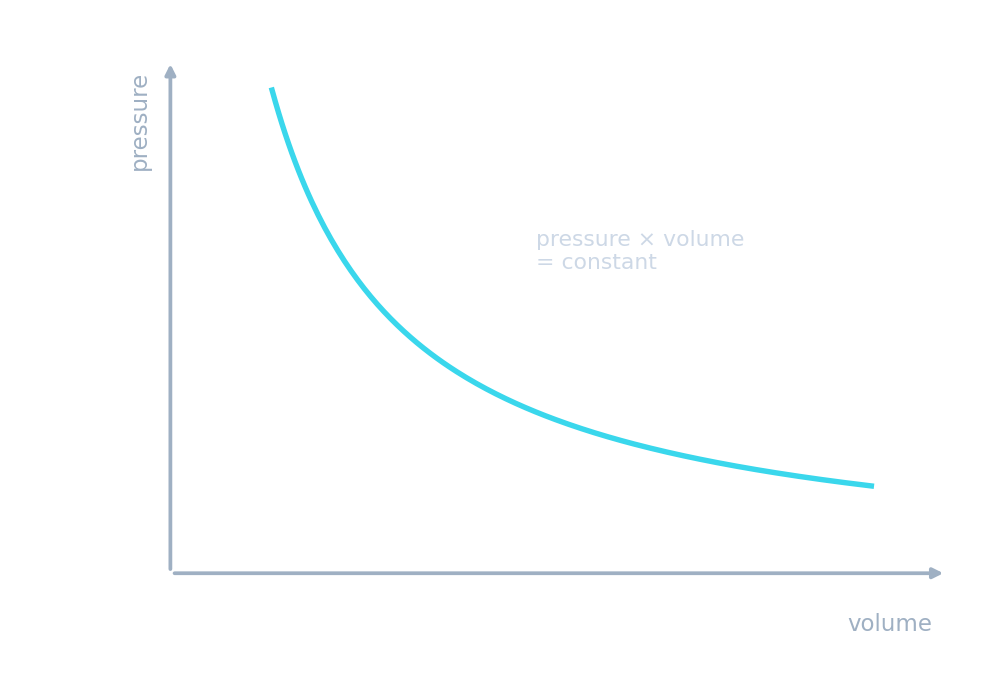
As volume decreases, pressure increases — their product stays constant.
圧力200、体積4の気体が体積2に圧縮されました。新しい圧力はいくつですか?
難易度 2/5 · 140 コイン + 今日初回完了時に小ボーナス付与
200 × 4 = p × 2 なので、p = 800 ÷ 2 = 400。
一定温度で気体の体積を半分にする場合、圧力は______します。
難易度 1/5 · 100 コイン + 今日初回完了時に小ボーナス付与
圧力と体積は反比例関係にあります。
Using the relationship
- If you halve the volume, the pressure doubles.
- So p₁V₁ = p₂V₂ lets you find a new pressure or volume.
Worked example. A gas at pressure 100 in a volume of 6 is squeezed to a volume of 2. Since pV is constant: 100 × 6 = p × 2, so p = 600 ÷ 2 = 300. Third the volume, triple the pressure.
You've got it
- gas pressure comes from particles colliding with the walls
- pressure × volume = constant at fixed temperature (Boyle's law)
- halve the volume → double the pressure (p₁V₁ = p₂V₂)