| English | 意味 |
|---|---|
| monopoly/məˈnɒpəli/ | 独占 |
| price discrimination/praɪs dɪˌskrɪmɪˈneɪʃn/ | 価格差別 |
| consumer surplus/kənˈsuːmə ˈsɜːpləs/ | 消費者余剰 |
| market power/ˈmɑːkɪt ˈpaʊə/ | 市場権力 |
| allocatively inefficient/ˈæləkətɪvli ɪnɪˈfɪʃənt/ | 配置非効率性 |
The power of one seller
- A monopolist doesn't take the price — it sets it, by choosing how much to supply. That power can mean fat profits and higher prices.
- But monopolies can also use a clever trick: charging different customers different prices.
利益を最大化する独占者は、次のような地点で生産量を設定する:
難易度 1/5 · 100 コイン + 今日初回完了時に小ボーナス付与
MR = MCは利益最大化の数量を示し、その数量における需要から価格が導かれる。
The monopolist's choice
- A monopoly 垄断 faces the whole market demand, so to sell more it must lower the price (MR lies below AR).
- It maximises profit where MR = MC, then reads the price up from the demand curve — a higher price and lower output than perfect competition.
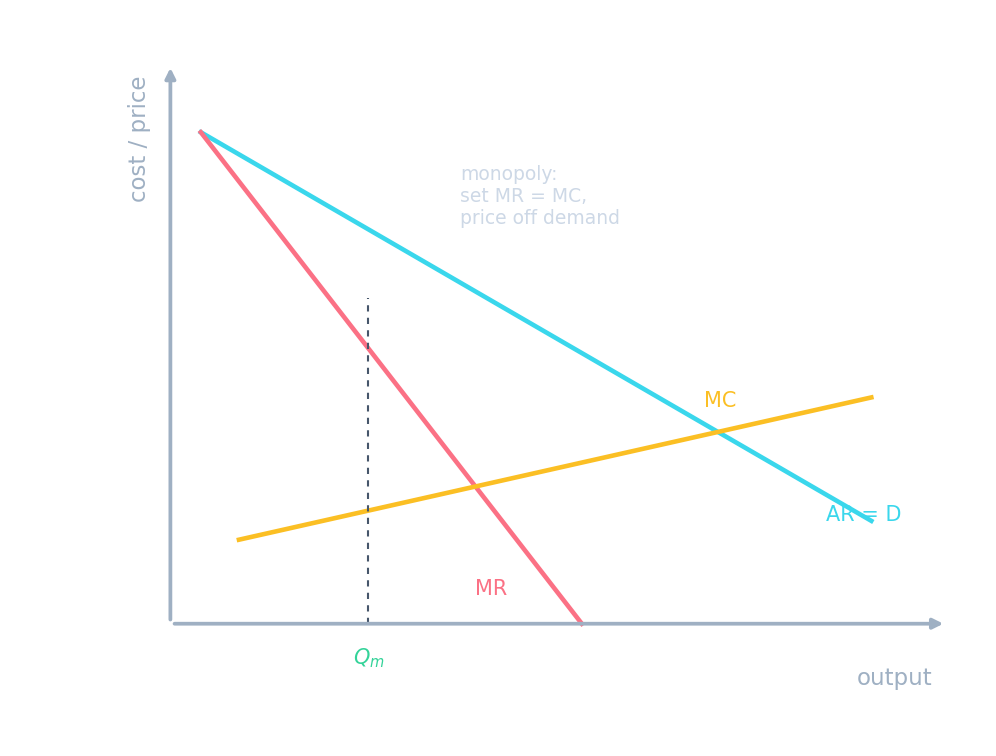
The monopolist picks the output where MR = MC, then charges the highest price demand will bear.
価格設定と競争
企業の価格設定は需要と供給に依存するが、市場力がある場合、競争水準より高い価格を設定できる。
価格差別を行うために必要なのは以下の条件すべてだが、例外は:
難易度 1/5 · 100 コイン + 今日初回完了時に小ボーナス付与
価格差別とは異なる価格を課すことを意味し、市場力、分離可能なグループ、転売の不可能性が必要である。
それぞれの価格差別の種類と例を結びつけよ。
難易度 2/5 · 140 コイン + 今日初回完了時に小ボーナス付与
三階層はグループごとに分割し、一階層は各購入者の最大支払い意思額をすべて抽出する。
価格差別が機能するためには、企業はグループ間の ______ を防止しなければならない。
難易度 1/5 · 100 コイン + 今日初回完了時に小ボーナス付与
否则、安価なグループが高額なグループへ転売を行い、仕組みが崩壊する。
Price discrimination 价格歧视
- Price discrimination = charging different prices to different buyers for the same good (to capture more consumer surplus 消费者剩余).
- It needs market power 市场势力, the ability to separate groups, and to stop resale between them.
- Third-degree discrimination: by group (student/adult tickets); first-degree: each buyer's maximum.
Monopoly isn't all bad. It can fund R&D and reap economies of scale (lower costs). But it tends to be allocatively inefficient 配置无效率 (P > MC) and can exploit consumers.
独占は配分非効率である。なぜなら、価格を限界費用以上に設定するためである(P > MC)。
難易度 1/5 · 100 コイン + 今日初回完了時に小ボーナス付与
P > MC は、最終単位の価値がその費用を上回っていることを意味し、生産量が不足している。
The costs and benefits of monopoly
- Costs: higher prices, lower output, allocative inefficiency (P > MC).
- Benefits: economies of scale (lower costs) and profits that can fund research and innovation.
You've got it
- a monopoly is a price-maker: set output at MR = MC, price off demand (P > MC)
- this gives higher price, lower output, and possible supernormal profit
- price discrimination charges groups different prices — needs power, separable markets, no resale