語彙
| English | 意味 |
|---|---|
| carrier gas/ˈkærɪə ɡæs/ | キャリアガス |
| retention time/rɪˈtenʃn taɪm/ | 保持時間 |
| chromatogram/krəʊˈmætəɡræm/ | クロマトグラム |
| mass spectrometer/mæs spekˈtrɒmɪtə/ | 質量分析計 |
English
Separating a vapour
- Gas/liquid chromatography (GLC) separates a mixture of volatile components.
- The mobile phase is a carrier gas 载气; the stationary phase is a liquid on a solid.
- Each component leaves a peak at its own retention time 保留时间.
探索
気体/液体クロマトグラフィーの流れ
揮発性サンプルをカラム分離を経てクロマトグラムまで追跡する。
実践
ガスクロマトグラフィーにおいて、成分がカラムを通過する時間は______時間という。
難易度 1/5 · 100 コイン + 今日初回完了時に小ボーナス付与
成分の同定に用いられる。
実践
ガスクロマトグラフィーは揮発性物質の混合物を分離する。
難易度 1/5 · 100 コイン + 今日初回完了時に小ボーナス付与
各成分は異なる速度でカラム内を移動する。
English
How it works
- the stationary phase is a high-boiling-point non-polar liquid on a solid support.
- the mobile phase is an unreactive carrier gas (e.g. nitrogen).
- the retention time is how long a component takes to pass through.
- A component that interacts more with the stationary phase has a longer retention time.
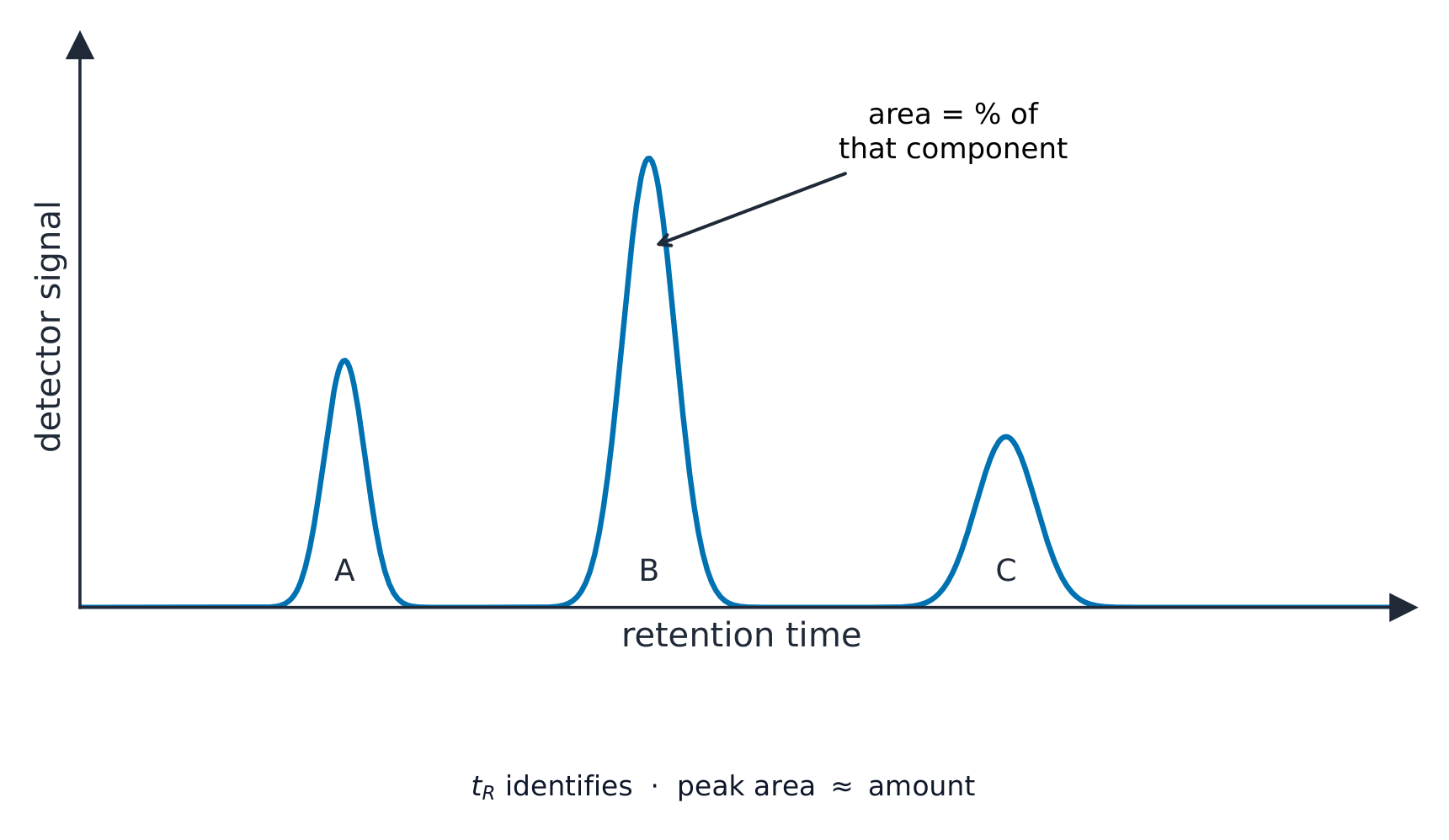
A gas-liquid chromatogram 色谱图 with retention times and peak areas
実践
GLCにおける移動相は:
難易度 1/5 · 100 コイン + 今日初回完了時に小ボーナス付与
キャリアガスが成分を液体固定相の上流へ運ぶ。
実践
固定相との相互作用が強い成分には:
難易度 1/5 · 100 コイン + 今日初回完了時に小ボーナス付与
相互作用が強いと移動が遅くなり、カラム通過に長い時間を要する(保持時間が長い)。
English
Reading the chromatogram
- The area of each peak gives the proportion of that component in the mixture.
Example
A chromatogram shows two peaks with areas in the ratio 3 : 1.
- Total = 3 + 1 = 4 parts.
- So the mixture is 75% of the first component and 25% of the second.
(Peak height can mislead — always use the area.)
実践
クロマトグラムの各ピークの面積は:
難易度 1/5 · 100 コイン + 今日初回完了時に小ボーナス付与
ピーク面積は量に比例するため、組成比率を与える。
English
Identifying the components
- A peak's retention time matches a known standard run in the same conditions → that names the component.
- Coupling GLC to a mass spectrometer 质谱仪 (GC–MS) confirms each component's identity from its mass spectrum.
- GC–MS is the workhorse of forensics, drug testing and airport security.
English
You've got it
Key idea
- GLC: mobile phase = carrier gas; stationary phase = a non-polar liquid on a solid
- each component has a retention time; more interaction → longer retention
- the peak area = the proportion of that component (areas 3:1 → 75% : 25%)
- match retention time to a standard to identify; GC–MS confirms it