Bumi, Matahari, dan Bulan
Diperkenalkan| English | Makna |
|---|---|
| Moon/muːn/ | Bulan |
| orbital speed/ˈɔːbɪtl spiːd/ | kecepatan orbit |
| rotates/rəʊˈteɪts/ | berotasi |
| orbits/ˈɔːbɪts/ | berorbit |
| seasons/ˈsiːznz/ | musim |
| phases/ˈfeɪzɪz/ | fasa |
| period/ˈpɪərɪəd/ | periode |
Days, months and years
- A day, a month and a year all come from motion in space.
- The Earth spins, the Moon 月球 circles us, and we circle the Sun.
- Let's see what each motion gives us — and how to find an orbital speed 轨道速率.
The spinning, orbiting Earth
- The Earth rotates 自转 on its axis once in about $24$ hours — giving day and night.
- It orbits 公转 the Sun once in about $365$ days — one year.
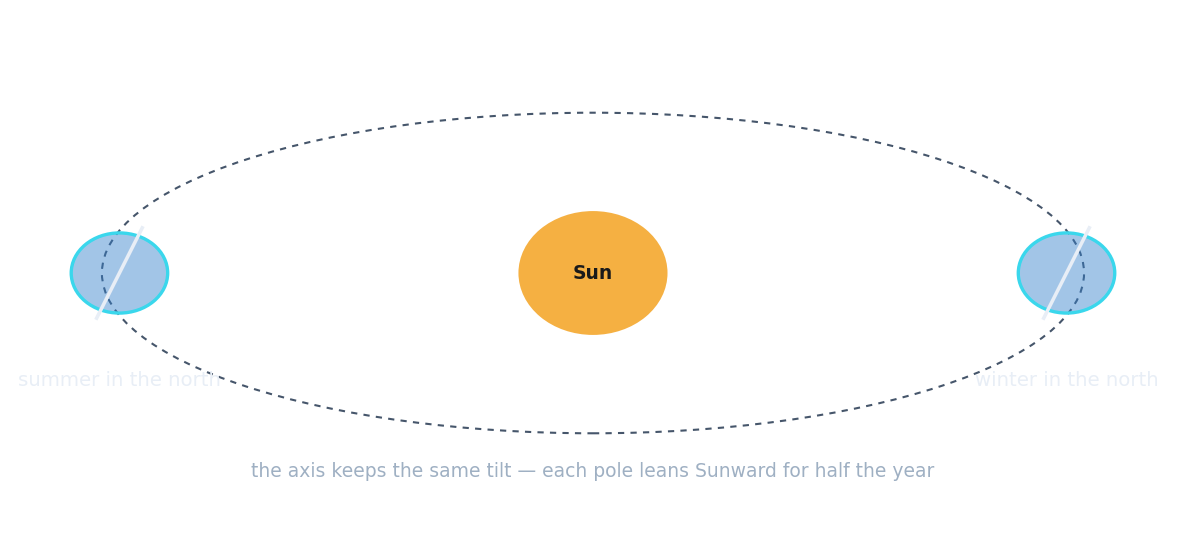
- Its axis is tilted, so each half of the Earth leans toward the Sun for part of the year — giving the seasons 季节.
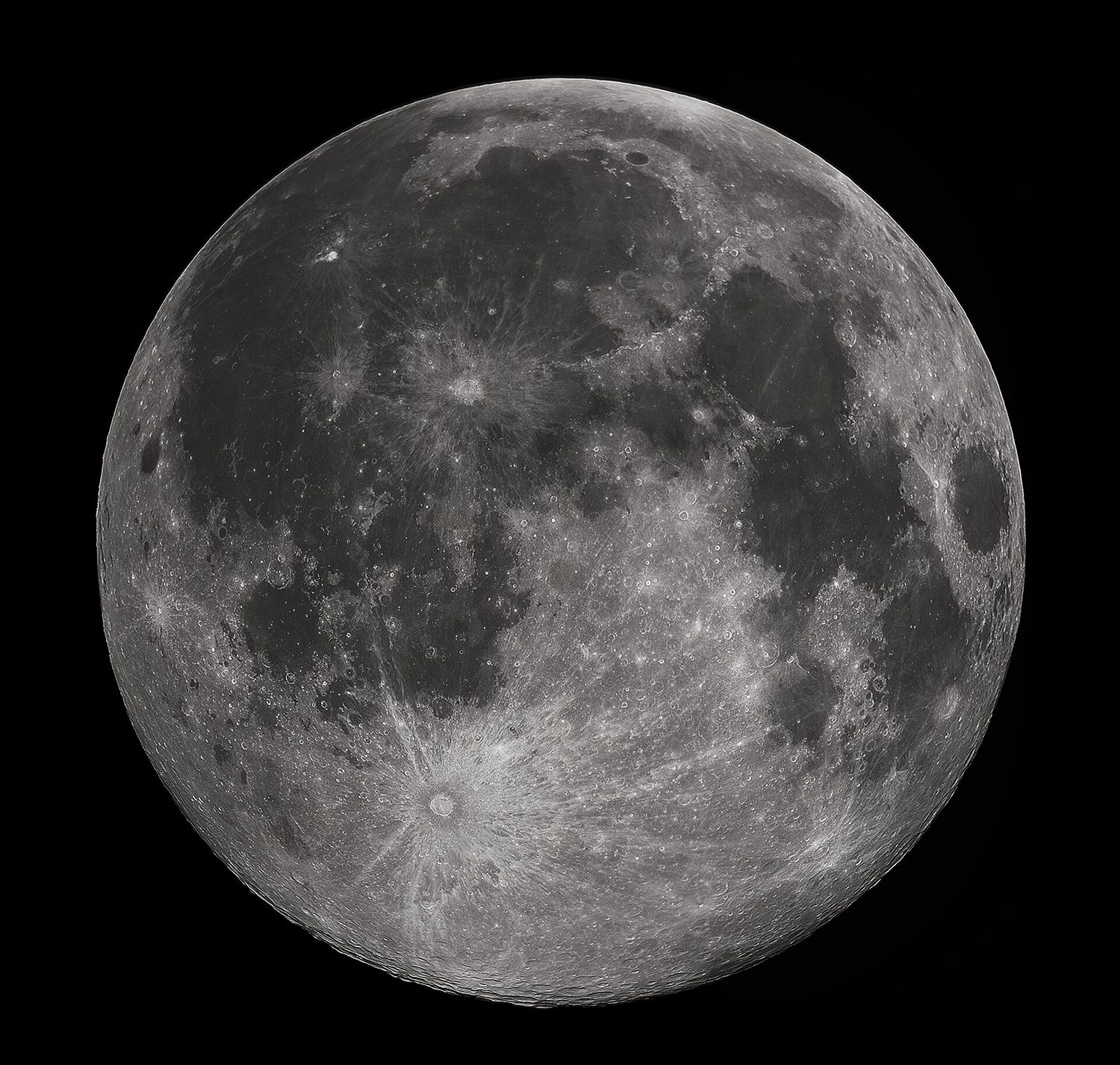
The full Moon, Earth's natural satellite
Mengapa Bulan berubah bentuk
Matahari selalu menerangi separuh Bulan; fase hanyalah seberapa banyak bagian yang terang itu menghadap kita saat Bulan mengorbit — bukan bayangan Bumi.
Apa yang menyebabkan siang dan malam?
Kesulitan 1/5 · 100 koin + bonus kecil pada penyelesaian pertama hari ini
Bumi berotasi sekali dalam sekitar 24 jam, sehingga setiap tempat menghadap Matahari (siang) lalu menghadap menjauh (malam).
Apa yang menyebabkan musim?
Kesulitan 1/5 · 100 koin + bonus kecil pada penyelesaian pertama hari ini
Sumbu miring berarti setiap belahan bumi condong ke arah Matahari selama setengah tahun (musim panas) dan menjauh selama setengah lainnya (musim dingin).
The Moon
- The Moon orbits the Earth once in about one month.
- As it goes round, we see different amounts of its lit side — the phases 月相 (new, half, full).
- From shortest to longest: day (Earth's spin) < month (Moon's orbit) < year (Earth's orbit).
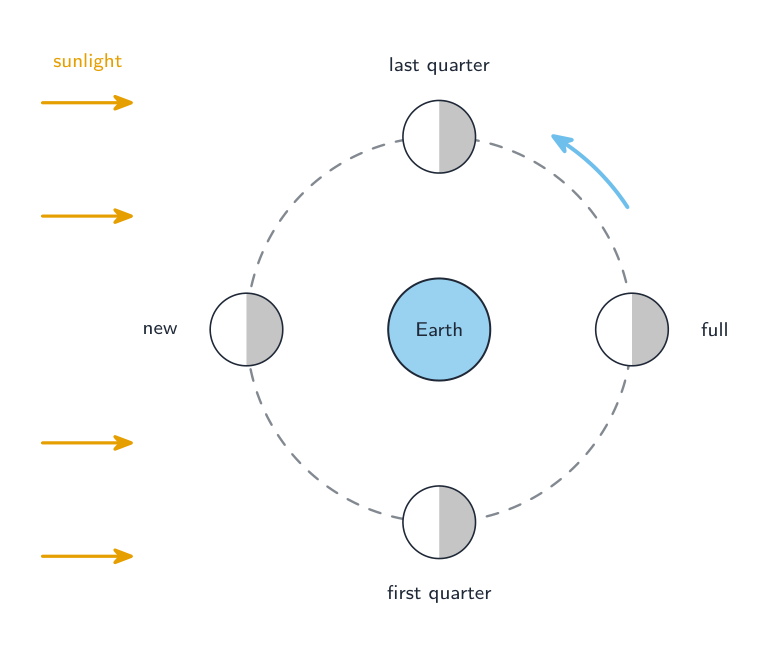
The Moon's lit half always faces the Sun, so as it orbits we see different amounts of it — new, half and full
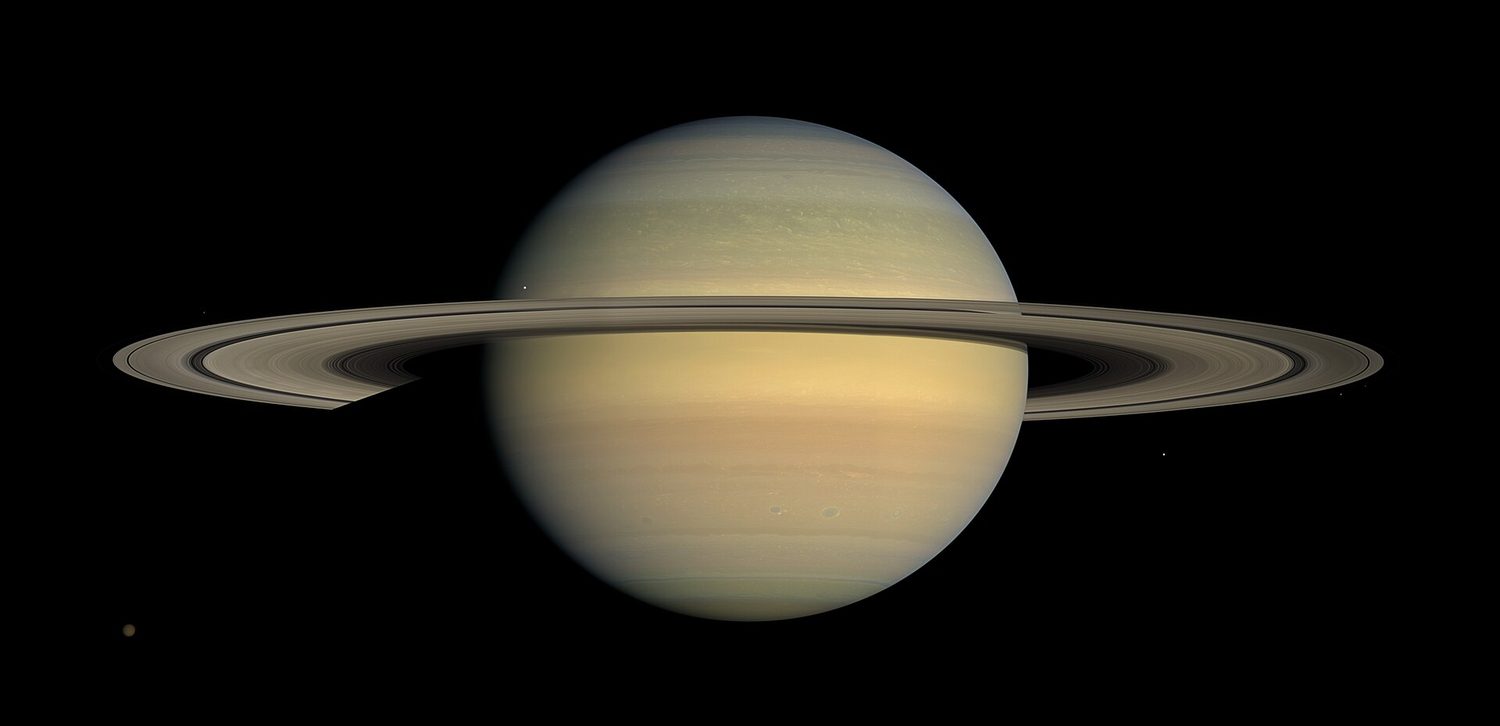
Saturn and its rings, photographed by the Cassini spacecraft
Urutkan ini dari waktu terpendek hingga terpanjang.
Kesulitan 3/5 · 200 koin + bonus kecil pada penyelesaian pertama hari ini
Hari (~24 jam) < bulan (~1 orbit Bulan) < tahun (~365 hari).
Fase-fase Bulan terjadi karena kita melihat jumlah sisi yang terang berbeda saat Bulan mengorbit.
Kesulitan 1/5 · 100 koin + bonus kecil pada penyelesaian pertama hari ini
Saat Bulan mengorbit Bumi, fraksi sisi yang terkena sinar matahari yang dapat kita lihat berubah, memberikan bulan baru, bulan setengah, dan bulan purnama.
Orbital speed
- One full orbit covers the circumference $2\pi r$, where $r$ is the orbit radius.
- The orbital speed is that distance divided by the period 周期 $T$ (the time for one orbit):
- The same equation works for planets, moons and satellites.
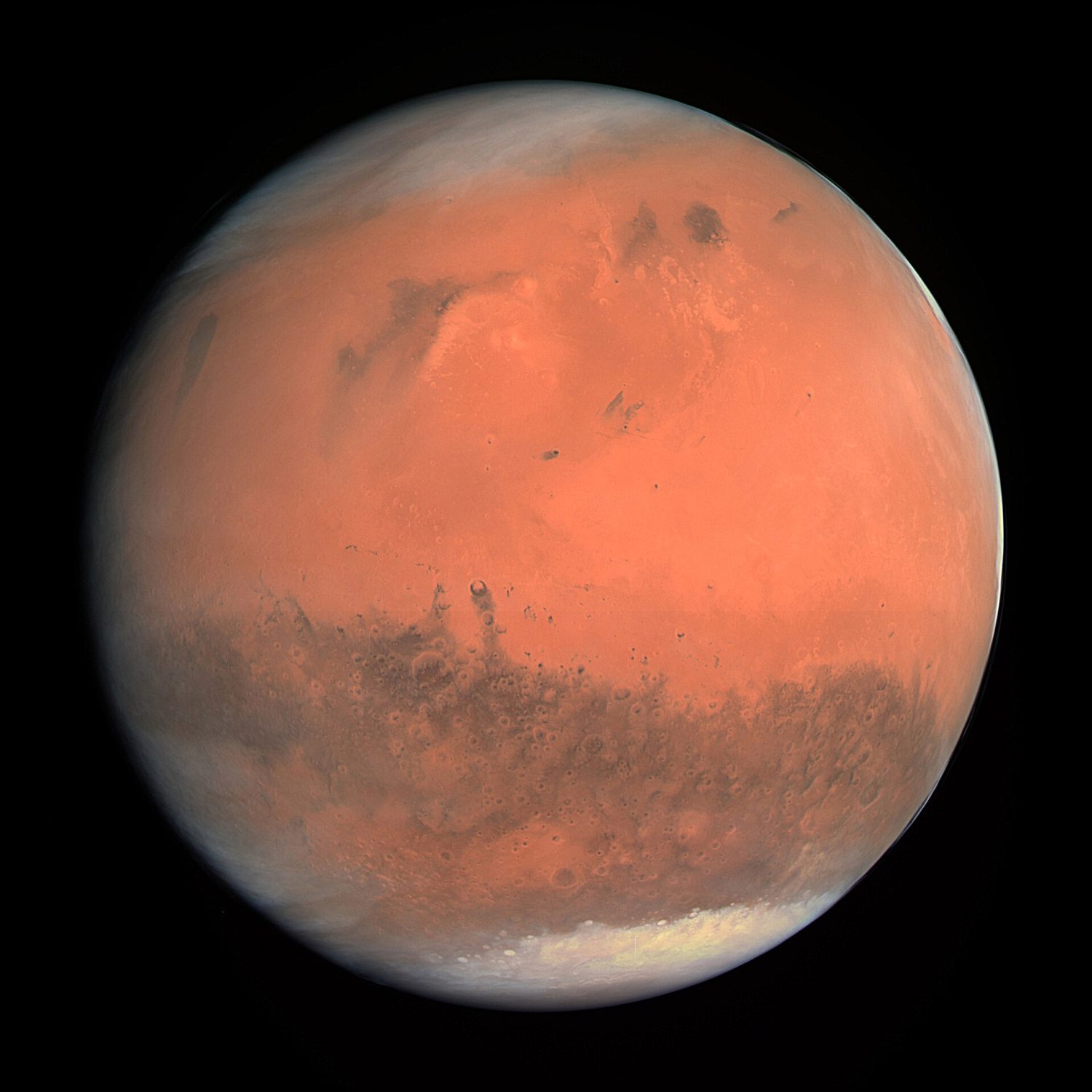
Mars, the red planet, one of the rocky inner planets
Sebuah satelit mengorbit pada jari-jari $r = 7.0 \times 10^6\ \text{m}$ dengan periode $T = 5800\ \text{s}$. Berapakah kecepatan orbitnya, dalam m/s?
Kesulitan 2/5 · 140 koin + bonus kecil pada penyelesaian pertama hari ini
$v = \dfrac{2\pi r}{T} = \dfrac{2\pi \times 7.0 \times 10^6}{5800} \approx 7600\ \text{m/s}$.
Dibandingkan dengan planet-planet dekat Matahari, planet-planet luar mengorbit:
Kesulitan 1/5 · 100 koin + bonus kecil pada penyelesaian pertama hari ini
Gravitasi Matahari lebih lemah semakin jauh, sehingga planet-planet luar bergerak lebih lambat dalam orbit mereka.
Worked examples
1. The Earth orbits the Sun at $r = 1.5 \times 10^{11}\ \text{m}$ in $T = 3.15 \times 10^7\ \text{s}$ (one year). $v = \dfrac{2\pi r}{T} = \dfrac{2\pi \times 1.5 \times 10^{11}}{3.15 \times 10^7} \approx 3.0 \times 10^4\ \text{m/s}$.
2. The Moon orbits the Earth at $r = 3.8 \times 10^8\ \text{m}$ in $27.3$ days $= 2.36 \times 10^6\ \text{s}$. $v = \dfrac{2\pi \times 3.8 \times 10^8}{2.36 \times 10^6} \approx 1.0 \times 10^3\ \text{m/s}$.
Seasons come from the tilt of the Earth's axis, not from the Earth moving closer to the Sun. A day is one spin on the axis; a year is one orbit of the Sun.
You've got it
- Earth spins → day/night; orbits the Sun → year; tilt → seasons
- the Moon orbits Earth in ~1 month, giving its phases
- day < month < year
- orbital speed $v = \dfrac{2\pi r}{T}$
Write from the data: find the orbital speed
- A satellite orbits at radius 4.0 times 10 to the 7 metres with period 8.0 times 10 to the 4 seconds. Use pi = 3.14.
- Find the orbital speed. Seasons come from the tilt of Earth's axis.
Sebuah satelit memiliki jari-jari orbit 4.0 kali 10 ke pangkat 7 meter dan periode 8.0 kali 10 ke pangkat 4 detik. Menggunakan pi = 3.14, berapakah kecepatan orbitnya, dan apa penyebab musim?
2 dikali 3.14 dikali 4.0 dikali 10 pangkat 7, dibagi dengan 8.0 dikali 10 pangkat 4, adalah 3140 meter per detik.
Berapakah kecepatan orbit?
Kesulitan 1/5 · 100 koin + bonus kecil pada penyelesaian pertama hari ini
2 pi r dibagi T dengan pi = 3.14 menghasilkan 3140 meter per detik.