Sistem Surya
Diperkenalkan| English | Makna |
|---|---|
| Solar System/ˈsəʊlə ˈsɪstəm/ | Sistem Matahari |
| planets/ˈplænɪts/ | planet |
| asteroids/ˈæstərɔɪdz/ | asteroid |
| comets/ˈkɒmɪts/ | komet |
| rocky/ˈrɒki/ | batu |
| gas giants/ɡæs ˈdʒaɪənts/ | raksasa gas |
| satellites/ˈsætəlaɪts/ | satelit |
| ellipses/ɪˈlɪpsɪz/ | elips |
| accretion/əˈkreʃn/ | akresi |
The Sun's family
- At the centre of the Solar System 太阳系 is one star — the Sun.
- Around it move eight planets 行星, plus moons, asteroids 小行星 and comets 彗星.
- Gravity holds the whole family together.
The eight planets
- In order from the Sun: Mercury, Venus, Earth, Mars, Jupiter, Saturn, Uranus, Neptune.
- The four inner planets are small and rocky 岩石.
- The four outer planets are large and gaseous (no solid surface).
- Jupiter and Saturn are gas giants 气态巨行星; Uranus and Neptune are ice giants.
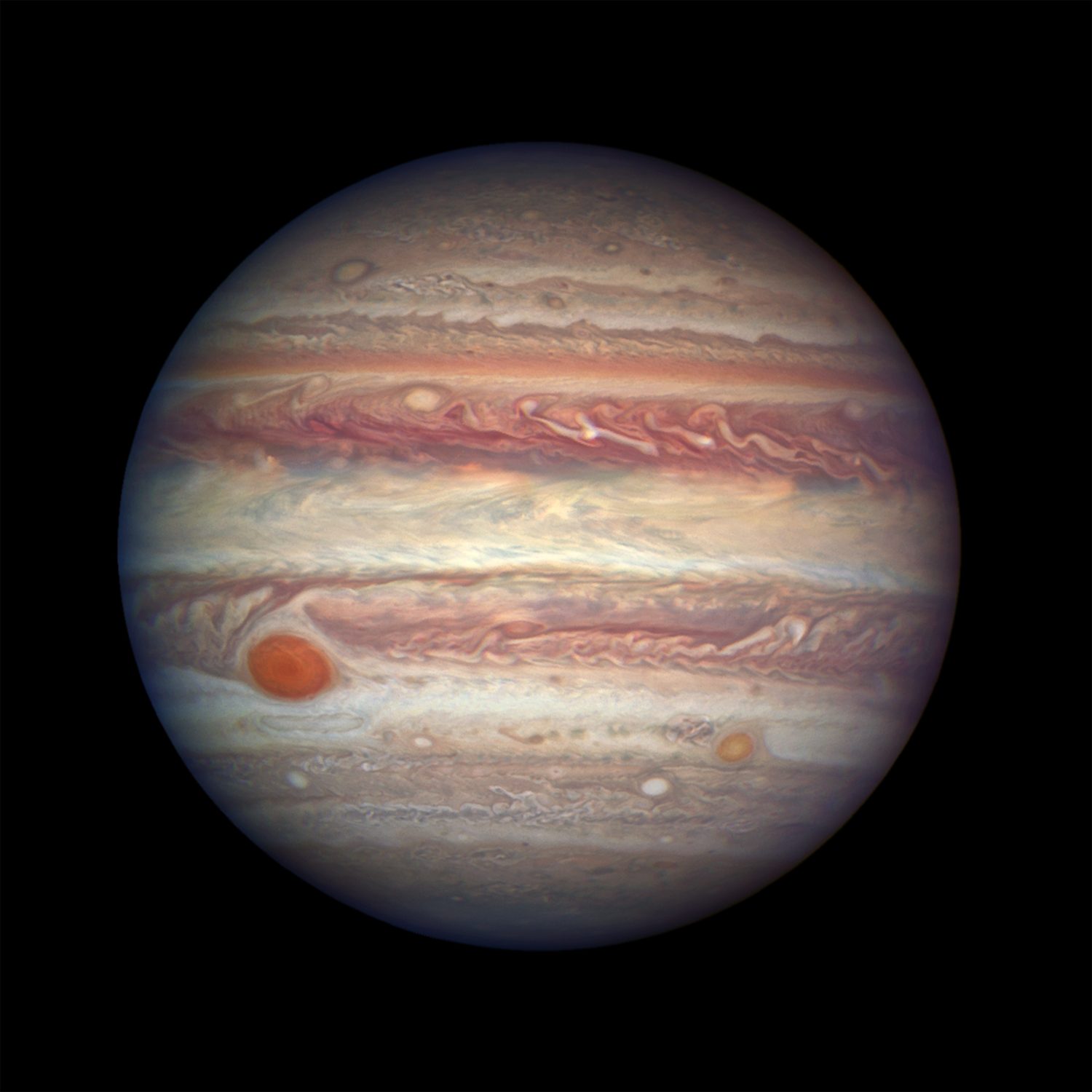
Jupiter, the largest planet, with its swirling bands of gas
Tonton perlombaan planet
Semakin dekat sebuah planet ke Matahari, semakin cepat ia mengorbit — Merkurius dalam 88 hari, Jupiter dalam 12 tahun — karena gravitasi Matahari lebih kuat di area dekat.
Urutkan planet-planet ini, yang terdekat ke Matahari terlebih dahulu.
Kesulitan 3/5 · 200 koin + bonus kecil pada penyelesaian pertama hari ini
Dari Matahari: Merkurius, Venus, Bumi, Mars, Jupiter, Saturnus, Uranus, Neptunus — jadi dari daftar ini, Merkurius, Bumi, Jupiter, Neptunus.
Bagaimana perbedaan antara planet dalam dan planet luar?
Kesulitan 1/5 · 100 koin + bonus kecil pada penyelesaian pertama hari ini
Empat planet dalam kecil dan berbatu; empat planet luar besar dan gas (raksasa gas dan raksasa es).
Other objects
- Dwarf planets (like Pluto) and asteroids — most asteroids lie in a belt between Mars and Jupiter.
- Moons (natural satellites 卫星) that orbit the planets.
- Comets — small icy bodies on very stretched orbits.
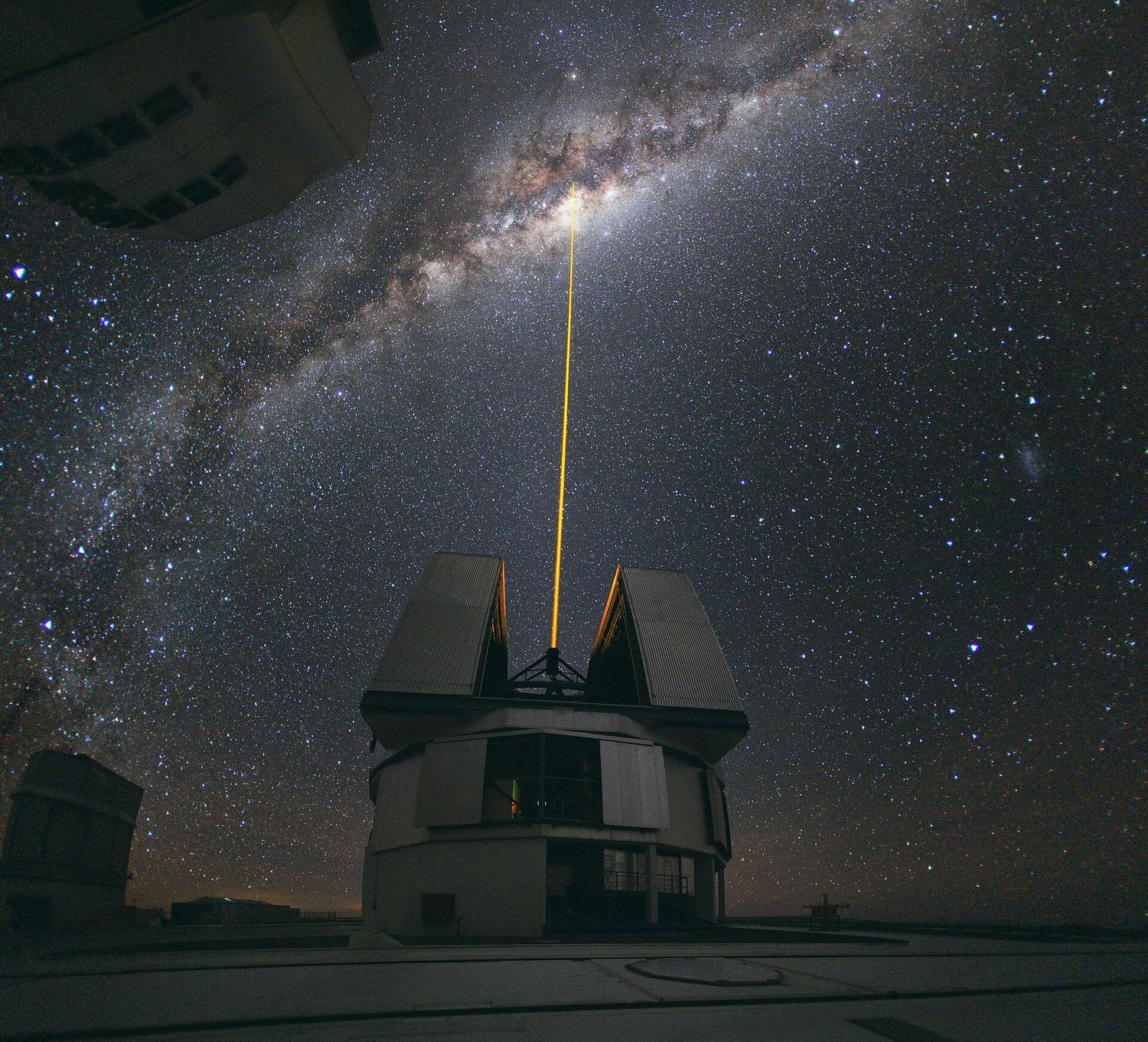
A giant telescope fires a laser to study the night sky
Orbits and gravity
- The Sun's gravity reaches out and keeps the planets in orbit; it is weaker further out, so outer planets orbit more slowly.
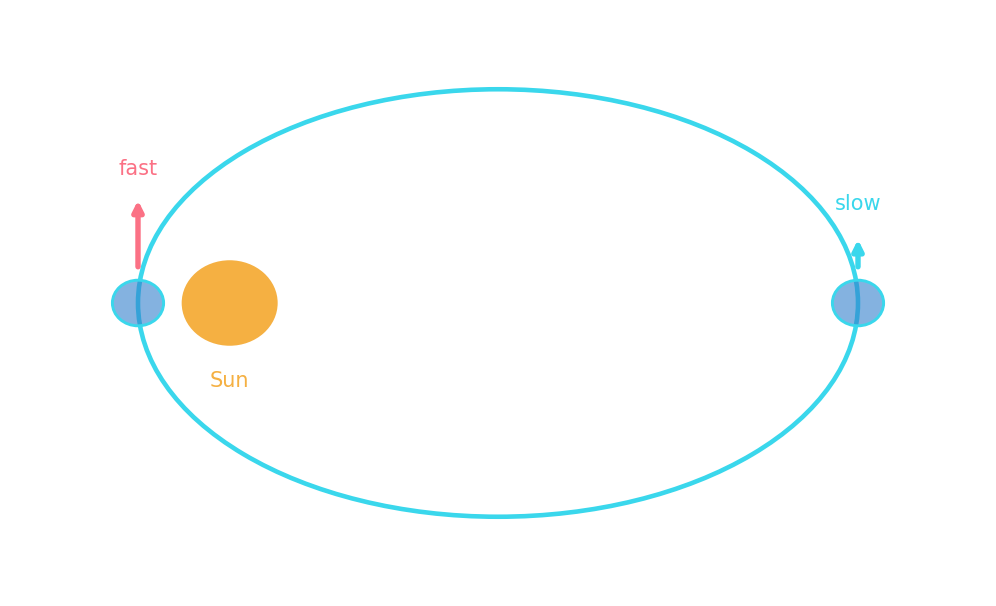
- Most orbits are ellipses 椭圆 (stretched circles), with the Sun at one focus (not the centre).
- A planet moves faster when closer to the Sun: as its gravitational PE falls, its kinetic energy rises (energy is conserved).
Apa yang menjaga planet-planet tetap dalam orbit mereka mengelilingi Matahari?
Kesulitan 1/5 · 100 koin + bonus kecil pada penyelesaian pertama hari ini
Matahari memegang sebagian besar massa Sistem Surya, dan gravitasinya menarik planet-planet ke orbit.
Sebuah planet pada orbit elips bergerak paling cepat ketika berada:
Kesulitan 1/5 · 100 koin + bonus kecil pada penyelesaian pertama hari ini
Saat planet mendekati, energi potensial gravitasinya turun dan energi kinetiknya naik (energi kekal), sehingga kecepatannya bertambah.
Light travel time and how it formed
- Space is huge, so we use light travel time: $\text{time} = \dfrac{\text{distance}}{\text{speed}}$, with light at $3.0 \times 10^8\ \text{m/s}$.
- Sunlight takes about 8 minutes to reach Earth.
- The Solar System formed by accretion 吸积: gravity pulled a spinning cloud of gas and dust into a disc; most fell to the centre to form the Sun, and the planets grew from the rest.
- Near the hot young Sun only rock and metal stayed solid → rocky inner planets; far out, gases collected too → giant outer planets.
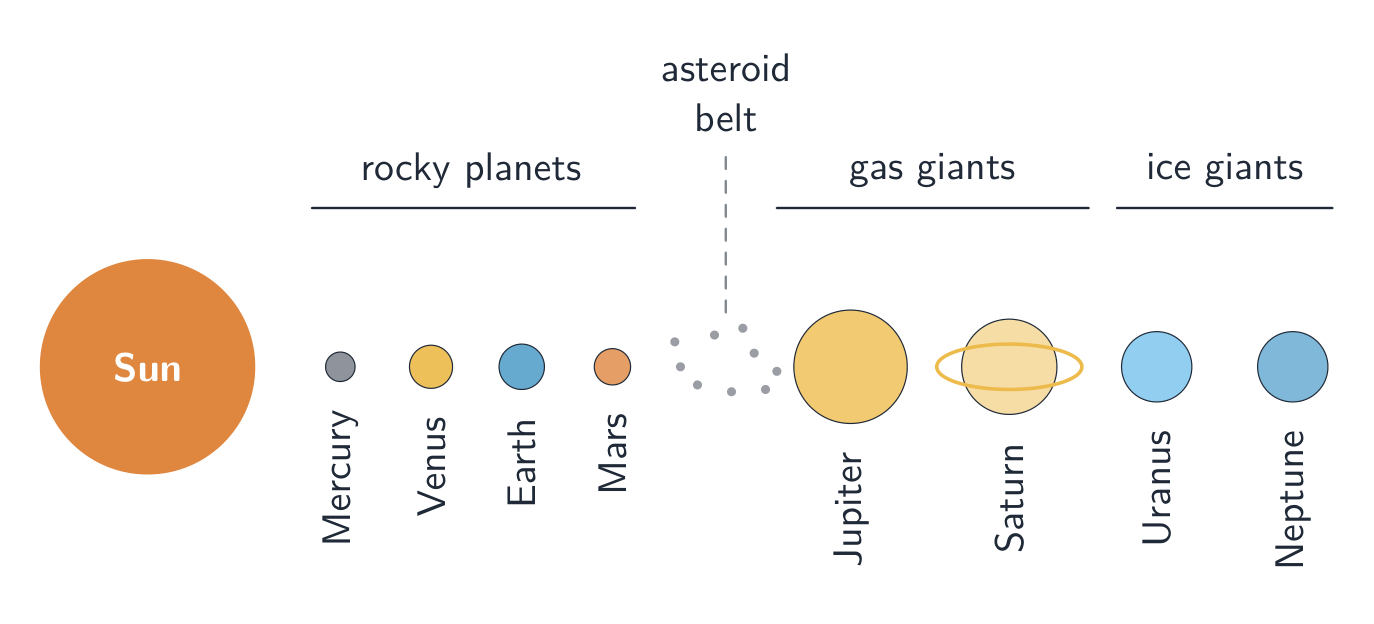
The Solar System
Matahari berjarak sekitar $1.5 \times 10^{11}\ \text{m}$. Berapa lama cahaya Matahari membutuhkan waktu untuk mencapai Bumi, dalam detik? (kecepatan cahaya $3.0 \times 10^8\ \text{m/s}$)
Kesulitan 2/5 · 140 koin + bonus kecil pada penyelesaian pertama hari ini
$\text{time} = \dfrac{d}{v} = \dfrac{1.5 \times 10^{11}}{3.0 \times 10^8} = 500\ \text{s}$ (sekitar 8 menit).
Mengapa planet-planet bagian dalam bersifat batuan?
Kesulitan 1/5 · 100 koin + bonus kecil pada penyelesaian pertama hari ini
Dekat Matahari yang panas, gas tidak dapat mengembun — hanya batu dan logam yang tetap solid, sehingga planet-planet bagian dalam bersifat batuan.
Worked examples
1. Jupiter is about $7.8 \times 10^{11}\ \text{m}$ from the Sun. Light takes $\dfrac{7.8 \times 10^{11}}{3.0 \times 10^8} = 2600\ \text{s}$, about $43$ minutes, to reach it.
2. Planet data show that planets further from the Sun have longer orbital periods and lower orbital speeds: the Sun's gravitational pull on them is weaker, and their orbits are longer.
Distances go from the centre. An orbit radius is measured from the centre of the Sun (or planet), not from its surface.
You've got it
- eight planets: four rocky inner, four gaseous outer (gas giants + ice giants)
- the Sun's gravity holds the planets; outer ones orbit slower
- orbits are ellipses with the Sun at a focus; planets move faster when closer
- light from the Sun takes ~8 min; the system formed by accretion of gas and dust
Write from the data: find the light-travel time
- A planet is 7.5 times 10 to the 11 metres from Earth. Light travels at 3.0 times 10 to the 8 metres per second.
- Find the travel time. The Sun's gravity holds the orbit.
Sebuah planet berada pada jarak 7.5 kali 10 ke pangkat 11 meter. Berapa lama cahaya planet tersebut sampai ke Bumi pada kecepatan 3.0 kali 10 ke pangkat 8 meter per detik, dan apa yang menahan planet dalam orbit?
7.5 kali 10 pangkat 11 dibagi dengan 3.0 kali 10 pangkat 8 adalah 2500 detik.
Berapa lama cahaya tersebut memerlukan?
Kesulitan 1/5 · 100 koin + bonus kecil pada penyelesaian pertama hari ini
Jarak dibagi dengan 3.0 kali 10 pangkat 8 adalah 2500 detik. Pilihan lain — 500 detik (hasil contoh pelajaran untuk Matahari pada 1.5 kali 10 pangkat 11 meter); 2500 detik (karena planet luar mengorbit lebih cepat daripada planet dalam).