Frequency and Period of SHM
Diperkenalkan 8:13
Osilasi
Di museum sains, bola kuningan tergantung dari kawat yang sangat panjang. Ia berayun sepanjang hari di atas lantai bertanda, tak tersentuh. Setiap ayunan memakan waktu yang sama dengan sebelumnya.…
Narasi bahasa Inggris · takarir bahasa Inggris dan 中文 yang dapat dipilih
In this lesson
| English | Makna |
|---|---|
| period/ˈpɪərɪəd/ | periode |
| frequency/ˈfriːkwənsi/ | frekuensi |
| angular frequency/ˈæŋɡjʊlə ˈfriːkwənsi/ | frekuensi sudut |
Counting the beats
- A metronome ticks at a steady rate you can count.
- A heavy mass on a soft spring bobs slowly; a stiff spring snaps back quickly.
- Each oscillator has its own natural rhythm.
- Two simple formulas predict exactly how fast each one repeats.
Period, frequency, and omega
- The period 周期 $T$ is the time for one full cycle.
- The frequency 频率 $f = 1/T$ counts cycles per second.
- The angular frequency 角频率 is $\omega = 2\pi f = \dfrac{2\pi}{T}$.
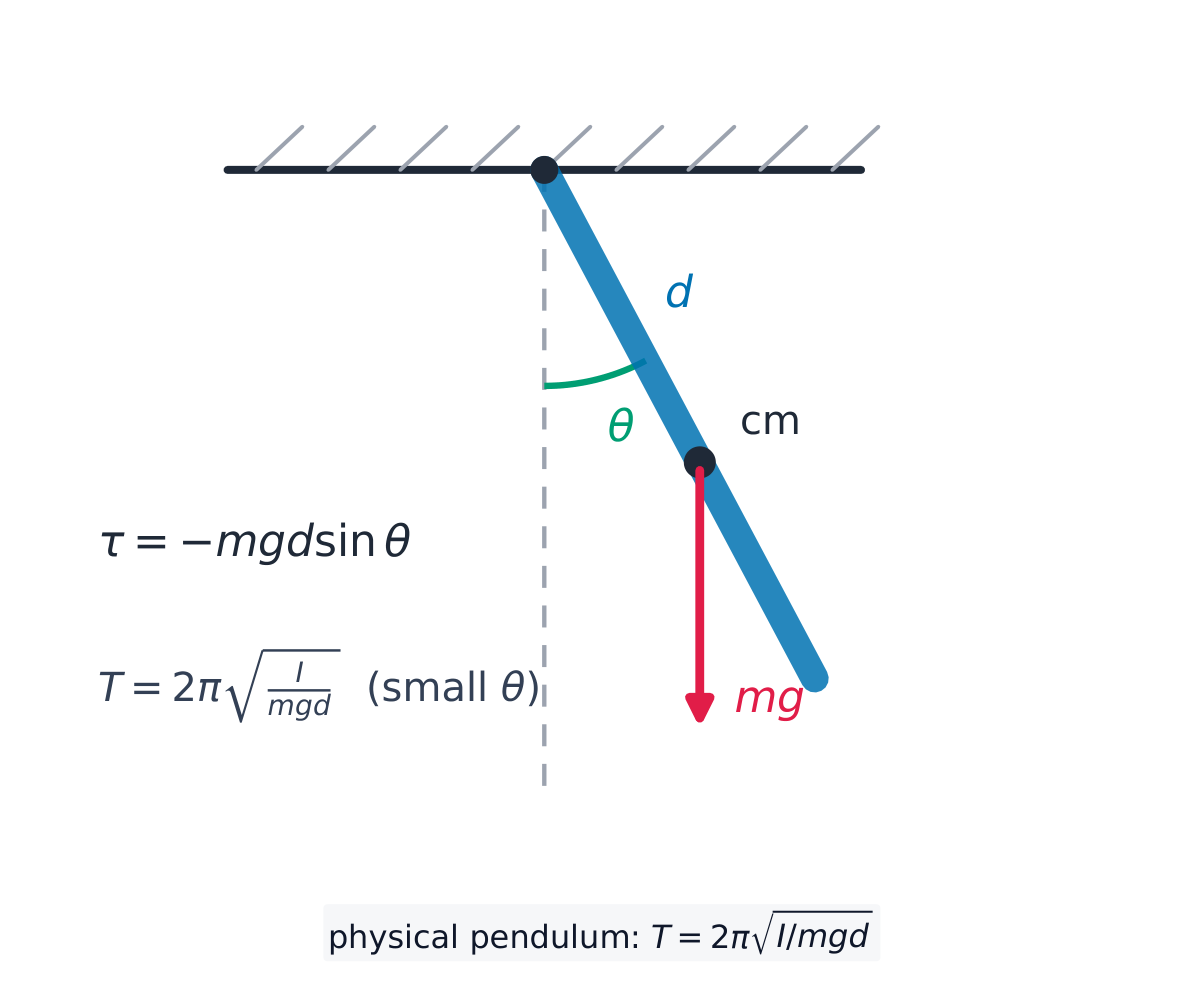
A physical pendulum: T = 2π√(I/mgd) for small angles
An oscillator has a period of $0.25\ \text{s}$. Its frequency (in Hz)?
Kesulitan 2/5 · 140 koin + bonus kecil pada penyelesaian pertama hari ini
$f = 1/T = 1/0.25 = 4\ \text{Hz}$.
A mass on a spring
- A mass $m$ on a spring of stiffness $k$ has period:
- A heavier mass swings slower (longer $T$); a stiffer spring is faster.
- It follows from $\omega = \sqrt{k/m}$.
You replace a mass-spring oscillator's mass with a heavier one. The period...
Kesulitan 1/5 · 100 koin + bonus kecil pada penyelesaian pertama hari ini
$T = 2\pi\sqrt{m/k}$, so a bigger $m$ gives a longer $T$.
If you quadruple the mass on a spring, the period becomes...
Kesulitan 1/5 · 100 koin + bonus kecil pada penyelesaian pertama hari ini
$T \propto \sqrt{m}$, so $\sqrt{4} = 2$ times the period.
A swinging pendulum
- A simple pendulum of length $L$ has the following small-angle period:
- A longer pendulum swings slower; stronger gravity is faster.
- Notice the mass of the bob does not appear.
What changes the period?
Sort each change by whether it changes an oscillator's period.
Making a pendulum's bob heavier (same length) changes its period.
Kesulitan 1/5 · 100 koin + bonus kecil pada penyelesaian pertama hari ini
$T = 2\pi\sqrt{L/g}$ has no mass term -- the bob's mass does not matter.
A simple pendulum swings through small angles with $L = 1.0\ \text{m}$ dan $g = 9.8\ \dfrac{\text{m}}{\text{s}^2}$. Find its period (in s, to 1 decimal).
Kesulitan 2/5 · 140 koin + bonus kecil pada penyelesaian pertama hari ini
$T = 2\pi\sqrt{L/g} = 2\pi\sqrt{1/9.8} \approx 2.0\ \text{s}$.
A $0.2\ \text{kg}$ mass on a $k = 50\ \text{N/m}$ spring.
- Period: $T = 2\pi\sqrt{m/k} = 2\pi\sqrt{0.2/50} = 2\pi\sqrt{0.004} \approx 0.40\ \text{s}$.
- Frequency: $f = 1/T \approx 2.5\ \text{Hz}$.
For ideal SHM, a larger amplitude gives a longer period.
Kesulitan 1/5 · 100 koin + bonus kecil pada penyelesaian pertama hari ini
The period is independent of amplitude -- big and small swings take the same time.
A remarkable fact — for ideal SHM the period does not depend on amplitude, so a big swing and a small swing take the same time. The pendulum formula holds only for small angles; the spring period ignores gravity and the pendulum period ignores the bob's mass. And mind the square root: quadrupling the mass only doubles the period.
The period $T$ (one cycle), frequency $f = 1/T$, and angular frequency $\omega = 2\pi/T$ describe the rhythm. A spring gives $T = 2\pi\sqrt{m/k}$; a pendulum gives $T = 2\pi\sqrt{L/g}$. For ideal SHM the period is independent of amplitude; for a pendulum this is a small-angle approximation. Each formula ignores one thing — the spring ignores gravity, the pendulum ignores the bob's mass.
Write from the data: find the frequency
- An oscillator has a period of 0.50 s.
- Find the frequency.
An oscillator has a period of 0.50 s. What is its frequency, in hertz? Does a heavier bob, at the same length, change a simple pendulum's period?
1 divided by 0.50 is 2.
An oscillator has period 0.50 s. What is its frequency?
Kesulitan 1/5 · 100 koin + bonus kecil pada penyelesaian pertama hari ini
Frequency is the reciprocal of the 0.50 s period. Other options — 4 Hz (the lesson frequency); 0.50 Hz (the period used as a frequency).